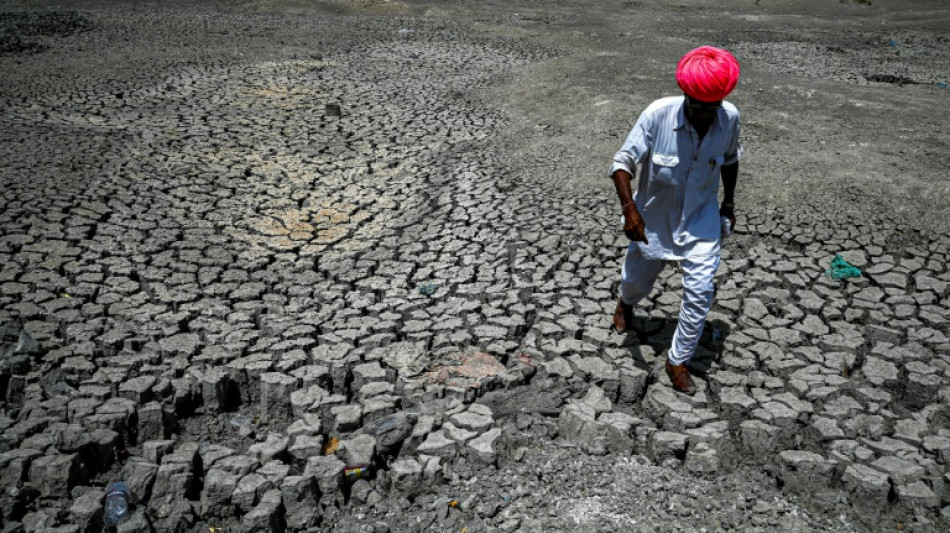
How climate change fuels extreme heat / Photo: Prakash SINGH - AFP/File

Heatwaves across Asia and beyond have already broken records this year, while the arrival of the El Nino climate phenomenon will mean even more extreme temperatures.
Here AFP looks at how climate change produces extreme heat, how scientists evaluate heatwaves and the risks to human health:
What is extreme heat?
Extreme heat is defined from a baseline of the average temperature in any one location, which varies widely across the world.
So a temperature of 25 degrees Celsius (77 degrees Fahrenheit) could be record-breaking in parts of Canada in spring, but might be below average for the same period in the Middle East.
What role does climate change play?
"Greenhouse gases trapping heat are at the root of the problem," said Martin Jucker, a lecturer at the University of New South Wales' Climate Change Research Centre.
Gases like carbon dioxide, methane and nitrous oxide play a crucial role in stopping heat from being reflected or lost from our atmosphere.
When this process is balanced, it keeps the planet at a livable temperature.
But an unsustainable increase in the amount of greenhouse gases in the atmosphere means more heat is being trapped, creating an overall global warming effect and other climate anomalies.
For example, warming air holds more moisture, which produces stronger and more frequent storms.
Overall, climate change is strengthening the duration, intensity and geographical reach of heatwaves, scientists say.
What about human interventions?
The problem is made worse in some places by the way cities are built -- the so-called heat island effect, where urban conglomerations are warmer than surrounding rural areas.
This happens because cities with too little greenery and too much concrete, asphalt and other building materials absorb heat and often offer insufficient shade.
The use of cooling technologies like air conditioners creates surging demand for energy, including the fossil fuels that are behind the climate crisis in the first place.
Are all heatwaves linked to climate change?
To determine climate change's role in any given event, experts use a technique called attribution science.
They simulate a world with and without climate change, using historical and more recent measurements, or computer models.
Comparing the two then "gives us a measure of how much more likely a given extreme is under climate change", Jucker told AFP.
Findings for over 500 events have been collected by the organisation Carbon Brief, with most shown to have been made more severe or more likely because of climate change.
Just a handful, including some floods, droughts and extreme cold, have been found to have no clear link to human activity, while in other cases experts found the evidence inconclusive.
"Every heatwave in the world is now made stronger and more likely to happen because of human-caused climate change," according to Friederike Otto, a scientist at Imperial College London and pioneer of attribution methodology.
How does extreme heat affect people?
Exposure to higher-than-normal temperatures produces health problems ranging from heatstroke and dehydration to cardiovascular stress.
Those with pre-existing heart conditions are especially vulnerable, as the body's response to heat is to pump more blood to the skin to help with cooling.
Risk is also unevenly distributed, with the elderly and the unwell more vulnerable, and those who work outdoors or live in places without air conditioning more likely to suffer.
The deadliest heat combines soaring temperatures with high humidity -- the moist air undermines the body's ability to cool off by sweating.
In May, a study warned a fifth of the world's population would be exposed to extreme and potentially life-threatening heat by the end of the century on our current climate track.
"For every 0.1C of warming above present levels, about 140 million more people will be exposed to dangerous heat," the study published in Nature Sustainability warned.
(G.Gruner--BBZ)