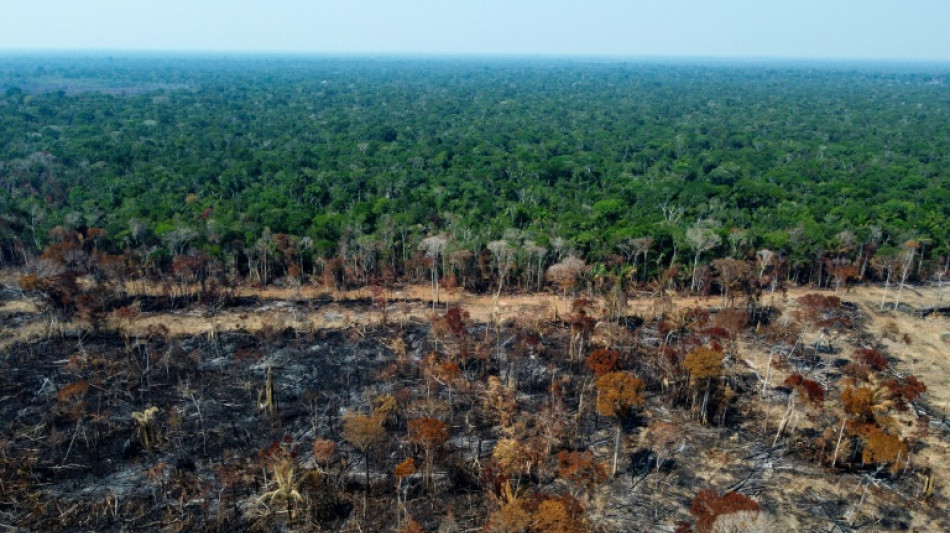
Football pitch of tropical forest lost every 5 seconds / Photo: MICHAEL DANTAS - AFP/File

Earth lost an area of carbon-absorbing rainforest larger than Switzerland or the Netherlands in 2022, most of it destroyed to make way for cattle and commodity crops, an analysis of satellite data released Tuesday revealed.
That is nearly a football pitch of mature tropical trees felled or burned every five seconds, night and day, and 10 percent more than the year before, according to the World Resources Institute (WRI).
Tropical forests destroyed last year released 2.7 billion tonnes of CO2 into the atmosphere, equivalent to the fossil fuel emissions of India, the world's most populous nation, the WRI's Global Forest Watch unit reported.
Brazil accounted for 43 percent of the loss, with the Democratic Republic of Congo and Bolivia responsible for about 13 and nine percent, respectively.
The more than 41,000 square kilometres (nearly 16,000 square miles) decimated globally last year makes 2022 the fourth most devastating year for primary forests in two decades.
The accelerating loss comes a year after world leaders vowed at the Glasgow COP26 summit in 2021 to halt and reverse forest loss by 2030.
"Since the turn of the century, we have seen a haemorrhaging of some of the world's most important forest ecosystems despite years of efforts to turn that trend around," Mikaela Weisse, director of WRI's Global Forest Watch told journalists in a briefing.
"We are rapidly losing one of our most effective tools for combating climate change, protecting biodiversity, and supporting the health and livelihoods of millions of people."
Globally, vegetation and soil have consistently absorbed about 30 percent of CO2 pollution since 1960, even as those emissions increased by half.
- 90 billion tonnes -
Some 1.6 billion people, nearly half of them members of indigenous groups, rely directly on forest resources for their food and livelihoods.
Deforestation in Brazil surged during the four-year rule of far-right President Jair Bolsonaro, and increased 15 percent last year compared to 2021.
Bolsonaro's administration gutted environmental policies, turned a blind eye to illegal deforestation, and weakened protections of the rights of indigenous peoples proven to be effective stewards of healthy forests.
President Luiz Inacio Lula da Silva, sworn in at the start of this year, has vowed to end deforestation in the Brazilian Amazon by 2030 but will face many challenges in doing so, experts say.
Scientists fear that climate change and deforestation combined could trigger the accelerating transition of the Amazon basin from tropical forest to savannah, which could profoundly disrupt weather not just in South America but across the globe.
Some 90 billion tonnes of CO2 is stored in the Amazon basin's forest, twice worldwide annual emissions from all sources.
"Halting and reversing forest loss is one of the most cost-effective mitigation options available to us today," said Frances Seymour, WRI's distinguished senior fellow for forests.
High rates of primary forest loss also continued in the Democratic Republic of the Congo (DRC), which saw more than half a million hectares destroyed in 2022, the report said.
- Cocoa, gold & fires -
Unlike in Brazil, the main drivers were subsistence-agriculture and the small-scale production of charcoal made by cutting and burning timber, a reflection of the country's poverty.
More than 80 percent of the population lacks electricity.
A half-billion dollar agreement signed by the DRC in 2021 to protect its forests has been undermined by the recent auctioning of permits for oil and gas exploration.
The government has also indicated it would lift a moratorium on new logging concessions.
Bolivia, meanwhile, saw the third largest loss of primary forests (nearly 4,000 sq km) in 2022 and a 32 percent increase in the rate of deforestation compared to 2021.
"The majority of the loss occurred within protected areas, which cover the last patches of primary forest in the country," the Global Forest Watch report said.
Cocoa production, gold-mining and fires were the main drivers.
Just over five percent of global tropical forest loss last year occurred in Indonesia (2,300 sq km), which has seen deforestation levels drop more than four-fold since 2016.
Other countries rounding out the 'top ten' in tropical forest loss worldwide last year are Peru (3.9 percent), Colombia (3.1), Laos (2.3), Cameroon (1.9), Papua New Guinea (1.8) and Malaysia(1.7).
The rest of the world combined accounted for just under 15 percent of forest lost in 2022.
(O.Joost--BBZ)