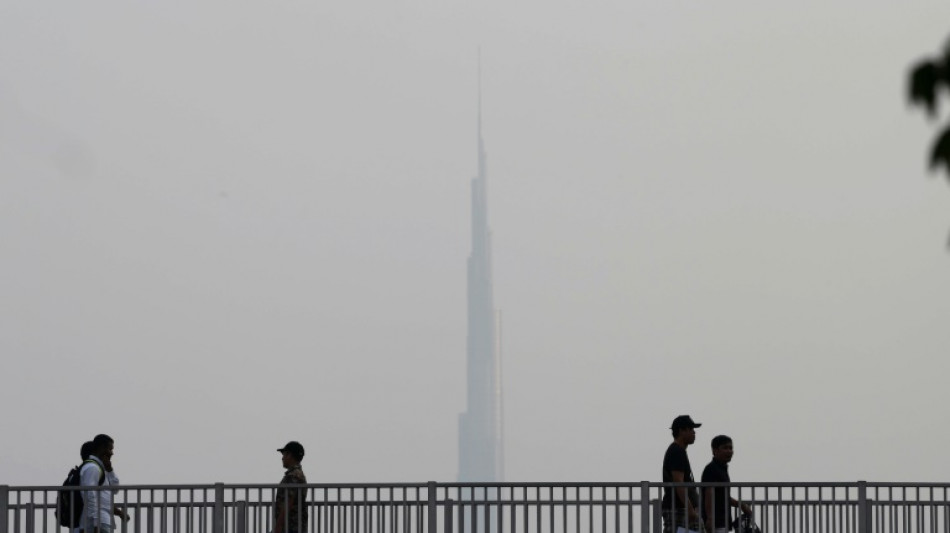
'We cannot work' - why Gulf summer feels even hotter than usual / Photo: Giuseppe CACACE - AFP

As much of the world swelters in record temperatures, spare a thought for Issam Genedi, who ekes out a living washing cars in one of the planet's hottest regions, the Gulf.
Pausing from his work at an outdoor carpark in Dubai, the Egyptian migrant says the United Arab Emirates' furnace-like summer feels even hotter this year.
"This summer is a little more difficult than other years," says Genedi, who shines cars for about 25 dirhams ($6.80) a time in temperatures that pass 40 degrees Celsius (104 degrees Fahrenheit) each day.
"Between noon and 3pm or 3:30pm, we simply cannot work."
The oil-rich UAE -- host of this year's COP28 United Nations climate talks, where the world will try to sharpen its response to global warming -- is no stranger to unbearable summers.
In the blistering summer months, those who can decamp to cooler climes, or stay cocooned inside air-conditioned homes, offices and shopping malls.
The streets are largely deserted, apart from labourers hired cheaply from abroad. Many manual workers have a compulsory rest period in the hottest hours of the day.
It's a similar story all around the energy-rich desert region. In Bahrain, an island nation off Saudi Arabia, July average temperatures threaten to beat the record of 42.1C (107.8F) set in 2017.
Two weeks ago, more than 1.8 million Muslims battled through a days-long hajj pilgrimage in Saudi Arabia in temperatures up to 48C (118F), with thousands treated for heat stress.
And in Kuwait, which regularly records some of the world's highest temperatures, experts warn the mercury could pass a formidable 50C (122F) in the coming weeks.
- Where 'real feel' is 60C -
Genedi is right that this summer seems unusually hot. Apart from last week being identified as the hottest ever recorded worldwide, a wave of humidity has been suffocating the Gulf.
"People have been left wondering if the temperatures are even higher" than usual, Ahmed Habib of the UAE's National Centre of Meteorology told AFP.
"An increase in relative humidity... combined with already high temperatures, makes the temperature seem higher than it really is," he said, adding that 'real-feel' temperatures have ranged between 55-60C (131-140 F) in some areas.
The Gulf's extreme heat and high humidity are a dangerous mix as in such conditions the human body struggles to cool itself by evaporating sweat on the skin.
The combination is measured by a thermometer wrapped in a wet cloth to calculate the "wet bulb temperature" -- the lowest possible through evaporative cooling.
The Gulf is one of the few places to have repeatedly measured wet bulb temperatures above 35C (95F), the threshold of human survivability beyond which heat stress can be fatal within hours, regardless of age, health and fitness.
It is for this reason that experts warn accelerated climate change will make parts of the Gulf region unliveable by the end of this century.
In Kuwait, meteorologist Issa Ramadan said "the increase in temperature over the past year has been significant".
"It is expected that from the middle of the month until August 20 there will be a noticeable rise in temperatures that may reach and even exceed 50C (122F) in the shade," he told AFP.
Humidity could top 90 percent in Bahrain by the end of the week, with maximum temperatures ranging between 42-44C (108-111F), according to official forecasts.
- 'Our profession is difficult' -
Gulf temperatures will rise to disruptive levels if global warming is left unchecked, according to projections by Barrak Alahmad of the Harvard T.H. Chan School of Public Health and Dominic Roye of the Foundation for Climate Research.
In the UAE's capital Abu Dhabi, the number of 40C-plus (104F-plus) days will rise by 98 percent by 2100 if global temperatures increase by 3C, according to the findings published in June by Vital Signs, a coalition of rights groups working on migrant labourer deaths in the Gulf.
The same 3C global increase will see Kuwait, Bahrain and Saudi Arabia experiencing 180 days of 40C-plus temperatures a year by the end of the century, it said.
"These conditions could seriously disrupt human societies in ways we are just beginning to understand," Alahmad told the Vital Signs Partnership.
Intense heat and humidity is already a daily reality for many in the Gulf, not least the thousands of mostly South Asian delivery motorcyclists who criss-cross its cities carrying food and other packages.
"Our profession is a difficult one," one of them, Mohammad Rajab, from Egypt, told AFP in a Dubai street that was vacant apart from other riders.
"We always try to avoid the direct glare of the sun."
(Y.Yildiz--BBZ)