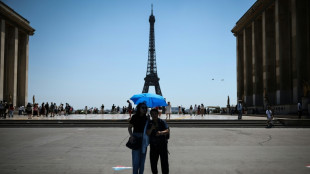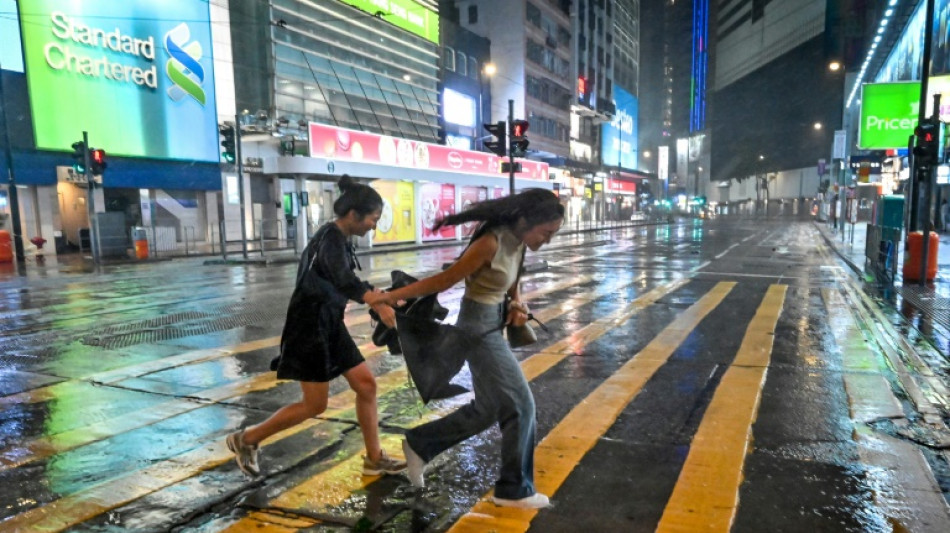
Super Typhoon Saola nears Hong Kong, southern China / Photo: Mladen ANTONOV - AFP

Tens of millions of people in Hong Kong, Shenzhen and other southern Chinese megacities hunkered down indoors late Friday as Super Typhoon Saola threatened to become the strongest storm to hit the region in decades.
Over 880,000 people were evacuated across two Chinese provinces ahead of Saola making landfall, hundreds of flights were cancelled across the region, and trees were uprooted around the rain-battered streets of Hong Kong.
China's national weather office predicted Saola "may become the strongest typhoon to make landfall in the Pearl River Delta since 1949", referring to a low-lying region that includes Hong Kong, Macau and Guangdong province.
With a direct hit possible, authorities in Hong Kong raised the warning level on Friday evening to the city's highest -- "T10" -- which had only been issued 16 times since World War II before Saola.
"Do not go outside... Stay away from exposed windows and doors because glass, already under strain from wind pressure, will shatter easily if hit by a flying object," the Hong Kong Observatory warned in a bulletin released after the highest alert was issued.
Hong Kong residents struggled with flailing umbrellas as they ran under the unrelenting rainfall, while people wearing plastic bags on their heads rushed home past sandbags stacked in waterfront areas to prevent flooding.
By 11:00 pm Saola was 30 kilometres (18 miles) south-southwest of the city, the "closest to Hong Kong at present" and packing sustained wind speeds of 185 kilometres per hour.
"Members of the public should stay on high alert. You are advised to remain where you are if protected and be prepared for destructive winds of Saola," the observatory said.
It added that "the maximum water level may reach a historical record", warning that "there will be serious flooding".
The last time Hong Kong issued a T10 warning was in 2018, when Typhoon Mangkhut slammed into the city, shredding trees and unleashing floods, and leaving more than 300 people injured.
In mainland China, Mangkhut killed six people and impacted the lives of more than three million others.
Across the mainland border in neighbouring Guangdong province, authorities evacuated more than 780,000 people from high-risk areas, while eastern Fujian province saw more than 100,000 moved to safer ground.
Trains in and out of Guangdong were also suspended until 6:00 pm Saturday, while the national flood defence agency raised its emergency response for prevention to its second-highest level.
"It's going to affect our life," said Wu Wenlai, 43, who had to close his restaurant in a Shenzhen suburb.
"My eldest son was planning to fly to Chengdu today for university and his flight has been cancelled now."
- More intense typhoons -
Southern China is frequently hit in summer and autumn by typhoons that form in the warm oceans east of the Philippines and then travel west.
Climate change has increased the intensity of tropical storms, with more rain and stronger gusts leading to flash floods and coastal damage, experts say.
In Hong Kong, authorities received at least seven confirmed cases of flooding, as well as nearly 40 reports of downed trees. The city's hospital authority reported a total of seven people seeking medical treatment during Saola.
Businesses taped up their glass displays and windows, while high-rise buildings swayed under the whipping gusts.
In eastern Heng Fa Chuen -- a coastal residential area and the site of devastation during 2018's Typhoon Mangkhut -- officers in orange vests urged storm-watchers to go home, as trees leaned sideways from the heavy gusts.
In the low-lying fishing village of Lei Yue Mun, which is prone to flooding, water seeped into shops, prompting residents to set up sandbags and board up doors.
"I hope we can save the tools needed for our business, like the fridge. We elevated them so the water wouldn't damage the (electronics)," a restaurant operator surnamed Lee told a local TV station.
burs-dhc/mlm
(Y.Yildiz--BBZ)