Berliner Boersenzeitung - Antarctic sea ice hits lowest winter maximum on record: US data

EUR -
AED 4.308724
AFN 77.53857
ALL 96.624273
AMD 447.449324
ANG 2.100573
AOA 1075.861168
ARS 1684.86077
AUD 1.766091
AWG 2.111833
AZN 1.988896
BAM 1.954268
BBD 2.36005
BDT 143.197773
BGN 1.953631
BHD 0.441754
BIF 3463.356168
BMD 1.173241
BND 1.513301
BOB 8.096654
BRL 6.357821
BSD 1.171782
BTN 105.96795
BWP 15.525832
BYN 3.454393
BYR 22995.513884
BZD 2.356653
CAD 1.615218
CDF 2628.058653
CHF 0.934175
CLF 0.027299
CLP 1070.938431
CNY 8.276619
CNH 8.270131
COP 4461.223553
CRC 586.140628
CUC 1.173241
CUP 31.090873
CVE 110.17865
CZK 24.273936
DJF 208.666463
DKK 7.469236
DOP 74.491619
DZD 151.490982
EGP 55.654426
ERN 17.598608
ETB 183.089309
FJD 2.665371
FKP 0.877875
GBP 0.878183
GEL 3.177275
GGP 0.877875
GHS 13.451458
GIP 0.877875
GMD 85.646688
GNF 10190.926274
GTQ 8.974966
GYD 245.147872
HKD 9.130451
HNL 30.849822
HRK 7.534556
HTG 153.58832
HUF 384.730253
IDR 19546.304125
ILS 3.784774
IMP 0.877875
INR 106.419599
IQD 1534.996987
IRR 49419.822308
ISK 148.384759
JEP 0.877875
JMD 187.612963
JOD 0.831772
JPY 181.906836
KES 151.641831
KGS 102.599728
KHR 4691.283347
KMF 492.162008
KPW 1055.916087
KRW 1726.335387
KWD 0.359835
KYD 0.976535
KZT 611.12105
LAK 25403.09101
LBP 104931.962394
LKR 362.076232
LRD 206.817912
LSL 19.769406
LTL 3.464274
LVL 0.709681
LYD 6.365012
MAD 10.780151
MDL 19.808476
MGA 5190.931747
MKD 61.501538
MMK 2462.943764
MNT 4160.152767
MOP 9.396136
MRU 46.894248
MUR 53.910621
MVR 18.092247
MWK 2031.907547
MXN 21.128747
MYR 4.798387
MZN 74.982124
NAD 19.769406
NGN 1701.257622
NIO 43.125834
NOK 11.885683
NPR 169.54912
NZD 2.030334
OMR 0.449118
PAB 1.171782
PEN 3.945108
PGK 5.050998
PHP 69.34788
PKR 328.388334
PLN 4.222082
PYG 7870.831447
QAR 4.270553
RON 5.091161
RSD 117.287579
RUB 93.312766
RWF 1705.463389
SAR 4.402231
SBD 9.593296
SCR 17.555092
SDG 705.707555
SEK 10.878268
SGD 1.514266
SHP 0.880234
SLE 28.304461
SLL 24602.271054
SOS 668.4761
SRD 45.226102
STD 24283.709675
STN 24.480605
SVC 10.252965
SYP 12972.146962
SZL 19.762512
THB 36.923643
TJS 10.76856
TMT 4.118074
TND 3.425515
TOP 2.824882
TRY 50.099481
TTD 7.951768
TWD 36.702469
TZS 2903.770373
UAH 49.510497
UGX 4164.736
USD 1.173241
UYU 45.983961
UZS 14116.876116
VES 313.771147
VND 30873.23725
VUV 142.111846
WST 3.256309
XAF 655.443314
XAG 0.018645
XAU 0.00027
XCD 3.170741
XCG 2.111845
XDR 0.815161
XOF 655.443314
XPF 119.331742
YER 279.815677
ZAR 19.775323
ZMK 10560.576536
ZMW 27.038809
ZWL 377.782964
  • RBGPF

    0.0000

    81.17

    0%

  • SCS

    0.0200

    16.14

    +0.12%

  • VOD

    0.0500

    12.59

    +0.4%

  • CMSD

    -0.1500

    23.25

    -0.65%

  • GSK

    -0.0700

    48.81

    -0.14%

  • RELX

    0.1000

    40.38

    +0.25%

  • BTI

    -1.2700

    57.1

    -2.22%

  • RIO

    -1.0800

    75.66

    -1.43%

  • RYCEF

    -0.2500

    14.6

    -1.71%

  • BCE

    0.3100

    23.71

    +1.31%

  • CMSC

    -0.1300

    23.3

    -0.56%

  • BCC

    0.2500

    76.51

    +0.33%

  • JRI

    -0.0200

    13.7

    -0.15%

  • NGG

    0.2400

    74.93

    +0.32%

  • AZN

    -0.4600

    89.83

    -0.51%

  • BP

    -0.2700

    35.26

    -0.77%

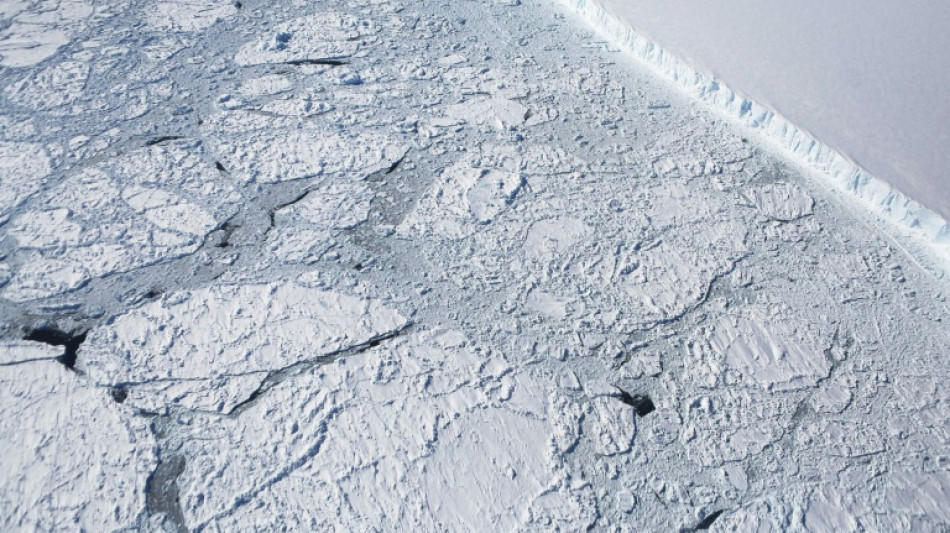
Antarctic sea ice hits lowest winter maximum on record: US data
Antarctic sea ice hits lowest winter maximum on record: US data / Photo: MARIO TAMA - GETTY IMAGES NORTH AMERICA/AFP

Antarctic sea ice hits lowest winter maximum on record: US data

The sea ice around Antarctica likely had a record low surface area when it was at its maximum size this winter, a preliminary US analysis of satellite data showed Monday.

Text size:

As the southern hemisphere transitions into spring, the US National Snow and Ice Data Center (NSIDC) said in a statement that Antarctic sea ice had only reached a maximum size of 16.96 million square kilometers (6.55 million square miles) this year, on September 10.

The ice pack typically reaches its largest size during the colder winter months, so the September 10 reading will likely remain this year's maximum.

"This is the lowest sea ice maximum in the 1979 to 2023 sea ice record by a wide margin," said the NSIDC, a government-supported program at the University of Colorado at Boulder.

At its high-point this year, the sea ice was 1.03 million square kilometers smaller than the previous record, roughly the size of Texas and California combined.

"It's a record-smashing sea ice low in the Antarctic," said NSIDC scientist Walt Meier.

He added that the growth in sea ice appeared "low around nearly the whole continent as opposed to any one region."

In February, at the height of the austral summer, the Antarctic sea ice pack had reached a minimum extent of 1.79 million square kilometers, also a record, according to the NSIDC.

The ice pack then grew back at an unusually slow pace, despite the onset of winter.

Meanwhile at the other end of the globe, where summer is drawing to a close, Arctic sea ice reached a low of 4.23 million square kilometers, the NSIDC said. It represents the sixth lowest minimum in 45 years of recordkeeping.

- Warming oceans -

For several decades, the Antarctic sea ice pack had remained stable, even expanding slightly.

But "since August 2016, the Antarctic sea ice extent trend took a sharp downturn across nearly all months" the NSIDC said.

There is debate among scientists over the cause of the shift, with some reluctant to establish a formal link with global warming. Climate models have struggled in the past to predict changes in the Antarctic ice pack.

The downward trend is "now thought to be linked to warming in the uppermost ocean layer," the NSIDC said.

"There is some concern that this may be the beginning of a long-term trend of decline for Antarctic sea ice, since oceans are warming globally."

Melting pack ice has no immediate impact on sea levels, as it forms by freezing salt water already in the ocean.

But the white ice reflects more of the Sun's rays than darker ocean water, so its loss accentuates global warming.

The loss of pack ice also exposes Antarctica's coastline to greater wave action, which could destabilize the freshwater ice cap and endanger coastal habitats. The melting land ice would cause a catastrophic rise in sea levels.

However the NSIDC notes a possibility that waves impacting the ice sheet may increase "accumulation near the coast, offsetting in part the threat of rising sea level."

(O.Joost--BBZ)