Berliner Boersenzeitung - Hong Kong halts trading, closes schools post-typhoon

EUR -
AED 4.211535
AFN 71.676752
ALL 95.733091
AMD 433.823977
ANG 2.053148
AOA 1051.593401
ARS 1600.374619
AUD 1.627412
AWG 2.06563
AZN 1.950295
BAM 1.947379
BBD 2.317448
BDT 141.189442
BGN 1.955936
BHD 0.432929
BIF 3415.654921
BMD 1.146776
BND 1.466819
BOB 7.950618
BRL 6.002451
BSD 1.150589
BTN 105.991651
BWP 15.510453
BYN 3.392216
BYR 22476.807566
BZD 2.314162
CAD 1.56754
CDF 2497.677846
CHF 0.902966
CLF 0.026473
CLP 1045.297774
CNY 7.877226
CNH 7.904876
COP 4245.788675
CRC 542.340521
CUC 1.146776
CUP 30.389561
CVE 109.790224
CZK 24.446682
DJF 204.901247
DKK 7.472524
DOP 70.284225
DZD 151.871011
EGP 60.137153
ERN 17.201638
ETB 179.600058
FJD 2.54229
FKP 0.858972
GBP 0.865016
GEL 3.113466
GGP 0.858972
GHS 12.467087
GIP 0.858972
GMD 83.714446
GNF 10087.115518
GTQ 8.822847
GYD 240.728994
HKD 8.976188
HNL 30.457361
HRK 7.531678
HTG 150.713002
HUF 391.770184
IDR 19417.209475
ILS 3.590716
IMP 0.858972
INR 105.92488
IQD 1507.381498
IRR 1515779.710561
ISK 144.195796
JEP 0.858972
JMD 180.085743
JOD 0.813055
JPY 182.742753
KES 148.106628
KGS 100.285209
KHR 4617.929609
KMF 490.819871
KPW 1031.959506
KRW 1712.801471
KWD 0.352198
KYD 0.958854
KZT 563.224399
LAK 24650.509115
LBP 103040.1651
LKR 357.734577
LRD 210.569416
LSL 19.008383
LTL 3.386131
LVL 0.693673
LYD 7.344145
MAD 10.78297
MDL 19.980509
MGA 4769.230439
MKD 61.639079
MMK 2407.305418
MNT 4094.276022
MOP 9.274961
MRU 45.726067
MUR 52.763545
MVR 17.729364
MWK 1995.211039
MXN 20.460747
MYR 4.516584
MZN 73.275835
NAD 19.008301
NGN 1595.004784
NIO 42.345773
NOK 11.171322
NPR 169.581488
NZD 1.967822
OMR 0.440939
PAB 1.150624
PEN 3.937473
PGK 4.962475
PHP 68.32663
PKR 321.424127
PLN 4.270657
PYG 7449.68722
QAR 4.195059
RON 5.093291
RSD 117.371371
RUB 92.492751
RWF 1682.174285
SAR 4.302891
SBD 9.23345
SCR 15.967057
SDG 689.21271
SEK 10.757354
SGD 1.467534
SHP 0.860379
SLE 28.20642
SLL 24047.317495
SOS 656.441259
SRD 42.850997
STD 23735.945721
STN 24.394191
SVC 10.06846
SYP 128.021919
SZL 19.013199
THB 36.949339
TJS 11.029006
TMT 4.025183
TND 3.382871
TOP 2.761161
TRY 50.675682
TTD 7.808234
TWD 36.716099
TZS 2992.90847
UAH 50.946931
UGX 4307.373247
USD 1.146776
UYU 46.01103
UZS 13963.615909
VES 505.056676
VND 30153.325415
VUV 136.420806
WST 3.1976
XAF 653.112754
XAG 0.013638
XAU 0.000224
XCD 3.09922
XCG 2.073732
XDR 0.812263
XOF 653.124095
XPF 119.331742
YER 273.563802
ZAR 19.260525
ZMK 10322.358766
ZMW 22.351053
ZWL 369.261371
  • NGG

    1.3350

    92.12

    +1.45%

  • RBGPF

    0.1000

    82.5

    +0.12%

  • JRI

    -0.0300

    12.82

    -0.23%

  • BCC

    0.3800

    70.03

    +0.54%

  • CMSC

    -0.1000

    23.14

    -0.43%

  • GSK

    0.3600

    54.65

    +0.66%

  • RELX

    0.0250

    34.21

    +0.07%

  • RIO

    -0.7000

    90.01

    -0.78%

  • RYCEF

    -0.1000

    17.25

    -0.58%

  • BCE

    0.0450

    25.735

    +0.17%

  • CMSD

    -0.0500

    23.1

    -0.22%

  • VOD

    0.4000

    14.71

    +2.72%

  • BTI

    0.3750

    60.29

    +0.62%

  • AZN

    1.2100

    193.355

    +0.63%

  • BP

    0.2300

    42.39

    +0.54%

Hong Kong halts trading, closes schools post-typhoon
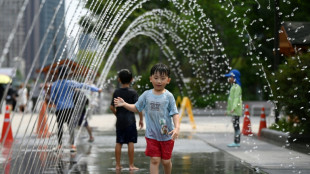
Hong Kong halts trading, closes schools post-typhoon / Photo: Peter PARKS - AFP

Hong Kong halts trading, closes schools post-typhoon

Asian finance hub Hong Kong halted trading at its stock exchange on Monday and closed schools, after Typhoon Koinu generated torrential rainfall overnight.

Text size:

Koinu -- which caused one death in Taiwan last week -- had weakened into a severe tropical storm by Monday, said the Hong Kong Observatory, as it moved toward the coastal areas of China's Guangdong province.

The storm caused non-stop rain overnight, leading the agency to issue a "black" rainstorm warning signal -- its highest -- for about six hours before it was downgraded at 10:30 am (0230 GMT).

More than 150 millimetres of rain were recorded over most parts of the territory since midnight Monday, and rainfall exceeded 300 millimetres over some parts of urban Hong Kong island, data showed.

"Heavy rain will bring flash floods... People should stay away from watercourses," the observatory said, adding that residents living near rivers be alert in case they need to evacuate.

The city's third-highest storm warning signal -- "T8" -- was to remain in place until 11:40 am local time.

Due to the storm warning, trading at the city's stock exchange was suspended in the morning session, but was expected to resume at 2:00 pm.

Schools and daycare centres, ordered to shut when authorities issued the T8 signal a day earlier, remained closed Monday.

This was the second time in a month the city has issued the black rain warning.

In early September, Hong Kong experienced its highest rainfall in nearly 140 years, flooding subway stations and malls, and causing landslides.

- Transport disruptions -

While no major damage was initially reported, the hoisting of the second-highest typhoon warning on Sunday evening caused issues at Hong Kong's international airport, where hundreds of arriving passengers were stranded without bus, subway or taxi services.

"A large number of arriving passengers had to wait for a relatively long time because the AirPort Express -- a main transport link between the airport and the city -- was suspended due to safety reasons," said an airport representative Monday.

After the storm was downgraded just before midnight, "12 train rides provided more than 18,000 seats for the passengers who waited an average of three hours", the official said.

In China's Guangdong province -- where Koinu is expected to sweep past en route to Hainan island -- the cities of Zhuhai and Jiangmen issued a Level III emergency response, according to the Xinhua news agency Sunday.

That meant more than 35,500 fishing boats had to return to port, while dozens of coastal scenic areas were temporarily closed.

Before moving to Hong Kong, Koinu had grazed nearby Taiwan, bringing torrential rain and record-breaking winds to its outlying Orchid Island.

The storm left at least one dead in Taiwan, knocking out power to hundreds of thousands of homes.

Southern China is frequently hit during the summer and autumn seasons by typhoons that form in the warm oceans east of the Philippines and then travel west.

But climate change has made tropical storms more unpredictable while increasing their intensity -- bringing more rain and stronger gusts that lead to flash floods and coastal damage, experts say.

(S.G.Stein--BBZ)