The river disappearing in drought-hit France / Photo: ARNAUD FINISTRE - AFP

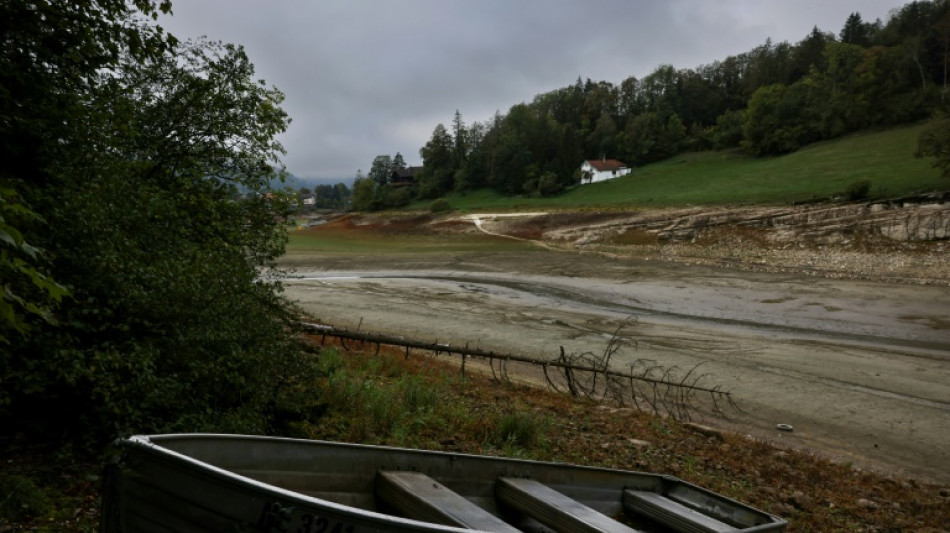
The once deep and coursing waters of the Doubs river in eastern France have shrunken to a dry bed that locals can cross almost without getting their feet wet.
A confluence of nearly no rainfall and existing geological features are draining the river to the point that boats and docks rest on the dry rocks that used to be underwater.
"When the river is high, we have our feet in the water here," said 81-year-old Pierre Billod, far above what remains of France's tenth largest river.
The retired watchmaker recalled that a drought like this "almost never" happened during his lifetime, but admitted there were periods of dryness previously.
The lake where the town Villers-le-Lac derives its name from is nothing more than a memory now. On its grassy bed, one could imagine crossing to Switzerland by foot without getting their feet wet.
On the other side, in the Swiss town Les Brenets, a dock that seemed to have be waiting for water for ages also awaits excursion boats with a sign reading "120 places".
"Its weird, it makes me sad. It's worrying," said Sebastien Arcidiacona, who believes the drought is tied to global warming. "It would be silly to deny it," he added.
While it can be hard to attribute a particular weather event to climate change, scientists insist human-linked global warming is responsible for more frequent and intense extreme weather.
- Losses from underground -
September was the hottest on record since 1947, according to Cedric Hertzog, Meteo France's chief forecaster for France's Grand Est region.
The rainfall deficit was between 10-15 percent where the Doubs is located for the meteorological year ending August 31.
"It's missing one month of rain," Hertzog said.
On top of the drought, water from the Doubs is emptying underground into a neighbouring river.
"Part of the Doubs's water flow is being lost to the Loue, as the two basins are connected," said Vincent Fister, hydrogeologist for EPTB, a national water management body.
The river's disappearance is a catastrophe for the local tourism industry, including a water sports centre on the edge of the lake.
"It's the second year like this. Last summer, we thought it was an exception," said Maxime Faivre, who has led water activites for more than 20 years. "But it's even worse -- it's even lower."
In 2022, the levels of the river began to rise from the beginning of September, said Antoine Michel, who operates river cruises on the Doubs for a local company.
Due to the lack of water, the company has had to stop taking passengers by boat from Villers. Instead, they are transported by bus seven kilometres (four miles) downstream to the Bassins du Doubs, a deep gorge where the last of the water remains.
- 'We didn't want to believe it' -
"We're losing at least 15 centimetres each day. Every day we lose a bit of area where we can take the boats," said the captain, who transports tourists at very low speed over a total distance of five kilometres on the silent, electric boat.
Between the rocky walls, his announcements over the microphone resonate in a sinister echo.
The water level has dropped 11 metres below the average. On the Swiss side, a fisherman struggled down the rocks to reach the shore.
Torn off tree trunks, left deliberately to serve as fish shelters, are completely dry.
Tourism has taken another hit since the Saut du Doubs, a 27-metre-high waterfall downstream, stopped flowing early in the summer.
"There has been a sharp drop in tourists: 65 percent less in July and August, and that's happened for basically four years in a row," said Michel, who has lowered his rates.
"We're very worried about the sustainability of the business."
(B.Hartmann--BBZ)