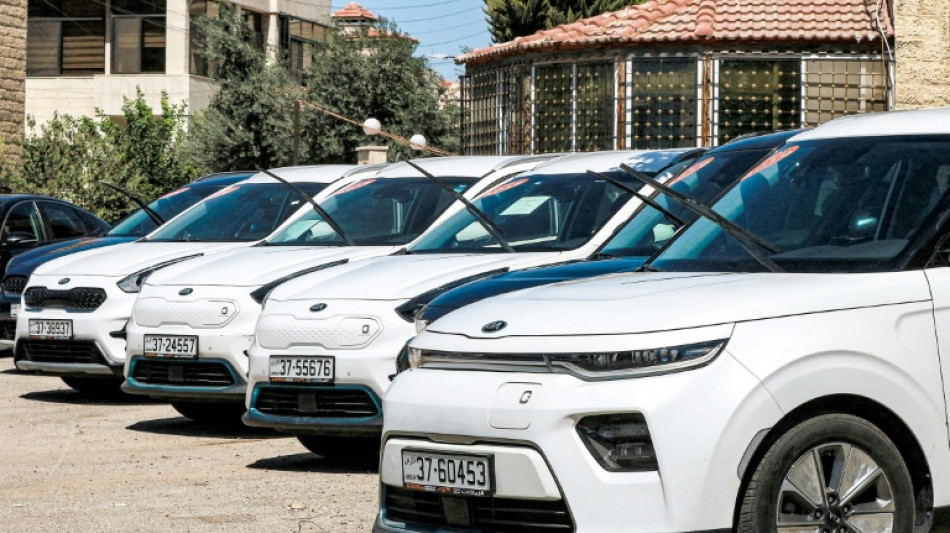
Electric vehicles gain traction in Jordan as petrol prices rise / Photo: Khalil MAZRAAWI - AFP

Electric vehicle sales are surging in Jordan, a trend drivers and showrooms attribute to high petrol prices more than any concerns about air pollution and climate change.
Boosted by low import taxes, especially affordable Chinese-made models have become a common sight on the streets of Amman and the kingdom's desert highways.
Tesla owner Shadi Zatari, 43, says he no longer worries about pump prices since he plugs in his car overnight at home, allowing him to drive 400 kilometres (250 miles) on a single charge.
"The main goal of buying an electric car is definitely saving money," said the Amman-based merchant and father of three. "I saved almost two thirds of what I used to spend on gasoline."
With Octane 90 unleaded petrol selling at about $1.40 per litre, Zatari said he used to spend about 120 dinars ($170) on fuel per month.
He has slashed this to 40 dinars -- the average rise in his monthly electricity bill -- and is able to drive longer distances at no additional cost.
Zatari's car is one of 60,000 EVs now registered in Jordan -- still just a fraction of the total 2.2 million registered vehicles, but the fastest-growing segment.
The number of EVs on Jordan's roads rose 103 percent by the end of July from the same period last year.
The rise was 167 percent for all of 2022 -- a year that also saw imports of petrol and diesel powered cars drop 27 percent and hybrid vehicle imports fall almost 25 percent.
- Driven by savings -
EVs have become a common sight, especially China's Changan Eado EV and E-Star, and models sold by BYD, Dongfeng and MG.
Also popular are the South Korean-made Hyundai Ioniq 5 and Kona and Kia's Niro, as well as Japan's Nissan Leaf and Sylphy, Germany's Volkswagen ID4 and Italy's Fiat 500.
"There is currently a great demand for electric cars," said Hashim Al-Zayyat, director of Al-Zayyat Car Trading.
"The main reason is the high price of gasoline in Jordan, it is a burden with the high cost of living."
Jordan is facing tough economic times, with an unemployment rate of 22.6 percent last year, according to the International Monetary Fund, and youth unemployment around 50 percent.
Public debt exceeded 100 percent of GDP in the small and resource-poor country, which was hit hard by the Covid pandemic and the costs of hosting a large number of Syrian refugees.
The kingdom is now watching with high concern as Israel's war with Hamas militants flares in Gaza, the deadliest ever conflict in the Palestinian territory.
Amid the ongoing crises, budget-conscious Jordanians are mainly "interested in having the car travel the greatest distance with one charge", said Zayyat.
Battery-powered cars have none of the toxic tailpipe emissions that pollute cities, and are considered clean overall if they are charged using solar or wind power.
For most Jordanians, Zayyat said, "the issue is a matter of savings, not an environmental issue at all".
"The environment is the last thing one would think about," he added.
- Government incentives -
Jordan's government has encouraged the trend by slashing import duties on EVs to 10-15 per cent, far lower than for petrol cars, where duties can top 80 percent.
It has also licensed dozens of charging points at petrol stations and private businesses, and the number of battery-powered cars in the government fleet increased by a fifth in 2022.
Chinese-made EVs are especially popular in Jordan, said Haytham Abu Hasan, a sales consultant at the Changan Auto dealership in the capital.
"We used to sell 60 to 70 electric cars per month," he said. "Now we sell more than 100."
Many motorists driving petrol or diesel cars spend 150 to 200 dinars ($211-280) on fuel per month, Abu Hasan said, compared with the extra cost of 30 to 40 dinars for battery-powered cars.
Many motorists value the range, with the Changan E-Star able to go more than 300 kilometres on a single charge, the Eado EV achieving more than 400 kilometres and the SL03 more than 500 kilometres, he said.
"The demand for electric cars far exceeds the demand for gasoline cars, and every year it's greater than the year before."
(T.Burkhard--BBZ)