Berliner Boersenzeitung - Kenya's economy faces climate change risks: World Bank

EUR -
AED 4.232113
AFN 74.904337
ALL 93.279336
AMD 422.93454
AOA 1056.73216
ARS 1724.244391
AUD 1.637356
AWG 2.077164
AZN 1.957746
BAM 1.956835
BBD 2.320187
BDT 142.605425
BHD 0.434424
BIF 3442.590928
BMD 1.152379
BND 1.478182
BOB 13.991036
BRL 5.899604
BSD 1.151989
BTN 109.939717
BWP 15.665285
BYN 3.395296
BYR 22586.638176
BZD 2.316925
CAD 1.619871
CDF 2606.682187
CHF 0.932159
CLF 0.026766
CLP 1056.869799
CNY 7.781563
CNH 7.775272
COP 3706.997419
CRC 522.367217
CUC 1.152379
CUP 30.538057
CVE 110.323351
CZK 24.181992
DJF 205.135827
DKK 7.475187
DOP 67.185535
DZD 153.221543
EGP 57.825372
ERN 17.285692
ETB 185.938344
FJD 2.549582
FKP 0.857799
GBP 0.856893
GEL 3.007759
GGP 0.857799
GHS 13.495787
GIP 0.857799
GMD 85.275767
GNF 10117.351113
GTQ 8.786647
GYD 241.174419
HKD 9.038464
HNL 30.878466
HRK 7.535364
HTG 150.618356
HUF 361.584455
IDR 20688.669142
ILS 3.47076
IMP 0.857799
INR 109.599875
IQD 1509.098169
IRR 1584809.905586
ISK 141.800133
JEP 0.857799
JMD 182.146338
JOD 0.817011
JPY 181.564281
KES 148.956597
KGS 100.775916
KHR 4663.42604
KMF 493.218296
KRW 1643.938977
KWD 0.356592
KYD 0.959987
KZT 542.685256
LAK 26055.781022
LBP 103145.242854
LKR 386.784572
LRD 207.935467
LSL 18.991245
LTL 3.402677
LVL 0.697062
LYD 7.338882
MAD 10.733777
MDL 20.165228
MGA 4905.594591
MKD 61.562561
MMK 2419.612672
MNT 4130.473055
MOP 9.306821
MRU 46.055359
MUR 54.207824
MVR 17.804627
MWK 1997.530502
MXN 19.887028
MYR 4.721419
MZN 73.633658
NAD 18.991327
NGN 1570.946811
NIO 42.392422
NOK 10.995947
NPR 175.906038
NZD 1.958244
OMR 0.443092
PAB 1.152009
PEN 3.897661
PGK 5.08669
PHP 70.223124
PKR 319.880686
PLN 4.29845
PYG 6868.662669
QAR 4.199439
RON 5.250929
RSD 117.349118
RUB 93.202285
RWF 1696.260361
SAR 4.316732
SBD 9.301035
SCR 15.435614
SDG 691.427427
SEK 10.990623
SGD 1.477345
SLE 28.175676
SOS 658.348203
SRD 43.664799
STD 23851.92898
STN 24.512539
SVC 10.080332
SZL 18.987878
THB 38.329259
TJS 10.632785
TMT 4.033328
TND 3.38419
TRY 54.792766
TTD 7.821137
TWD 37.331683
TZS 3059.565236
UAH 51.511545
UGX 4314.206929
USD 1.152379
UYU 46.41475
UZS 13755.275228
VES 861.80862
VND 30265.518966
VUV 137.298882
WST 3.148549
XAF 656.304122
XAG 0.019369
XAU 0.000282
XCD 3.114363
XCG 2.076198
XDR 0.817161
XOF 656.304122
XPF 119.331742
YER 274.730931
ZAR 18.890208
ZMK 10372.806336
ZMW 21.798124
ZWL 371.065728
  • CMSD

    0.0800

    22.1

    +0.36%

  • BP

    -1.8890

    42.371

    -4.46%

  • RIO

    3.0450

    98.945

    +3.08%

  • BTI

    -0.4000

    59.16

    -0.68%

  • AZN

    -0.3450

    157.625

    -0.22%

  • GSK

    0.1400

    51.65

    +0.27%

  • NGG

    0.3800

    80.24

    +0.47%

  • BCC

    4.4100

    87.44

    +5.04%

  • BCE

    -0.1600

    21.63

    -0.74%

  • JRI

    0.0200

    12.84

    +0.16%

  • RYCEF

    0.0500

    20.25

    +0.25%

  • VOD

    0.0550

    15.665

    +0.35%

  • RBGPF

    3.9500

    69.95

    +5.65%

  • CMSC

    0.0200

    21.78

    +0.09%

  • RELX

    0.3650

    36.525

    +1%

Kenya's economy faces climate change risks: World Bank
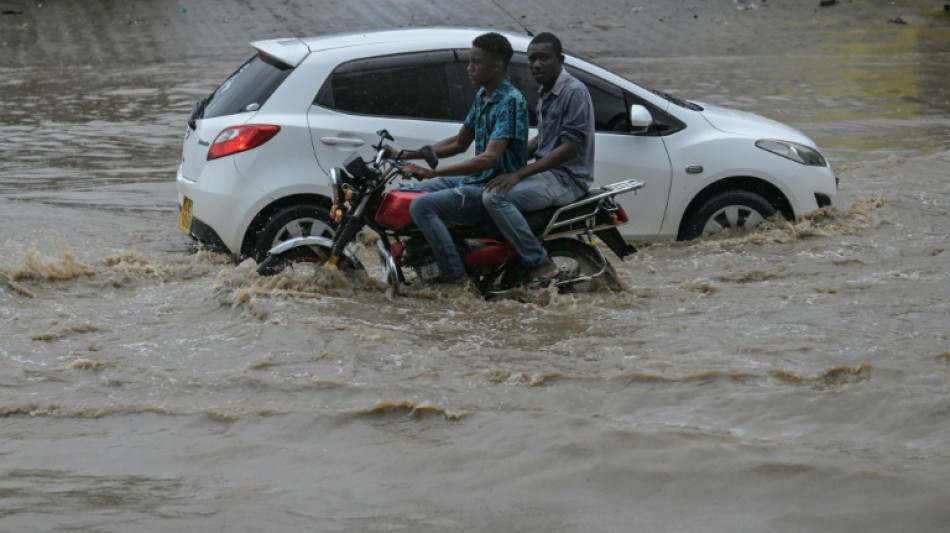
Kenya's economy faces climate change risks: World Bank / Photo: SIMON MAINA - AFP/File

Kenya's economy faces climate change risks: World Bank

The impacts of climate change could shave up to seven percent off Kenya's economic output by 2050 compared to baseline forecasts, unless it adapts, the World Bank warned on Friday.

Text size:

The East African economic powerhouse is extremely vulnerable to climate disasters, recently enduring a punishing years-long drought followed by flooding precipitated by the El Nino weather phenomenon.

"Without adaptation measures, the impact from climate change could not only disproportionately affect the poor, but also result in real GDP (gross domestic product) losses of up to seven percent from the baseline by 2050," the World Bank said.

Although African nations are among the world's lowest contributors to emissions, they are acutely vulnerable to the growing impacts of climate change, as extreme weather events occur with increased frequency and intensity.

The World Bank said that the number of poor people in Kenya could increase by 1.1 million by 2050 if there is "inaction against climate change".

"Furthermore, death and illness due to malaria and water borne diseases are expected to increase by 56 percent and 10 percent respectively by 2050," the Washington-based lender said.

The country of 53 million people will need $62 billion by 2030 to adapt its economy to climate challenges, according to the government.

"Financing to increase Kenya's resilience to climate change will require both domestic resources and expanding climate-compatible private investment in existing areas, such as livestock feed and tourism, and emerging sectors, such as e-mobility and green energy," the World Bank said.

But Kenya's government has limited room for manoeuvre, with its coffers depleted as it struggles to contain skyrocketing inflation and a plunging currency that has sent debt repayment costs soaring.

The country's public debt stood at more than 10.1 trillion shillings ($66 billion) at the end of June, according to Treasury figures, equivalent to around two-thirds of GDP.

Kenya also has a $2-billion eurobond repayment due next year.

The agriculture sector, which is the top contributor to Kenya's economy, representing around 21 percent of GDP in 2022, has already come under pressure from drought and torrential rains.

(A.Berg--BBZ)