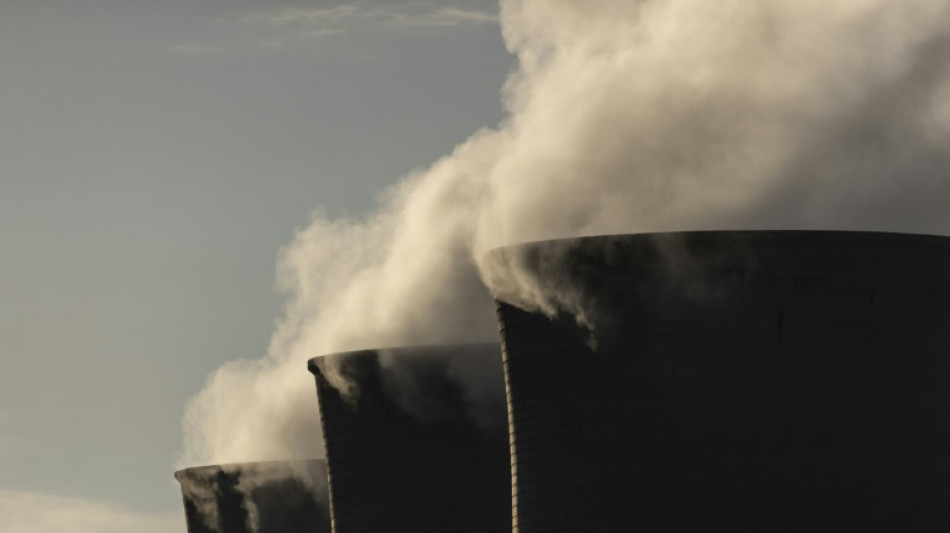
'Unabated': a word to split the world at COP28 / Photo: GUILLEM SARTORIO - AFP/File

The outcome of the most important climate negotiations in years could rest on the ambiguity surrounding one linchpin term, according to experts: "unabated fossil fuels".
With the world experiencing its hottest year on record and devastating heat, wildfires and flooding battering communities across the planet, negotiators at the COP28 talks must hammer out a response to a UN assessment that countries are far from meeting their climate targets.
Ditching coal, oil and gas for cleaner energies is essential if the world is to meet its goal of limiting global warming and avoiding the most catastrophic climate impacts.
Among the menu of hotly contested options negotiators have picked over this week include an agreement to accelerate "efforts towards phasing out unabated fossil fuels" and to cut their use to reach net-zero by around mid-century.
There is also an option of a "rapid phase out of unabated coal power" this decade.
The problem, experts say, is in specifying what this actually means.
"Terms like unabated, they have no clear meaning at the moment," Lisa Fischer, an analyst with the think tank E3G said at a briefing this week.
- Tech fix? -
Abated is generally understood as capturing emissions before they go into the atmosphere.
A footnote in the most recent benchmark report of the UN IPCC scientific advisory body said unabated fossil fuels are those "without interventions that substantially reduce" greenhouse gas emissions.
That can include capturing at least 90 percent of carbon dioxide from power plants, or up to 80 percent of the methane that leaks during energy production and transport, the report suggested.
Discussions of abatement largely centre around Carbon Capture and Storage (CCS) technologies that trap emissions from power stations or industrial facilities.
This is touted by the fossil fuel industry and major producing countries, including oil-rich COP28 host the United Arab Emirates.
COP28 president Sultan Al Jaber, who also leads the UAE's national oil company ADNOC, has said climate diplomacy should focus on phasing out emissions -- not necessarily the fossil fuels themselves.
His stance clashes with nations seeking a commitment to phasing out oil, gas and coal altogether, such as Pacific island nations that could be swallowed by rising seas.
In the near-term, the IPCC says greenhouse gas emissions need to be slashed almost in half this decade to meet the Paris deal's more ambitious -- and safer -- limit of 1.5C warming.
That means rapidly replacing fossil fuels with renewables, say experts, noting that CCS has little role to play in this crucial decade.
In 2022, 35 commercial-scale facilities worldwide applying CCS isolated a total of 45 million tonnes of CO2, according to the International Energy Agency.
By comparison, Jaber has said the world needs to cut emissions amounting to 22 billion tonnes of greenhouse gases "in the next seven years".
- 'Distraction tactic' -
Even in the longer term, scientists project there will be only limited use of abatement technology, focused in sectors that are particularly hard to decarbonise, like cement.
In a statement released before the climate talks, the High Ambition Coalition of countries -- including France, Kenya and Colombia -- said abatement technology has a "minimal" role to play in decarbonising energy.
"We cannot use it to green-light fossil fuel expansion," they said.
There are also concerns that the technology will not stop enough emissions from reaching the atmosphere.
An analysis by the group Climate Analytics this week found that an overreliance on large-scale CCS -- and an underperformance of the technology -- could lead to 86 billion tonnes of excess greenhouse gas emissions between 2020 and 2050.
Fischer said the focus on CCS was "very much a distraction tactic," adding it is unlikely ever to be useful in some significant areas of fossil fuel consumption, particularly oil.
"You can't really fit a little carbon capture device onto every exhaust pipe of a car," said Fischer.
CCS is not new. The fossil fuel industry has been using it since the 1970s, not to prevent CO2 from leaching into the atmosphere but to inject the gas into oil fields to extract more crude.
Historically, bolting CCS facilities onto coal- and gas-fired power plants and then storing the CO2 to reduce emissions has proven technically feasible but uneconomical.
A new report from Oxford University's Smith School of Enterprise and the Environment found that heavy dependence on CCS to reach net zero targets around 2050 would cost at least $30 trillion more than using mainly renewables, efficiency and electrification.
"Using CCS to facilitate business-as-usual fossil fuel use, even if feasible, would be highly economically damaging," it said.
(O.Joost--BBZ)