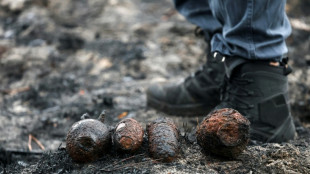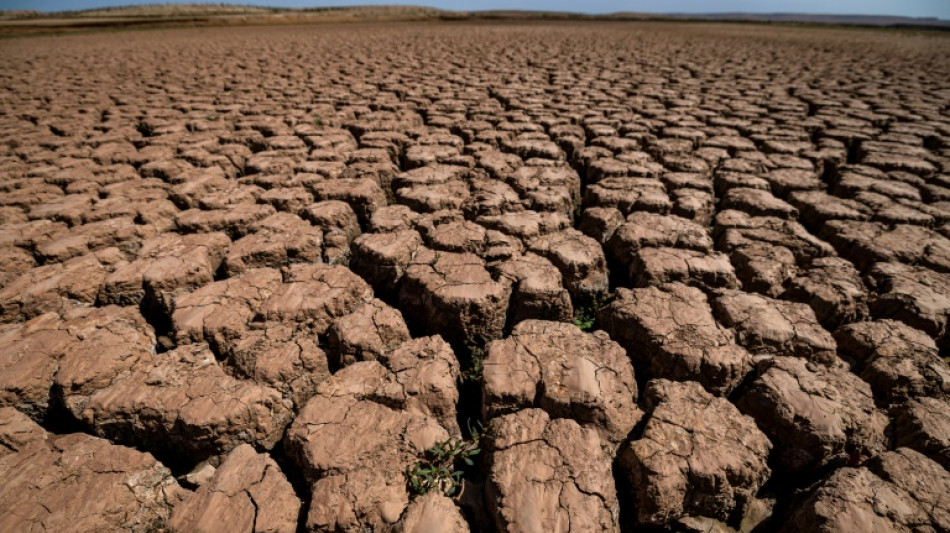
Planet 'on the brink', with new heat records likely in 2024: UN / Photo: Fadel SENNA - AFP/File

Global temperatures "smashed" heat records last year, as heatwaves stalked oceans and glaciers suffered record ice loss, the United Nations said Tuesday -- warning 2024 was likely to be even hotter.
The annual State of the Climate report by the UN weather and climate agency confirmed preliminary data showing 2023 was by far the hottest year ever recorded.
And last year capped off "the warmest 10-year period on record", the World Meteorological Organization said, with even hotter temperatures expected.
"There is a high probability that 2024 will again break the record of 2023", WMO climate monitoring chief Omar Baddour told reporters.
Reacting to the report, UN chief Antonio Guterres said it showed "a planet on the brink".
"Earth's issuing a distress call," he said in a video message, pointing out that "fossil fuel pollution is sending climate chaos off the charts", and warning that "changes are speeding up".
The WMO said that last year the average near-surface temperature was 1.45 degrees Celsius above pre-industrial levels -- dangerously close to the critical 1.5-degree threshold that countries agreed to avoid passing in the 2015 Paris climate accords.
- 'Red alert' -
"I am now sounding the red alert about the state of the climate," Saulo told reporters, lamenting that "2023 set new records for every single climate indicator".
The organisation said many of the records were "smashed" and that the numbers "gave ominous new significance to the phrase 'off the charts'."
"What we witnessed in 2023, especially with the unprecedented ocean warmth, glacier retreat and Antarctic sea ice loss, is cause for particular concern," Saulo said.
One especially worrying finding was that marine heatwaves gripped nearly a third of the global ocean on an average day last year.
And by the end of 2023, more than 90 percent of the ocean had experienced heatwave conditions at some point during the year, the WMO said.
More frequent and intense marine heatwaves will have "profound negative repercussions for marine ecosystems and coral reefs", it warned.
Meanwhile key glaciers worldwide suffered the largest loss of ice since records began in 1950, "driven by extreme melt in both western North America and Europe".
In Switzerland, where the WMO is based, Alpine glaciers lost 10 percent of their remaining volume in the past two years alone, it said.
The Antarctic sea ice extent was also "by far the lowest on record", WMO said.
- Rising sea levels -
The maximum area at the end of the southern winter was around one million square kilometres below the previous record year -- equivalent to the size of France and Germany combined, according to the report.
Ocean warming and the rapidly melting glaciers and ice sheets drove the sea level last year to its highest point since satellite records began in 1993, WMO said.
The agency highlighted that the global mean sea level rise over the past decade (2014-2023) was more than double the rate in the first decade of satellite records.
The dramatic climate shifts, it said, are taking a heavy toll worldwide, fuelling extreme weather events, flooding and drought, which trigger displacement and drive up biodiversity loss and food insecurity.
"The climate crisis is THE defining challenge that humanity faces and is closely intertwined with the inequality crisis," Saulo said.
- 'Glimmer of hope' -
The WMO did highlight one "glimmer of hope": surging renewable energy generation.
Last year, renewable energy generation capacity -- mainly from solar, wind and hydropower -- increased by nearly 50 percent from 2022, it said.
The report sparked a flood of reactions and calls for urgent action.
"Our only response must be to stop burning fossil fuels so that the damage can be limited," said Martin Siegert, a geosciences professor at the University of Exeter.
Jeffrey Kargel, a senior scientist at the Planetary Science Institute, stressed that the dramatic climae shifts "do not connote the inevitable doom of civilisation".
The outcome, he said, "depends on how people and governments change or don't change behaviours".
Saulo acknowledged that the cost of climate action might seem high.
"But the cost of climate inaction is much higher," she said. "The worst thing would be to do nothing."
Guterres also emphasised that there was still time to "avoid the worst of climate chaos".
"But leaders must step up and act -- now."
(Y.Berger--BBZ)