Oman, UAE deluge 'most likely' linked to climate change: scientists
/ Photo: Giuseppe CACACE - AFP

Global warming caused by fossil fuel emissions "most likely" exacerbated the intense rains that lashed the UAE and Oman last week, causing deaths and widespread flooding, an expert group of scientists said Thursday.
Extreme rainfall in El Nino years has become 10-40 percent heavier in the region affected, a study published by the World Weather Attribution (WWA) group found.
Climate change caused by fossil fuel emissions is the probable reason but cannot be pinpointed "with certainty", added the study compiled by 21 international researchers.
Twenty-one people died in Oman and four in the United Arab Emirates, which was battered by the heaviest rainfall since records began for the desert Gulf state 75 years ago.
"Warming, caused by burning fossil fuels, is the most likely explanation for the increasing rainfall," WWA said in the study.
"There are no other known explanations" for the sharp rise in precipitation, added the international group of scientists that investigates the role of climate change in extreme weather events.
The UAE and Oman are oil-producing states already suffering extreme heat brought on by global warming. But last week's floods revealed the additional risk of exceptional weather events as the planet heats up.
"The UAE and Oman floods have shown that even dry regions can be strongly affected by precipitation events, a threat that is increasing with increasing global warming due to fossil fuel burning," said Sonia Seneviratne, a WWA member and professor at Zurich's ETH university.
- Severe disruption -
The WWA study analysed historic weather data and climate models to determine changes in rainfall patterns in the area, including in El Nino years -- a recurring pattern when global temperatures rise.
It found extreme rains were significantly less intense in the years before 1.2 degrees Celsius of warming above pre-industrial levels.
"Extreme rainfall events have become at least 10 percent heavier in the UAE and Oman," said Mariam Zachariah, a WWA member and researcher at London's Imperial College.
"This finding... agrees with the basic physics that a warmer atmosphere can hold more moisture."
The storm first landed in Oman on April 14, killing at least 21 people in flash floods and other incidents, according to the official Oman News Agency.
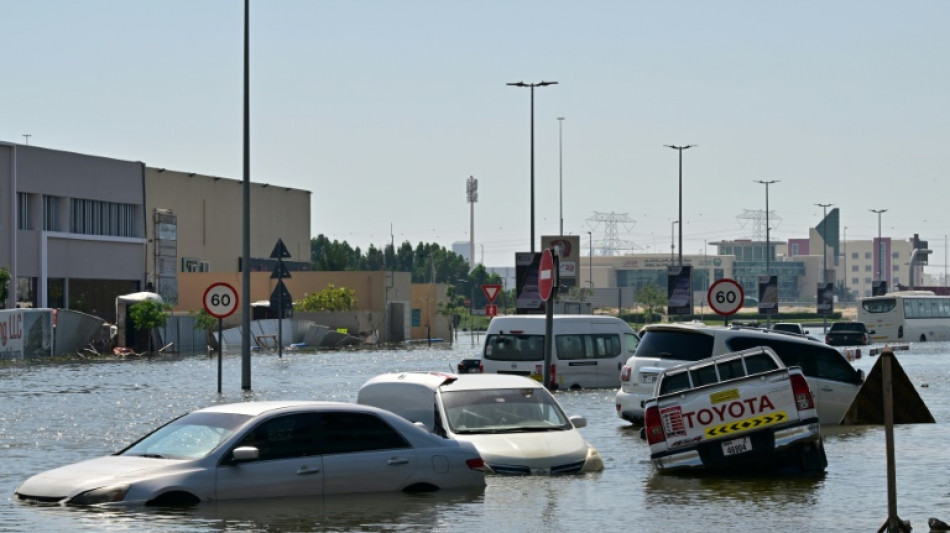
It hit the UAE on April 16, dumping nearly two years' worth of rain that flooded homes, roads, malls and offices and left four people dead.
Financial hub Dubai, carefully marketed as a centre for glamour and luxury, faced severe disruption for days with major roads blocked by floods, power outages and some residents trapped in their homes.
Dubai airport, the world's busiest by international travellers, cancelled 2,155 flights, diverted 115 and did not return to full capacity until Tuesday.
"The situation was unprecedented in its severity but we are a country that learns from every experience," Dubai ruler and UAE Prime Minister Sheikh Mohammed bin Rashid al-Maktoum said on Wednesday, announcing a $544 million package to repair homes.
- 'Destructive floods' -
Reports of cloud seeding, the practice of spraying clouds with chemicals to increase rainfall, were denied by UAE officials last week.
The WWA said it did not investigate "the possible influence of cloud seeding" but added: "Given the huge size of the storm system, massive rainfall would have fallen regardless of whether (cloud seeding) operations had been carried out."
The UAE last year hosted the United Nation's COP28 climate talks, during which nations reached a landmark agreement to "transition away" from fossil fuels.
Both the UAE and Oman are investing in renewable energy and have pledged to decarbonise their domestic economies -- excluding the fossil fuels they sell abroad.
But like other oil producers including the United States, they are building up their capacities to cater for an expected rise in demand.
"At COP28 in Dubai, the world agreed to 'transition away' from fossil fuels. Nearly half a year later, countries are still opening new oil and gas fields," said Friederike Otto, a climatologist and WWA member.
"If the world keeps burning fossil fuels, rainfall in many regions of the world will get heavier and heavier, resulting in deadlier and more destructive floods."
(K.Müller--BBZ)