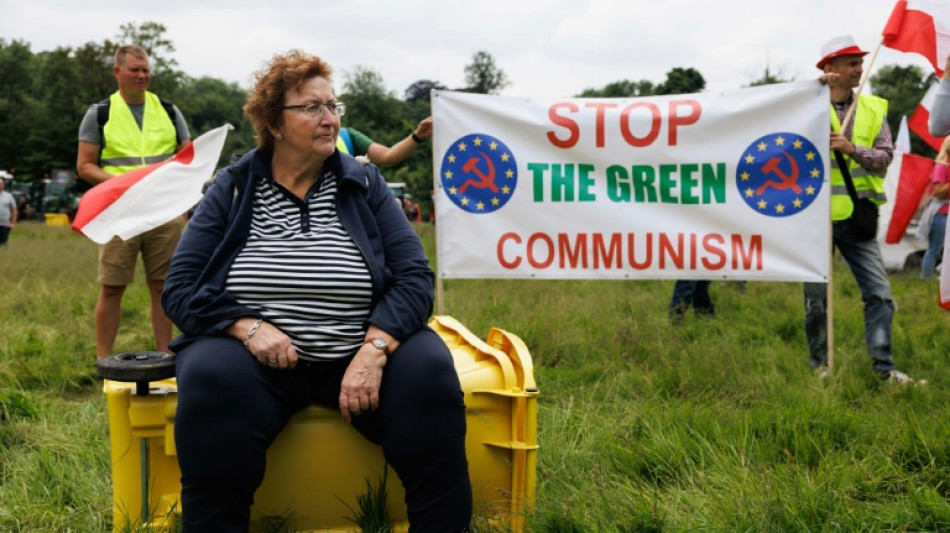
From wave to washout? Greens face tough time at EU vote / Photo: Simon Wohlfahrt - AFP

Five years ago Green parties swept to their best results ever at elections for the European Union's parliament, before helping to push through a sweeping raft of landmark legislation.
But this time around, as people across the 27-nation bloc cast ballots later this week, Greens are expected to suffer heavy losses in the face of a right-wing backlash and voter fatigue.
Opinion polls predict the coalition of Green parties could lose one-third of the 72 European Parliament seats they currently hold -- and in France they risk dropping from 12 to zero.
While the last EU Parliament election in 2019 was accompanied by mass rallies over climate change, environmental issues have slipped down the pecking order this year as voters grapple with an array of other global crises.
Top concerns now include the economy, unemployment and security as wars rage in Ukraine and the Middle East and the EU struggles to revive growth after record inflation.
"Environmental issues remain important, but no longer strongly enough to determine the vote," said Phuc-Vinh Nguyen, a researcher at the Jacques Delors Institute think-tank.
Backing up that assertion, a recent poll from EU pollster Eurobarometer found that 84 percent of respondents believe legislation to protect the environment is necessary -- even if it is not their priority.
"But the election result will send a political signal, with the risk of interpreting the weakness of the Greens as a rejection of climate policy in general," Nguyen said.
- Hitting pause? -
But it's not just that other major issues are diluting the Green vote in the race for the 720-seat EU parliament.
As the EU has pushed through its mammoth package of "Green Deal" laws, right-wing parties have seized on discontent to turn it into a political football.
Nathalie Brack, a political scientist at Belgium's ULB university, said the conservative European People's Party (EPP) -- the biggest grouping in the EU parliament -- had set about "discrediting the ecological agenda".
After watering down or rejecting several green laws over the past year, election favourites EPP are now openly calling for a "pause" on any more such legislation to concentrate on competitiveness.
"The centre-right changed its tune and began to present things more and more as a dilemma of choosing between the economy on the one hand and the environment on the other," Brack said.
"That has amplified the far right's message that people are more interested in making ends meet at the end of each month than in the end of the world."
Most prominent in the pushback against the EU's environmental law have been a wave of farmer protests across the bloc that have been fuelled by ire at the perceived excessive regulations.
Philippe Lamberts, co-president of the Green grouping in parliament, said other political factions across the spectrum had increasingly lost the stomach to push through tough reforms.
"They initially supported the Green Deal when it was politically costly to oppose it, before changing course when it was no longer electorally promising and we were entering the hard part of the transition," Lamberts said.
But Green parties also have themselves to blame for their declining poll numbers as their involvement in a number of coalition governments across Europe has forced concessions that angered their base.
For example in Germany, where the Greens are in a three-party ruling coalition, they appear set to see their vote drop from 20.5 percent in 2019 to 14 percent after accepting the reopening of coal power plants in the wake of Russia's invasion of Ukraine.
- Coalition conundrums -
As they struggle at the polls, the Greens are pinning their hopes on mobilising voters by emphasising the threat posed by a likely surge in the far right to the EU's environmental ambitions.
That is a real risk as numerous laws in the Green Deal have revision clauses or will need to be adapted to match the EU's yet-to-be-adopted 2040 climate goals.
But analysts say not everything is lost.
Even as they face slipping from their ranking as the fourth-largest party in the parliament, the Greens could still play a key role in helping form a majority after the elections.
Current EU chief Ursula von der Leyen, who hails from the EPP, could be scrambling for support to try to secure the backing required for a second term.
That could mean the Greens might be able to exact "guarantees" on sticking to the environmental ambitions in return for backing von der Leyen, said Nguyen.
"A partial unraveling of the Green Deal could be avoided with a 'wider grand coalition' bringing together Greens, social democrats, liberals and the EPP," he said.
(T.Renner--BBZ)