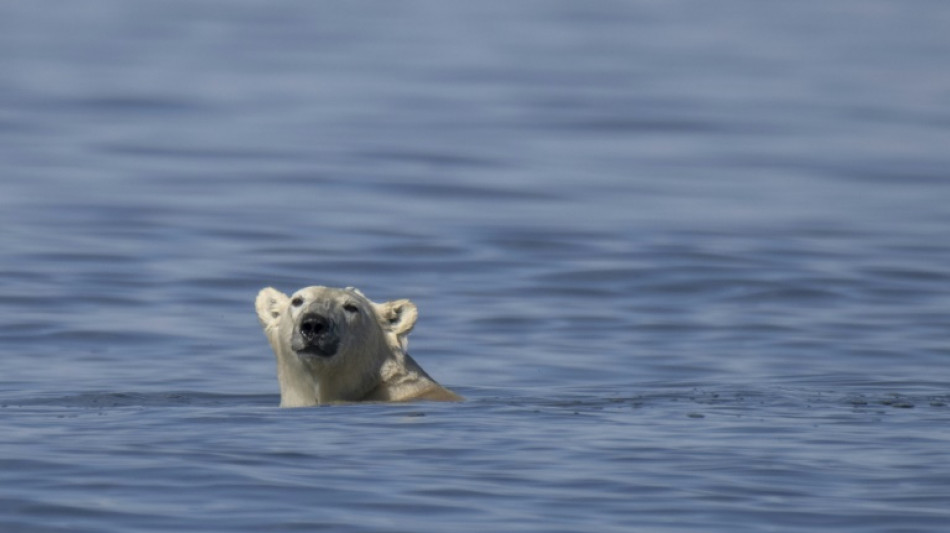
Polar bears could vanish from Canada's Hudson Bay if temperatures rise 2C / Photo: Olivier MORIN - AFP

An international team of scientists said Thursday that polar bears faced local extinction in Canada's Hudson Bay by mid-century if global warming exceeds limits set under the Paris climate accords.
Climate change has sharply increased the number of days where Arctic sea ice is too thin for polar bears to hunt seals.
That forces them to spend longer stretches ashore without their main food source.
Using models, researchers considered how future rises in global temperatures could hit ice thickness in Hudson Bay and in turn, the fate of its iconic and endangered polar bears.
They found that if temperatures rose 2 degrees Celsius above pre-industrial levels the resulting ice-free period would simply be too long for many bears to survive.
Bear populations in southern Hudson Bay -- where it takes longer for winter ice to return -- would be the first to go, said the study's lead author Julienne Stroeve.
"Those bears are unlikely to survive in that region" and could disappear by the middle of this century, the Arctic climate scientist from the University of Manitoba told AFP.
The collapse of Hudson Bay's other major bear population in the west would not be far behind, she added. Global warming above 2C would render this habitat increasingly unsuitable for hunting and breeding.
- Struggle to survive -
Under the 2015 Paris agreement, nations agreed to limit temperature rises to well below 2C to avoid the worst effects of climate change, and to strive for a safer 1.5C cap.
Global temperatures are already 1.2C higher than the 1850-1900 pre-industrial era and the world is tracking toward 2.9C of warming by 2100, according to the United Nations.
This has lengthened periods without ice in the fast-warming Arctic, directly affecting polar bears, which need a firm platform to cross the seas and hunt seals, their main prey.
During the summer melt the bears are forced ashore to await the return of winter sea ice, and can shed up to two kilograms a day during this fasting period.
But human-caused climate change has extended the ice-free period in Hudson Bay by a month over the past decade, said the study, published in the journal Communications Earth and Environment.
With 2C of warming, the southern Hudson Bay would be ice-free for more than 180 days -- beyond the "hard limit" of what bears can endure, said Stroeve.
"It might start getting too long, then they won't be able to survive," she added.
This same threshold would be breached in western Hudson Bay at between 2.2C and 2.6C of warming, she said.
- 'Wake up call' -
Longer ice-free periods in Hudson Bay were already impacting polar bear breeding and population numbers, meaning their extinction locally "may already be inevitable", said the study.
"That environment is rapidly changing, and I don't think these ecosystems can adapt as quickly as they need to," Stroeve said. "That's really quite sad for me."
Other research has found that Hudson Bay's bears were trying to adapt to longer periods on land by finding other food, but could not match the calories of their normal marine diets.
The past 12 months have been the hottest in recorded history, with land and ocean temperatures hitting unprecedented highs.
Stroeve said southern parts of Hudson Bay were already ice-free, something that does not normally start happening until early July.
"This is the earliest breakout of ice we've ever seen," she said. "That doesn't spell good news for the bears."
Their findings were a harbinger of polar bear survival elsewhere in the Arctic, she added.
As Hudson Bay's bears are further south than any others, they have long been considered an indicator of how their counterparts further north will fare in the future.
"It sort of gives us a wake-up call. This is starting to be the fate of these bears," Stroeve said.
(G.Gruner--BBZ)