Berliner Boersenzeitung - Humanity suffering from 'extreme heat epidemic,' UN chief warns

EUR -
AED 4.308835
AFN 74.49196
ALL 95.752485
AMD 433.698247
ANG 2.100015
AOA 1077.060107
ARS 1634.062666
AUD 1.619899
AWG 2.111883
AZN 1.991476
BAM 1.958911
BBD 2.358165
BDT 143.658162
BGN 1.957131
BHD 0.442705
BIF 3484.13359
BMD 1.173268
BND 1.495075
BOB 8.089849
BRL 5.759602
BSD 1.17087
BTN 111.500038
BWP 15.911271
BYN 3.314593
BYR 22996.060933
BZD 2.35476
CAD 1.595434
CDF 2716.116648
CHF 0.915365
CLF 0.026988
CLP 1062.183556
CNY 8.013834
CNH 8.000259
COP 4358.938548
CRC 532.648236
CUC 1.173268
CUP 31.091613
CVE 110.440404
CZK 24.380163
DJF 208.492911
DKK 7.47298
DOP 69.761094
DZD 155.38575
EGP 63.060593
ERN 17.599026
ETB 184.261902
FJD 2.563476
FKP 0.866879
GBP 0.863766
GEL 3.156259
GGP 0.866879
GHS 13.124845
GIP 0.866879
GMD 85.648623
GNF 10275.319526
GTQ 8.935325
GYD 244.949034
HKD 9.19332
HNL 31.122562
HRK 7.53602
HTG 153.233369
HUF 360.376445
IDR 20420.267455
ILS 3.43574
IMP 0.866879
INR 111.62728
IQD 1536.981624
IRR 1544021.234685
ISK 143.209371
JEP 0.866879
JMD 184.242619
JOD 0.831829
JPY 183.53262
KES 151.589327
KGS 102.567717
KHR 4696.459037
KMF 493.360307
KPW 1055.94532
KRW 1706.712534
KWD 0.361378
KYD 0.975658
KZT 544.048709
LAK 25711.054095
LBP 105065.228965
LKR 374.668251
LRD 214.84305
LSL 19.594087
LTL 3.464356
LVL 0.709699
LYD 7.42786
MAD 10.821086
MDL 20.208268
MGA 4880.796414
MKD 61.7262
MMK 2463.519483
MNT 4198.666619
MOP 9.45069
MRU 46.750649
MUR 54.885322
MVR 18.132862
MWK 2030.224454
MXN 20.305407
MYR 4.635602
MZN 74.97463
NAD 19.594087
NGN 1602.415095
NIO 43.070698
NOK 10.817069
NPR 178.399098
NZD 1.973918
OMR 0.451147
PAB 1.17086
PEN 4.104719
PGK 5.091086
PHP 72.05921
PKR 326.276691
PLN 4.243201
PYG 7094.32786
QAR 4.278502
RON 5.235247
RSD 117.384344
RUB 88.582143
RWF 1711.918913
SAR 4.401895
SBD 9.423995
SCR 16.802622
SDG 704.5479
SEK 10.819729
SGD 1.492673
SHP 0.875963
SLE 28.891716
SLL 24602.847529
SOS 669.162781
SRD 43.970569
STD 24284.28737
STN 24.538973
SVC 10.244358
SYP 129.682209
SZL 19.589779
THB 38.039123
TJS 10.94718
TMT 4.112306
TND 3.390157
TOP 2.824949
TRY 53.075266
TTD 7.936673
TWD 36.97966
TZS 3051.592546
UAH 51.453219
UGX 4420.019989
USD 1.173268
UYU 47.135018
UZS 14108.552463
VES 579.000876
VND 30880.424682
VUV 139.061086
WST 3.186516
XAF 657.000465
XAG 0.015467
XAU 0.000252
XCD 3.170816
XCG 2.110069
XDR 0.817098
XOF 656.445742
XPF 119.331742
YER 279.934303
ZAR 19.371072
ZMK 10560.814925
ZMW 22.099287
ZWL 377.791951
  • RIO

    1.8700

    100.5

    +1.86%

  • CMSC

    0.0099

    22.88

    +0.04%

  • BCC

    -2.2000

    72.13

    -3.05%

  • JRI

    0.1100

    13.04

    +0.84%

  • RBGPF

    0.0800

    63.18

    +0.13%

  • CMSD

    0.0400

    23.29

    +0.17%

  • BCE

    0.1700

    24.1

    +0.71%

  • NGG

    0.1400

    87.64

    +0.16%

  • BTI

    1.0500

    59.4

    +1.77%

  • BP

    -0.4400

    46.5

    -0.95%

  • GSK

    -0.5200

    50.38

    -1.03%

  • AZN

    -2.2200

    181.24

    -1.22%

  • RYCEF

    0.1500

    16.5

    +0.91%

  • RELX

    -0.2000

    36.16

    -0.55%

  • VOD

    -0.3100

    15.74

    -1.97%

Humanity suffering from 'extreme heat epidemic,' UN chief warns
Humanity suffering from 'extreme heat epidemic,' UN chief warns / Photo: Yuki IWAMURA - AFP/File

Humanity suffering from 'extreme heat epidemic,' UN chief warns

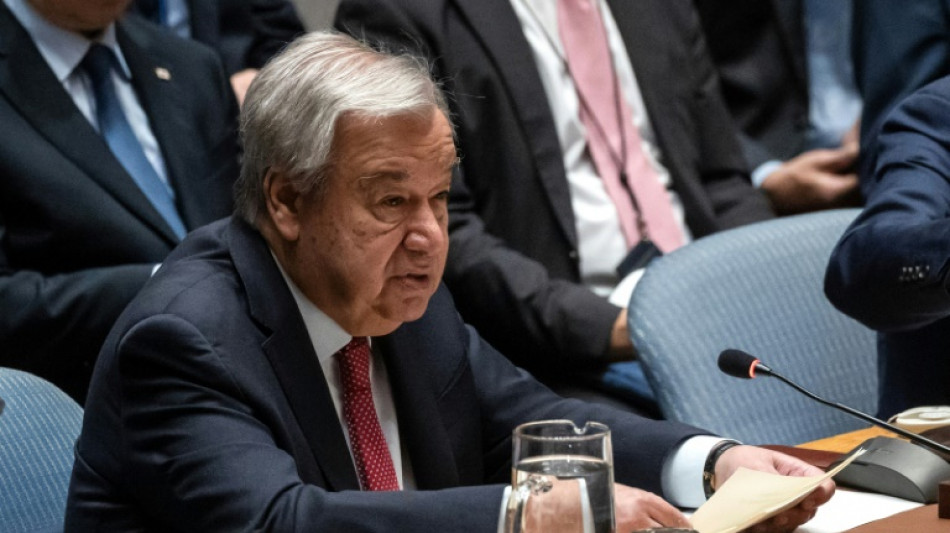
Humanity is suffering from an "extreme heat epidemic," UN Secretary-General Antonio Guterres warned Thursday, calling for action to limit the impacts of heat waves intensified by climate change.

Text size:

"Billions of people are facing an extreme heat epidemic -- wilting under increasingly deadly heat waves, with temperatures topping 50 degrees Celsius around the world," he said. "That's 122 degrees Fahrenheit. And halfway to boiling."

According to the European Copernicus network, July 21, 22 and 23 were the three hottest days ever recorded worldwide, with July 22 holding the absolute record of 17.16 degrees Celsius (62.9 degrees Fahrenheit).

Guterres repeated his call for humanity to fight its "addiction" to fossil fuels.

"Today, our focus is on the impact of extreme heat. But let's not forget that there are many other devastating symptoms of the climate crisis: ever-more fierce hurricanes. Floods. Droughts. Wildfires. Rising sea levels. And the list goes on," he said.

"To tackle all these symptoms, we need to fight the disease. And the disease is the madness of incinerating our only home. The disease is the addiction to fossil fuels. The disease is climate inaction," he stressed, calling in particular on G20 countries to take action.

While 2023 was the hottest year on record, and 2024 could set a new record, temperatures well above 40C (104F) are increasingly common.

In the space of a year, the 50C threshold has even been exceeded in at least 10 places, from Death Valley in the United States (53.9C on July 7) to Agadir in Morocco, and also in China and India.

The intense heat, often less visible than other devastating impacts of climate change such as storms or floods, is nonetheless more deadly.

This "silent killer" is responsible for around 489,000 deaths per year between 2000 and 2019, compared with 16,000 deaths per year from cyclones, according to the UN's "Call to Action" document published on Thursday.

- Workers exposed -

Extremely high temperatures also have an economic impact, with the UN estimating economic losses from heat stress at work will reach $2.4 trillion in 2030.

According to a report by the International Labor Organization published on Thursday, more than 70 percent of workers were exposed to excessive heat in 2020, 8.8 percent more than in 2000.

"The good news is that we can save lives and we can limit its impact," Guterres said Thursday.

The UN has called for the world community to first act to protect "the most vulnerable" -- including young children, the elderly and also humanity's poorest.

In this context, early warning systems should include extreme heat, warning populations of the arrival of heat waves and informing them of the precautions to take, the document says.

The call to action also recommends an "increase (to) equitable access to and scale up (of) low-carbon cooling."

This would involve investing in passive cooling systems -- which include climate-sensitive urban design measures, reflective surfaces and natural cooling systems -- and the phase-out of climate-warming gases that are used in many cooling systems.

(S.G.Stein--BBZ)