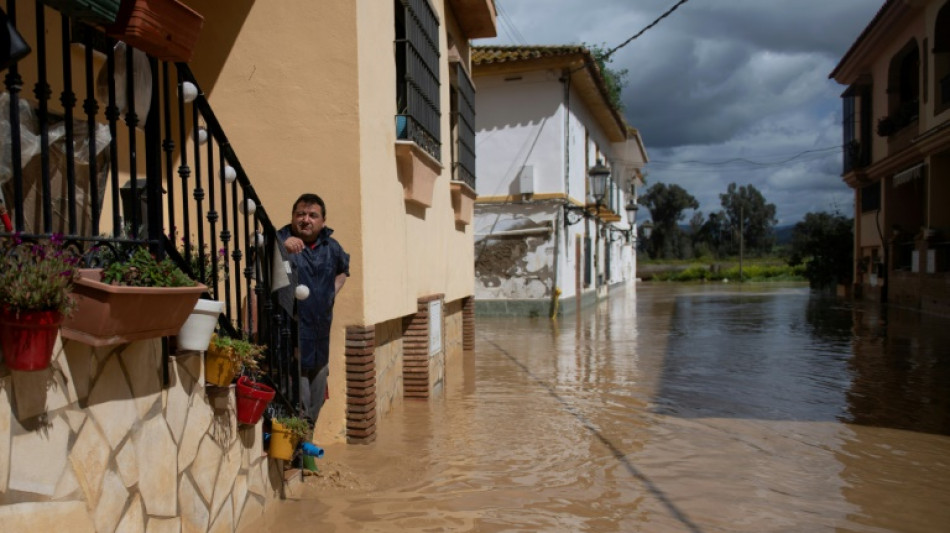
World's 'exceptional' heat streak lengthens into March / Photo: JORGE GUERRERO - AFP

Global temperatures hovered at historic highs in March, Europe's climate monitor said on Tuesday, prolonging an unprecedented heat streak that has pushed the bounds of scientific explanation.
In Europe, it was the hottest March ever recorded by a significant margin, said the Copernicus Climate Change Service, driving rainfall extremes across a continent warming faster than any other.
The world meanwhile saw the second-hottest March in the Copernicus dataset, sustaining a near-unbroken spell of record or near-record-breaking temperatures that has persisted since July 2023.
Since then, virtually every month has been at least 1.5 degrees Celsius hotter than it was before the industrial revolution, when humans began burning massive amounts of coal, oil and gas.
March was 1.6C above pre-industrial times, extending an anomaly so unusual that scientists are still trying to fully explain it.
"That we're still at 1.6C above preindustrial is indeed remarkable," said Friederike Otto of the Grantham Institute for Climate Change and the Environment at Imperial College London.
"We're very firmly in the grip of human-caused climate change," she told AFP.
Scientists had predicted the extreme run of global temperatures would subside after a warming El Nino event peaked in early 2024, but they have stubbornly lingered well into 2025.
"We are still experiencing extremely high temperatures worldwide. This is an exceptional situation," Robert Vautard, a leading scientist with the United Nations' climate expert panel IPCC, told AFP.
- 'Climate breakdown' -
Scientists warn that every fraction of a degree of global warming increases the intensity and frequency of extreme weather events such as heatwaves, heavy rainfall and droughts.
Climate change is not just about rising temperatures but the knock-on effect of all that extra heat being trapped in the atmosphere and seas by greenhouse gases like carbon dioxide and methane.
Warmer seas mean higher evaporation and greater moisture in the atmosphere, causing heavier deluges and feeding energy into storms.
This also affects global rainfall patterns.
March in Europe was 0.26C above the previous hottest record for the month set in 2014, Copernicus said.
Some parts of the continent experienced the "driest March on record and others their wettest" for about half a century, said Samantha Burgess of the European Centre for Medium-Range Weather Forecasts, which runs the Copernicus climate monitor.
Bill McGuire, a climate scientist from University College London, said the contrasting extremes "shows clearly how a destabilised climate means more and bigger weather extremes".
"As climate breakdown progresses, more broken records are only to be expected," he told AFP.
Elsewhere in March, scientists said that climate change intensified a blistering heatwave across Central Asia and fuelled conditions for extreme rainfall which killed 16 people in Argentina.
- Puzzling heat -
The spectacular surge in global heat pushed 2023 and then 2024 to become the hottest years on record.
Last year was also the first full calendar year to exceed 1.5C -- the safer warming limit agreed by most nations under the Paris climate accord.
This single year breach does not represent a permanent crossing of the 1.5C threshold, which is measured over decades, but scientists have warned the goal is slipping out of reach.
According to Copernicus, global warming reached an estimated 1.36C above pre-industrial levels in October last year.
If the 30-year trend leading up to then continued, the world would hit 1.5C by June 2030.
Scientists are unanimous that burning fossil fuels has largely driven long-term global warming, and that natural climate variability can also influence temperatures from one year to the next.
But they are less certain about what else might have contributed to this record heat spike, or how this impacts our understanding about how climate might behave in future.
Vautard said there were "phenomena that remain to be explained" but the exceptional temperatures still fell within the upper range of scientific projections of climate change.
Experts think changes in global cloud patterns, airborne pollution and Earth's ability to store carbon in natural sinks like forests and oceans could be among factors contributing to the planet overheating.
Copernicus uses billions of measurements from satellites, ships, aircraft and weather stations to aid its climate calculations.
Its records go back to 1940 but other sources of climate data -- such as ice cores, tree rings and coral skeletons -- allow scientists to expand their conclusions using evidence from much further in the past.
Scientists say the current period is likely to be the warmest the Earth has been for the last 125,000 years.
(Y.Berger--BBZ)