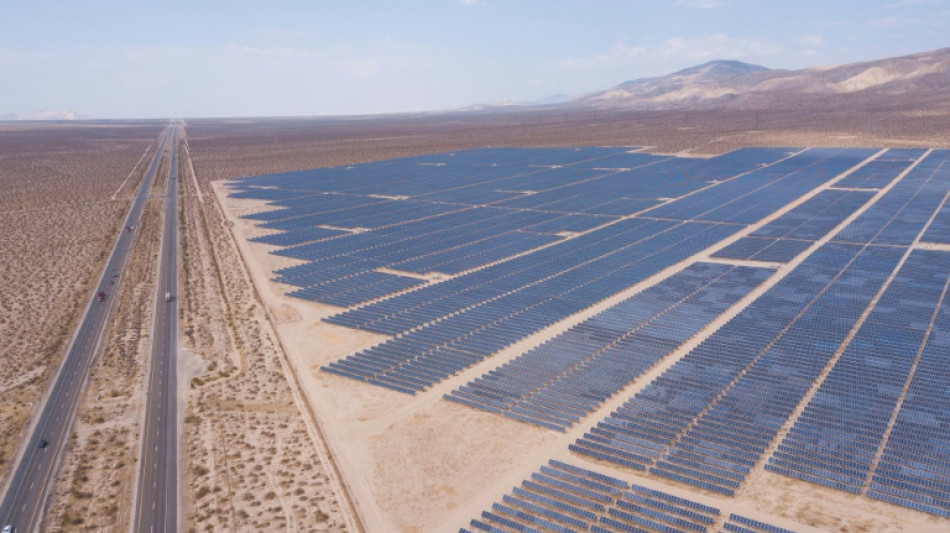
How will Trump's 'Big Beautiful Bill' impact US climate policy? / Photo: Patrick T. FALLON - AFP/File

With the passage of his party's "One Big Beautiful Bill," Republican President Donald Trump has largely delivered on his promise of curtailing Joe Biden's landmark climate law.
Here's a breakdown of how the new legislation will reshape US climate and energy policy.
- Clean energy tax incentives slashed -
The Inflation Reduction Act (IRA), signed by Biden in 2022, was the largest climate investment in US history, allocating around $370 billion in tax credits for renewable energy projects, efficient appliances, and more. Much of that now faces imminent repeal.
"These credits were all huge motivating incentives for clean energy to be built out across the country," said Jean Su, senior attorney at the Center for Biological Diversity. "With those removed, those renewable energy projects are all at risk of entirely failing."
Su noted the cuts come amid surging electricity demand from AI data centers. "Removing tax incentives for clean energy means that all of this new energy demand will be given over to the fossil fuel industry" -- resulting in more greenhouse emissions and air pollution.
Critics say keeping the US energy mix heavily tied to fossil fuels locks in market volatility, as seen during the Ukraine war.
Su added that utilities are incentivized to build costlier fossil plants to boost profits-raising electricity rates in the process.
Trump, who received an estimated $445 million from Big Oil during his campaign, has framed the clean energy rollbacks as a victory over what he calls the "Green New Scam."
Doug Jones, a tax attorney and partner at Husch Blackwell, told AFP that "wind and solar took the biggest hit."
Under the new rules, clean energy projects must be in service by 2027 or begin construction within 12 months of the bill's enactment to qualify for remaining credits.
"The pipeline of projects that had begun construction by the prescribed time is eventually going to dry up -- I don't know how they're going to start financing these projects without the tax credits," said Jones.
He added his clients include Fortune 500 companies now alarmed by the ripple effects of ending the credits, which they have been purchasing from renewable developers -- a practice that has infused the market with much-needed liquidity.
Tax credits for energy-efficient home and commercial upgrades also now face a shorter runway, expiring June 30, 2026. However, the bill preserves credits for nuclear, geothermal power, hydrogen and carbon capture technologies.
- Electric vehicles and fuel economy -
Electric vehicles come in for some of the harshest treatment. Tax credits for new and used EV purchases are set to sunset this year, while charging station installation credits expire June 30, 2026.
Albert Gore of the Zero Emission Transportation Project said the bill effectively abandoned "the goal we all share of making the United States globally competitive in the mineral, battery, and vehicle production markets of the future," ceding the market to China.
One eye-catching provision allows automakers to effectively ignore fuel economy rules by reducing fines to zero.
"If you tell a kid before a test, it's okay, there's no penalty if you cheat, what do you think they're going to do?" said Dan Becker of the Center for Biological Diversity.
- Skewing the market -
Meanwhile, provisions of the IRA that benefited fossil fuel companies remain intact, including billions in subsidies and drilling leases in the Gulf of Mexico.
There's a new tax credit for coal used in steel making, while a program to help gas and petroleum companies reduce waste and methane emissions is nixed.
The legislation also clears the way for drilling, mining and logging on vast swaths of public lands, including in the sensitive Arctic National Wildlife Refuge.
Analysts had hoped that the surge of investment and job creation driven by Biden's landmark climate law -- much of it in conservative-led states -- would serve as a check on efforts to fully dismantle it.
That has largely not materialized, though renewable advocates did win a small concession: the late withdrawal of a provision that would have imposed a devastating new tax on wind and solar.
(O.Joost--BBZ)