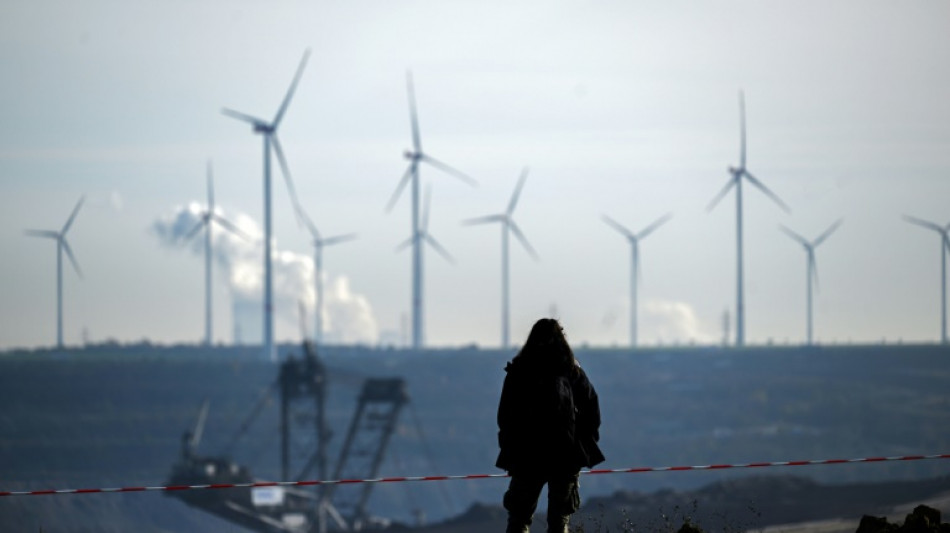
Not nothing, not enough: is the Paris Agreement working? / Photo: INA FASSBENDER - AFP/File

Climate cooperation is facing a reckoning. Ten years after the landmark Paris Agreement, major polluters are wavering on action while the world fast approaches the deal's safer warming limit.
With climate change already causing dangerous extremes across the planet, a United Nations-led system based on consensus and pledges faces tough questions.
Has climate diplomacy done enough so far? And can it survive in an era of fracturing global alliances and economic uncertainty?
The challenge for this year's COP30 UN climate summit in Brazil, and beyond, is taking promises already made and putting them into action.
Instead, US President Donald Trump is yanking the world's second biggest greenhouse gas emitter out of the Paris Agreement for a second time.
The United States and other major producing countries are planning to extract even more coal, oil, and gas, despite a 2023 UN climate agreement to "transition away" from fossil fuels.
The European Union missed a key UN deadline to submit its climate plans, while number-one polluter China low-balled its target.
Former UN climate chief Patricia Espinosa said COP summits were still "absolutely necessary" to unite countries and hold them accountable for their action -- or inaction.
"I don't think there's any other way to address a threat to humanity as big as this is," she told AFP at recent climate talks in Germany.
Though imperfect, she said, the COPs have "delivered a very clear blueprint on what we need to do".
- 'Admit failure' -
The centrepiece of the Paris Agreement, negotiated in 2015, was the commitment to keep average temperature rises "well below" 2C since pre-industrial levels -- and preferably the safer level of 1.5C.
For frontline countries, like Pacific Island nations threatened by rising sea levels, 1.5C is not a number but a matter of "survival", said Tuvalu's climate minister Maina Talia.
"Ten years after the Paris Agreement and we are still trying to lobby," he told AFP, adding that backtracking by polluters was "very disheartening".
The UN says the deal has made a difference. Before Paris, the world was heading to 5C of warming by the end of the century, a trajectory now moderated to a still-catastrophic 3C.
Scientists say the long-term 1.5C limit will be breached in a matter of years. The world experienced its first year above 1.5C in 2024, and witnessed monster fires, floods and heatwaves.
"We must admit failure, failure to protect peoples and nations from unmanageable impacts of human-induced climate change," said Johan Rockstrom, director of the Potsdam Institute for Climate Impact Research, speaking at the UN in New York last month.
"But we don't have to keep failing."
- 'Clear the path' -
The Paris deal was not only about temperatures.
It consecrated a swathe of measures, including climate finance and resilience goals, to help those who are least responsible for warming but often hardest hit.
Observers say it has also pushed climate risk onto the mainstream economic agenda and driven countries to draw up national climate plans.
This year it formed a key part of the International Court of Justice's ruling recognising states' legal climate obligations.
Arguably the most significant development in efforts to curb climate change -- the vertiginous cost reductions of solar and wind power, batteries and electric vehicles -- was seeded long before Paris.
Building on innovations from Europe and America over many decades, China started taking the lead on renewables in the 2000s, likely motivated by its lack of domestic oil and gas supplies, said Kingsmill Bond of clean energy research group Ember.
Now those huge investments are paying off, with a vast domestic rollout amounting to 60 percent of the world's solar capacity added in 2024.
Europe, shaken by energy security fears after Russia's invasion of Ukraine, has also raced to wean itself off its fossil-fuel dependency.
And some developing countries have imported Chinese renewables so fast they have upended ideas of what an energy transition looks like.
Ember has termed this an "electrotech revolution", spurred as much by economic and energy security needs as climate concerns.
Nevertheless, Bond said the Paris deal had successfully focused policymakers' minds on the problems of a warming world.
But he said the UN process should now direct its attention to deploying solutions.
"We now have these new technologies. Let's clear the path," he said.
(Y.Yildiz--BBZ)