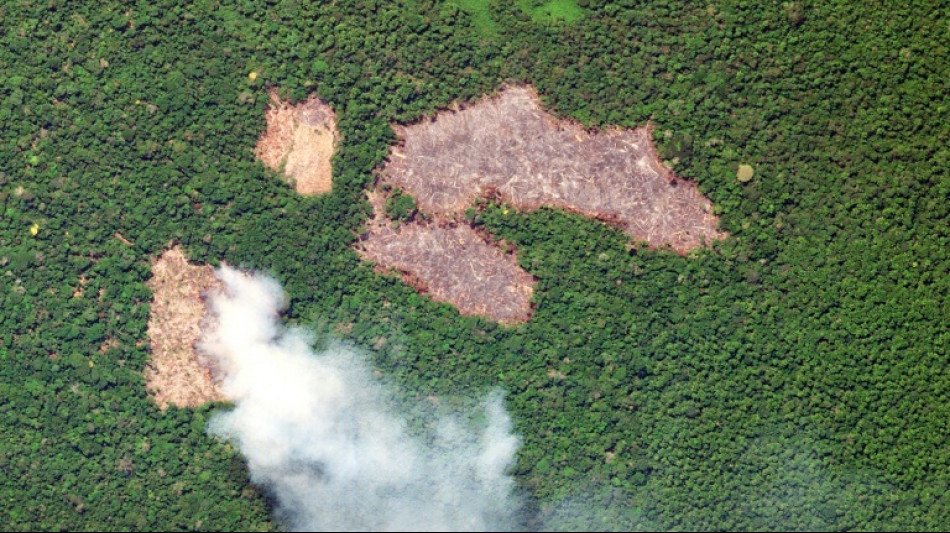
Pay to protect: Brazil pitches new forest fund at COP30 / Photo: Handout - © 2019 Planet Labs, Inc/AFP/File

Tropical countries from Cameroon to Colombia could earn tens of millions of dollars a year under a novel approach to protecting the world's rainforests being launched at the COP30 summit in Brazil.
The inauguration of the Tropical Forests Forever Facility (TFFF) is expected Thursday as global leaders meet in the Brazilian Amazon, where this year's UN climate negotiations are being held.
Brazil is courting $125 billion from governments and private financiers for a global investment fund that proposes making annual payments to developing countries for every hectare of forest they keep standing.
The scheme has attracted some early interest, but investors have been less forthcoming. Here's what to know about Brazil's centrepiece forest initiative at COP30:
- Why is it needed? -
Most of the world's primary rainforest lies in poorer tropical countries where there is simply more money to be made cutting down trees than saving them.
Decades of promises by wealthy countries to bankroll the fight against deforestation have not materialised, said Joao Paulo de Resende, special climate advisor at Brazil's finance ministry.
Despite some improvements at the national level, including in Brazil, deforestation rates remain at record highs globally: the equivalent of 18 football fields of primary forest was lost every minute in 2024.
This is an enormous problem for the planet. Rainforests are rich in biodiversity and help regulate the climate, and destroying them releases vast amounts of stored carbon.
- How does the fund work? -
Enter the forest fund, which proposes creating a reliable, long-term revenue stream to undercut the economic incentive in tropical countries to chop down trees.
It first needs to find $25 billion from "sponsor" governments wanting to burnish their conservation credentials and willing to take the first hit should the fund suffer losses.
By absorbing more risk, Brazil hopes to attract another $100 billion from private investors like pension and sovereign funds whose returns would be more protected.
The combined capital is ploughed into emerging markets to generate profits which, after interest repayments to investors, flow to tropical countries with low deforestation rates as confirmed by satellite.
This approach differs from carbon markets or the traditional "grant and aid model", where donations are given to specific forest conservation projects, said Pakhi Das, who has studied the fund for Plant-for-the-Planet, a non-profit initiative.
"It is profitable for both the tropical forest countries who are receiving these funds... and investors who are going to be paying for conservation," she said.
- Who stands to benefit? -
Brazil expects the fund to generate $4 billion a year for conservation and, according to its latest concept note, has identified 74 forest-rich nations that could split the spoils.
In reality, far fewer would be eligible, at least initially.
Only countries with a low rate of annual deforestation -- below 0.5 percent -- would meet the criteria, and that record must be maintained, year after year, to keep receiving payments.
"I think that's quite straightforward... is deforestation being reduced, or not? And if not -- no payment anymore," World Wildlife Fund (WWF) Brazil's executive director, Mauricio Voivodic, told AFP.
It should also motivate others to up their game, experts told AFP. In many cases, the potential payout is double or triple what national governments or outside donors provide for forest conservation.
Brazil, Indonesia and the Democratic Republic of Congo, at least theoretically, each stand to earn hundreds of millions of dollars a year should they stamp out deforestation entirely.
- Will it work? -
Resende said the fund could still launch without the full $25 billion startup capital in hand -- a good thing considering that so far Brazil is the only country to have committed any money.
"What we do need to get at COP is like a political message that this is the way forward -- let's continue making this happen," he said.
Some diplomats have expressed concerns over the fund's monitoring methods and scepticism that it will receive the high credit rating needed to attract outside investors, let alone such returns on emerging markets.
Observers said it was a difficult time to be asking governments for large contributions to forest conservation, but stressed that the long-term project could garner support over time.
"If successful, this will be operating forever, protecting forests forever... it's much better to do that than keep waiting for another solution that is perfect. There is no silver bullet," said Voivodic.
(H.Schneide--BBZ)