Berliner Boersenzeitung - 'Hectic' bushfires threaten rural towns in Australian heatwave

EUR -
AED 4.208972
AFN 73.34913
ALL 94.723353
AMD 421.974787
ANG 2.051943
AOA 1052.100506
ARS 1662.879862
AUD 1.633057
AWG 2.065807
AZN 1.978188
BAM 1.956541
BBD 2.309234
BDT 140.740843
BGN 1.937883
BHD 0.432188
BIF 3417.034603
BMD 1.146079
BND 1.480067
BOB 7.922931
BRL 5.913075
BSD 1.146514
BTN 108.094993
BWP 15.569964
BYN 3.174316
BYR 22463.148822
BZD 2.305953
CAD 1.620569
CDF 2635.982402
CHF 0.923513
CLF 0.02623
CLP 1032.353653
CNY 7.758154
CNH 7.7801
COP 3947.164915
CRC 519.496734
CUC 1.146079
CUP 30.371094
CVE 110.539495
CZK 24.21281
DJF 203.681339
DKK 7.474578
DOP 66.988435
DZD 152.877533
EGP 57.214216
ERN 17.191185
ETB 181.542388
FJD 2.57438
FKP 0.866335
GBP 0.866304
GEL 3.042833
GGP 0.866335
GHS 12.840022
GIP 0.866335
GMD 83.095899
GNF 10056.843814
GTQ 8.738271
GYD 239.878749
HKD 8.983701
HNL 30.577569
HRK 7.533061
HTG 149.887416
HUF 352.880059
IDR 20401.352662
ILS 3.389644
IMP 0.866335
INR 108.242008
IQD 1501.363518
IRR 1576145.174428
ISK 144.211309
JEP 0.866335
JMD 181.107005
JOD 0.812568
JPY 184.84937
KES 148.30689
KGS 100.224458
KHR 4595.776869
KMF 493.960537
KPW 1031.47152
KRW 1753.283128
KWD 0.353016
KYD 0.955453
KZT 559.764426
LAK 25288.233135
LBP 102631.376141
LKR 382.424825
LRD 208.58626
LSL 18.887737
LTL 3.384074
LVL 0.693252
LYD 7.306198
MAD 10.680023
MDL 20.070688
MGA 4813.532348
MKD 61.632041
MMK 2406.219499
MNT 4102.473907
MOP 9.255865
MRU 45.900542
MUR 54.863033
MVR 17.650441
MWK 1990.739584
MXN 19.87701
MYR 4.735597
MZN 73.245837
NAD 18.887637
NGN 1559.929785
NIO 41.980445
NOK 11.119145
NPR 172.952743
NZD 1.996321
OMR 0.440665
PAB 1.146524
PEN 3.877153
PGK 5.029002
PHP 69.62545
PKR 319.010697
PLN 4.260726
PYG 6982.613861
QAR 4.174591
RON 5.239069
RSD 117.378035
RUB 84.353628
RWF 1677.286648
SAR 4.300311
SBD 9.235444
SCR 15.640758
SDG 688.219677
SEK 10.975193
SGD 1.48023
SHP 0.855664
SLE 28.365606
SLL 24032.708241
SOS 654.985307
SRD 42.827769
STD 23721.521821
STN 24.583395
SVC 10.032887
SYP 126.678518
SZL 18.898513
THB 37.636661
TJS 10.640037
TMT 4.011277
TND 3.372337
TOP 2.759484
TRY 53.229627
TTD 7.785949
TWD 36.245092
TZS 3009.085442
UAH 51.527989
UGX 4184.548182
USD 1.146079
UYU 46.07745
UZS 13237.212413
VES 695.248966
VND 30176.260636
VUV 135.976896
WST 3.153785
XAF 656.199778
XAG 0.017601
XAU 0.000275
XCD 3.097336
XCG 2.066365
XDR 0.806493
XOF 652.688901
XPF 119.331742
YER 271.764039
ZAR 18.887164
ZMK 10316.082823
ZMW 20.508588
ZWL 369.036977
  • CMSD

    0.0000

    22.29

    0%

  • JRI

    0.0500

    12.67

    +0.39%

  • CMSC

    0.0500

    22.37

    +0.22%

  • NGG

    -1.2400

    79.44

    -1.56%

  • BCC

    3.8500

    74.66

    +5.16%

  • RBGPF

    -0.5300

    60.61

    -0.87%

  • RELX

    -0.8300

    31.18

    -2.66%

  • RYCEF

    -0.0300

    18.4

    -0.16%

  • BCE

    0.0000

    23.28

    0%

  • RIO

    -2.5900

    100.08

    -2.59%

  • VOD

    -0.2300

    14.3

    -1.61%

  • BTI

    -0.5800

    58.91

    -0.98%

  • GSK

    -1.4800

    50.67

    -2.92%

  • BP

    -1.0400

    39.1

    -2.66%

  • AZN

    -2.9600

    174.93

    -1.69%

'Hectic' bushfires threaten rural towns in Australian heatwave

'Hectic' bushfires threaten rural towns in Australian heatwave

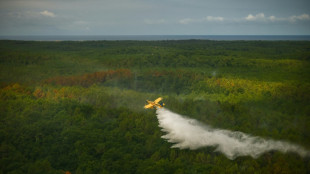
Bushfires threatened dozens of rural towns in southeast Australia on Friday, firefighters said as hot winds fanned "hectic" conditions in the tinder-dry countryside.

Text size:

Temperatures are forecast to soar past 40C as a heatwave blankets the region, creating some of the most dangerous bushfire weather since the "Black Summer" blazes of 2019-2020.

Dozens of rural hamlets in the state of Victoria were urged to evacuate while they still could.

"If you don't leave now, it could result in your life being lost," Emergency Management Commissioner Tim Wiebusch told reporters.

Powerful wind gusts of over 100 kilometres (60 miles) per hour would temporarily ground firefighting aircraft trying to contain some 30 different blazes, Wiebusch said.

Country Fire Authority boss Jason Heffernan said the fire danger was "catastrophic" -- the most severe rating possible.

"Victorians should brace themselves for more property loss or worse.

"Today is going to be quite a hectic and volatile day for firefighters, fire authorities and communities."

Police said three people including a child were missing inside one of the state's worst fire grounds.

One of the most destructive bushfires has already razed some 28,000 hectares (70,000 acres) near the town of Longwood, about 150 kilometres (90 miles) north of Victoria's capital Melbourne.

"Some properties have lost everything," said local fire captain George Noye.

"They've lost their livelihoods, they've lost their shearing sheds, livestock, just absolutely devastating," he told national broadcaster ABC.

"But thankfully, at the moment, no lives have been lost."

The worst bushfires have so far hit sparsely populated rural areas where towns might number a few hundred people at the most.

- 'Black Summer' -

Photos taken this week showed the night sky glowing orange as the fire near Longwood ripped through bushland.

"There were embers falling everywhere. It was terrifying," cattle farmer Scott Purcell told the ABC.

Another bushfire near the small town of Walwa crackled with lightning as it radiated enough heat to form a localised thunder storm, fire authorities said.

"Today represents one of the most dangerous fire days that this state has experienced in years," said state premier Jacinta Allan.

Allan urged people to flee rather than stay put and try to save their homes.

"You will simply not win against the fires of these magnitudes that are created on days like today."

Millions of people across Australia's two most populous states -- Victoria and New South Wales -- will swelter through the heatwave, including in major cities Sydney and Melbourne.

Hundreds of baby bats died earlier this week as stifling temperatures hit the state of South Australia, a local wildlife group said.

The "Black Summer" bushfires raged across Australia's eastern seaboard from late 2019 to early 2020, razing millions of hectares, destroying thousands of homes and blanketing cities in noxious smoke.

Australia's climate has warmed by an average of 1.51C since 1910, researchers have found, fuelling increasingly frequent extreme weather patterns over both land and sea.

Australia remains one of the world's largest producers and exporters of gas and coal, two key fossil fuels blamed for global heating.

(F.Schuster--BBZ)