Berliner Boersenzeitung - Climate change-fuelled storm decimated world's rarest great ape: study

EUR -
AED 4.228093
AFN 74.824423
ALL 93.226638
AMD 421.295497
AOA 1056.750053
ARS 1719.783145
AUD 1.644777
AWG 2.072059
AZN 1.954867
BAM 1.953753
BBD 2.31814
BDT 142.119343
BHD 0.434017
BIF 3405.124673
BMD 1.151144
BND 1.476057
BOB 14.012343
BRL 5.865765
BSD 1.150924
BTN 109.673926
BWP 15.653712
BYN 3.364455
BYR 22562.416614
BZD 2.314813
CAD 1.616304
CDF 2618.852233
CHF 0.933301
CLF 0.02702
CLP 1066.914398
CNY 7.771716
CNH 7.778399
COP 3730.23513
CRC 522.818071
CUC 1.151144
CUP 30.505308
CVE 110.140493
CZK 24.213129
DJF 204.950986
DKK 7.475493
DOP 66.765975
DZD 153.104429
EGP 57.696125
ERN 17.267156
ETB 185.767622
FJD 2.553119
FKP 0.853856
GBP 0.856825
GEL 3.010237
GGP 0.853856
GHS 13.479919
GIP 0.853856
GMD 84.603481
GNF 10106.575156
GTQ 8.781264
GYD 241.170515
HKD 9.027603
HNL 30.849796
HRK 7.532745
HTG 150.482504
HUF 364.513686
IDR 20690.65695
ILS 3.503661
IMP 0.853856
INR 109.668137
IQD 1507.728353
IRR 1582966.487118
ISK 142.017091
JEP 0.853856
JMD 182.318652
JOD 0.816153
JPY 180.375011
KES 149.016002
KGS 100.668118
KHR 4650.863699
KMF 491.538751
KRW 1645.669283
KWD 0.356198
KYD 0.959141
KZT 545.964678
LAK 26031.251717
LBP 103070.628234
LKR 386.433233
LRD 207.750565
LSL 18.981655
LTL 3.399028
LVL 0.696315
LYD 7.335898
MAD 10.731548
MDL 20.095807
MGA 4902.585703
MKD 61.452134
MMK 2417.037031
MNT 4136.667777
MOP 9.296933
MRU 46.095893
MUR 54.034696
MVR 17.796958
MWK 1995.72662
MXN 19.936307
MYR 4.714741
MZN 73.569574
NAD 18.981655
NGN 1569.077604
NIO 42.352124
NOK 10.98318
NPR 175.479443
NZD 1.96175
OMR 0.442596
PAB 1.150914
PEN 3.887206
PGK 5.07939
PHP 70.096015
PKR 319.591151
PLN 4.308978
PYG 6865.388212
QAR 4.195748
RON 5.247141
RSD 117.384436
RUB 92.258613
RWF 1687.835995
SAR 4.308189
SBD 9.302513
SCR 15.481419
SDG 690.686581
SEK 11.000882
SGD 1.476509
SLE 28.43061
SOS 657.770717
SRD 43.520133
STD 23826.35054
STN 24.472866
SVC 10.070616
SZL 18.984951
THB 38.483442
TJS 10.628923
TMT 4.040514
TND 3.377355
TRY 54.718698
TTD 7.804313
TWD 37.363845
TZS 3045.080179
UAH 51.627784
UGX 4307.243185
USD 1.151144
UYU 46.28888
UZS 13799.700007
VES 858.40372
VND 30260.114568
VUV 137.043837
WST 3.147792
XAF 655.233376
XAG 0.020079
XAU 0.000285
XCD 3.111023
XCG 2.0743
XDR 0.813664
XOF 655.233376
XPF 119.331742
YER 274.321302
ZAR 19.010281
ZMK 10361.675417
ZMW 21.629831
ZWL 370.667803
  • RBGPF

    -3.2100

    66

    -4.86%

  • RYCEF

    0.8000

    20.3

    +3.94%

  • CMSC

    -0.0300

    21.81

    -0.14%

  • BCC

    4.4700

    80.85

    +5.53%

  • RELX

    0.5850

    36.005

    +1.62%

  • JRI

    -0.1300

    12.83

    -1.01%

  • BCE

    0.0200

    21.7

    +0.09%

  • GSK

    -0.4800

    51.21

    -0.94%

  • CMSD

    -0.0300

    22.08

    -0.14%

  • VOD

    -0.2000

    15.58

    -1.28%

  • AZN

    -12.6900

    156.95

    -8.09%

  • BP

    -0.8500

    44.37

    -1.92%

  • BTI

    -0.8700

    59.78

    -1.46%

  • RIO

    -1.5300

    95.32

    -1.61%

  • NGG

    -0.4550

    79.515

    -0.57%

Climate change-fuelled storm decimated world's rarest great ape: study
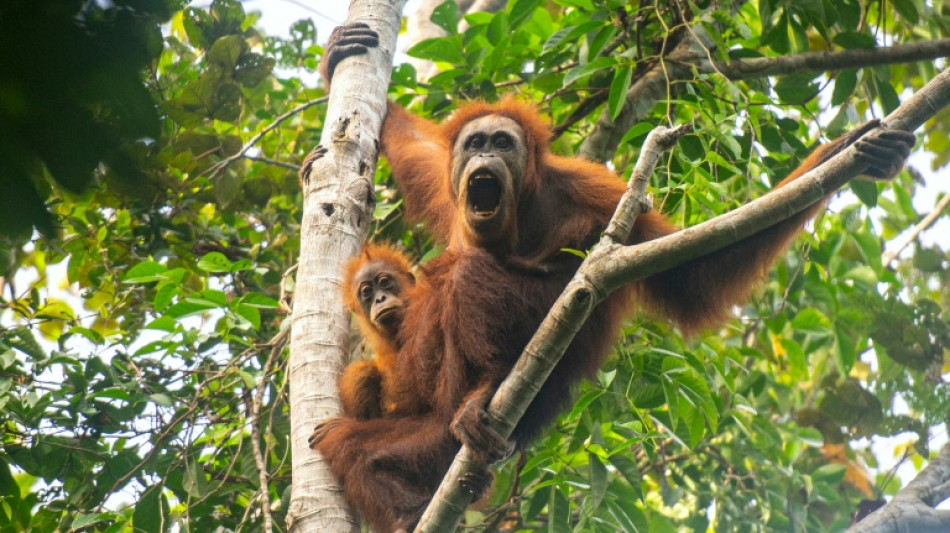
Climate change-fuelled storm decimated world's rarest great ape: study / Photo: Handout - Orangutan Information Centre/AFP

Climate change-fuelled storm decimated world's rarest great ape: study

Climate change-fuelled landslides wiped out nearly one in ten of the world's rarest great ape species on Indonesia's Sumatra island, scientists said Wednesday.

Text size:

A single weather event last November pushed the Tapanuli orangutan -- of which there are fewer than 800 left in the wild -- even closer to extinction, according to a study published in the science journal Current Biology.

An estimated 58 Tapanuli orangutans died as a result of mudslides triggered by heavy rains during Cyclone Senyar -- about 11 percent of the total living in the region, or seven percent of the estimated overall wild population.

The flooding killed more than 1,000 people.

Only scientifically classified as a species in 2017, Tpanulis are incredibly rare, confined to a small range in Sumatra.

"This level of loss is substantial for a species with such a small total population," said Erik Meijaard, chief scientist at Borneo Futures, a conservation initiative.

The floods also wiped out sources of Tapanuli food and shelter.

Scientists analyzed satellite evidence of landslide scars in the Batang Toru Ecosystem -- home to the largest remaining population of the apes.

They found that about 8,300 hectares of forest -- more than 11 percent of the area -- were affected.

The lost forest area was overlaid with orangutan density maps to come up with an estimate of population loss.

"The loss of an estimated 58 Tapanuli orangutans to a single climate-induced landslide event is a devastating demographic shock to the world's rarest great ape," said researcher Jatna Supriatna of Indonesia University.

Environmentalists have long campaigned against industrial activity in Batang Toru, particularly a hydroelectric dam and gold mine.

The highland homes inhabited by Tapanulis are not their preferred habitat, but it is where remaining orangutans have been pushed by human development elsewhere.

"To prevent the first modern extinction of a great ape species, Indonesia must permanently protect the Batang Toru ecosystem," Jatna said.

"But our international partners must also meet their global commitments by providing immediate biodiversity-recovery financing."

Sumatra lost 4.4 million hectares of forest -- an area larger than Switzerland -- between 2001 and 2024, making hilly landscapes more vulnerable to landslides, the conservation group Mighty Earth said in February.

(G.Gruner--BBZ)