Berliner Boersenzeitung - Floating igloo leaves France for polar exploration mission

EUR -
AED 4.199251
AFN 75.466241
ALL 93.805915
AMD 417.374456
ANG 2.047038
AOA 1049.671052
ARS 1690.585748
AUD 1.634186
AWG 2.058178
AZN 1.942751
BAM 1.954744
BBD 2.301645
BDT 140.783922
BGN 1.963854
BHD 0.430925
BIF 3399.040026
BMD 1.143432
BND 1.475461
BOB 7.916933
BRL 5.845231
BSD 1.142772
BTN 109.90361
BWP 15.560981
BYN 3.304614
BYR 22411.26925
BZD 2.296859
CAD 1.603492
CDF 2584.156943
CHF 0.923156
CLF 0.027142
CLP 1068.21691
CNY 7.744751
CNH 7.739166
COP 3739.30884
CRC 518.630437
CUC 1.143432
CUP 30.300951
CVE 110.205446
CZK 24.202569
DJF 203.492832
DKK 7.475768
DOP 66.97393
DZD 152.143885
EGP 58.542013
ERN 17.151482
ETB 184.445431
FJD 2.539901
FKP 0.850039
GBP 0.849284
GEL 3.001519
GGP 0.850039
GHS 13.178878
GIP 0.850039
GMD 84.613938
GNF 10022.412881
GTQ 8.713291
GYD 238.930885
HKD 8.965771
HNL 30.60393
HRK 7.530872
HTG 149.356153
HUF 361.221632
IDR 20509.74166
ILS 3.483181
IMP 0.850039
INR 110.240805
IQD 1496.091532
IRR 1572219.144248
ISK 143.409514
JEP 0.850039
JMD 181.021415
JOD 0.810664
JPY 185.690513
KES 147.864725
KGS 99.993408
KHR 4620.190332
KMF 490.532598
KPW 1029.088972
KRW 1694.297683
KWD 0.3538
KYD 0.951686
KZT 539.768316
LAK 25770.074196
LBP 102271.233993
LKR 383.792604
LRD 206.708298
LSL 18.847215
LTL 3.376258
LVL 0.691651
LYD 7.29546
MAD 10.655442
MDL 20.083147
MGA 4863.306679
MKD 61.589598
MMK 2401.439274
MNT 4099.663603
MOP 9.222916
MRU 45.549673
MUR 53.890252
MVR 17.677347
MWK 1981.524955
MXN 20.015373
MYR 4.679269
MZN 73.077117
NAD 18.847215
NGN 1577.741658
NIO 42.051732
NOK 11.03866
NPR 175.951326
NZD 1.954102
OMR 0.439641
PAB 1.142083
PEN 3.874007
PGK 5.10721
PHP 70.501164
PKR 317.740837
PLN 4.335946
PYG 6926.43678
QAR 4.174544
RON 5.241952
RSD 117.341316
RUB 89.527222
RWF 1682.706111
SAR 4.29604
SBD 9.229054
SCR 15.976943
SDG 686.626939
SEK 11.044777
SGD 1.475596
SHP 0.853688
SLE 27.871189
SLL 23977.207916
SOS 653.041181
SRD 43.005606
STD 23666.735985
STN 24.501009
SVC 9.9926
SYP 126.385949
SZL 18.844188
THB 38.461057
TJS 10.552598
TMT 4.013447
TND 3.372278
TOP 2.75311
TRY 53.949639
TTD 7.755809
TWD 36.926571
TZS 3012.946993
UAH 51.044819
UGX 4219.71972
USD 1.143432
UYU 45.905193
UZS 13716.587739
VES 828.805102
VND 30066.54719
VUV 135.501027
WST 3.136108
XAF 655.998367
XAG 0.020143
XAU 0.000285
XCD 3.090182
XCG 2.058288
XDR 0.815851
XOF 655.998367
XPF 119.331742
YER 272.824236
ZAR 18.845236
ZMK 10292.258646
ZMW 20.813753
ZWL 368.184671
  • NGG

    1.4800

    83.99

    +1.76%

  • BCE

    -0.3000

    21.84

    -1.37%

  • GSK

    -1.0100

    51.76

    -1.95%

  • RBGPF

    0.0000

    67.35

    0%

  • CMSD

    -0.0500

    22.26

    -0.22%

  • BCC

    -2.9500

    77.19

    -3.82%

  • CMSC

    -0.0700

    22.03

    -0.32%

  • RIO

    -0.5200

    90.15

    -0.58%

  • RELX

    -0.3200

    33.7

    -0.95%

  • BTI

    -0.3200

    62.84

    -0.51%

  • RYCEF

    -0.7700

    17.9

    -4.3%

  • AZN

    -0.3900

    168.9

    -0.23%

  • VOD

    0.1200

    15.74

    +0.76%

  • JRI

    -0.0600

    12.94

    -0.46%

  • BP

    0.8200

    41.9

    +1.96%

Floating igloo leaves France for polar exploration mission
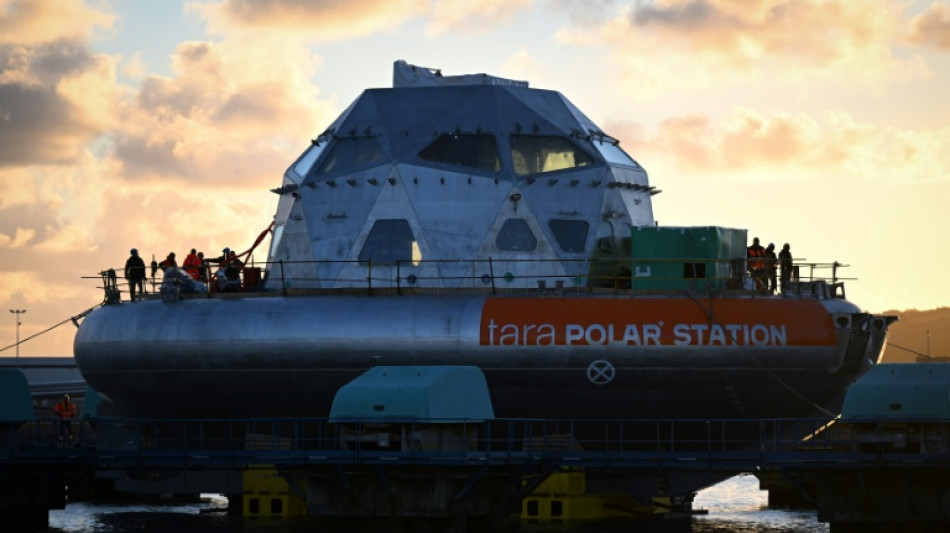
Floating igloo leaves France for polar exploration mission / Photo: LOU BENOIST - AFP/File

Floating igloo leaves France for polar exploration mission

A floating research station resembling a giant aluminium igloo on Sunday set out from France to begin a long-term mission in the Arctic that will see it drift with the polar ice in the most hostile of environments.

Text size:

The Tara Polar Station's specific shape enables it to withstand ice pressure and drift for months on end in a controlled fashion with the pack ice to explore biodiversity and the impact of climate change.

While the vessel was built in France, some 30 research centres from 12 countries -- including Germany, Canada, Spain, the US, Switzerland, and Japan -- are participating in the expedition.

"The Arctic is an ocean that has been little studied and is already changing significantly. It is undergoing a major transformation," said Romain Trouble, executive director of the Tara Ocean Foundation.

"You cannot understand the environment if you only spend two months a year there," he added.

The vessel sailed from France's western port of Lorient with French Minister for the Sea Catherine Chabaud in attendance and hundreds of people cheering on the quayside.

The floating laboratory -- shaped like an igloo perched on a large buoy -- is designed to withstand sea-ice pressure and endure temperatures as low as -52C.

Starting in mid-August, the station will travel eastward along the Russian coast, with an icebreaker clearing the way. Trapped in the pack ice by early September, the station is expected to drift at an average speed of 10 kilometres per day, eventually reaching the Fram Strait -- located between Greenland and Svalbard -- by the end of 2027.

Ten such expeditions are planned between 2026 and 2045, taking place every two years.

The vessel will carry 12 people during the winter, including six scientists, and 18 in the summer.

- 'Lose entire chapter of evolution' -

The international crew was carefully selected following medical and psychological aptitude tests and team-building.

"We weren't looking for adventurers who want to head to the North Pole alone. The idea is rather to have people who get along well to experience this confined human environment together," said Clementine Moulin, the expedition director.

Those staying through the winter will have to contend with five months of not just total darkness, claustrophobia and extreme cold, but also the presence of polar bears.

"Bears are a serious matter," said Eric Pelletier, a 58-year-old genomics researcher and crew member. "It's not a simple thing -- the bear is on its home turf and it's used to hunting and hides behind blocks of ice."

Every crew member has received firearms training to deal with potential attacks while a specially trained dog will accompany the crew to help spot approaching animals.

Using an opening in the hull and a wide array of onboard instruments, scientists will collect over 10,000 samples from the water, the atmosphere, and sea ice.

"There is biodiversity at the North Pole that is uniquely adapted to this environment. If the environment changes, that biodiversity might disappear," said Trouble.

"We could potentially lose an entire chapter of the evolution of life on this planet without even having had time to document it," he warned.

(T.Burkhard--BBZ)