Lexus ES Review: Electric ES 350e Falls Short in Luxury Saloon Segment

The Lexus ES has entered the Irish market with two powertrain options: a hybrid 300h and an electric 350e. While the vehicle offers excellent interior fit and finish, the electric variant faces criticism for underwhelming performance and ride refinement compared to European rivals. CompleteCar.ie provides a full assessment of its pricing, specifications, and driving dynamics.
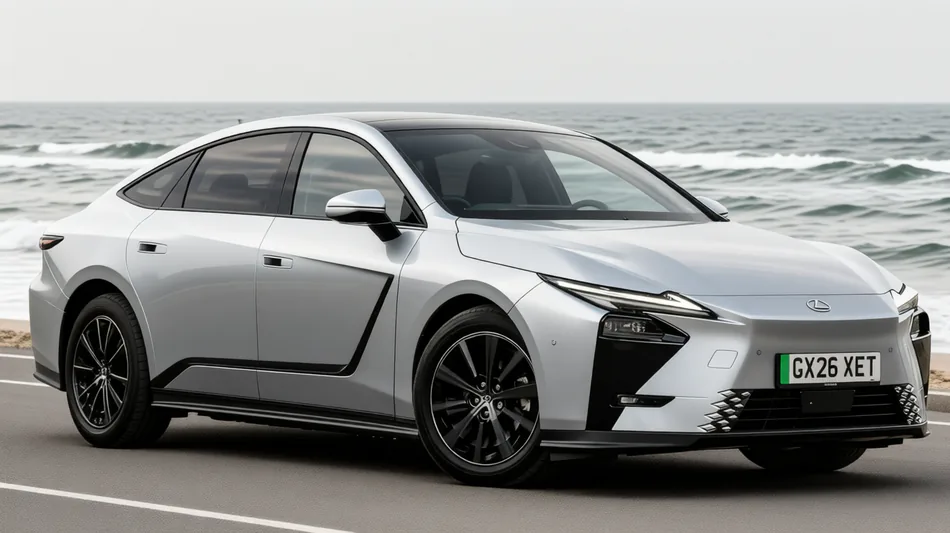
The Lexus ES has arrived in the Irish market as a four-door saloon that challenges traditional automotive proportions. Officially classified as a saloon, its profile features a continuous roofline sweep that creates a coupe-like silhouette, eliminating the conventional three-box design. The front end is defined by "double-L" light clusters where daytime running lights form an L-shaped motif and indicators are positioned below in an inverted arrangement.
The vehicle is available in six metallic colors: F White, Sonic Titanium, Sonic Grey, Sonic Platinum, Skylight Blue, and Graphite Black. Each color option costs €1,605. All Irish-specification models come with a single alloy-wheel design: 19-inch rims optimized for aerodynamics. The hybrid ES 300h and the electric ES 350e appear nearly identical externally, distinguished only by an additional engine-cooling slot on the nose of the hybrid.
Inside, Lexus maintains its reputation for high-quality materials and solid construction. The dashboard incorporates "shy technology," where hidden buttons illuminate only when the car is switched on. The primary interface consists of a 14-inch central display and a 12.3-inch digital instrument cluster with angled corners to prevent obstruction by the steering wheel. While the displays are clear and responsive, many climate-control functions must be accessed through the touchscreen. A few shortcuts are provided by hidden switches on the fascia, but advanced driver-assistance system controls, such as the driver-monitoring system, are difficult to locate within the menu structure.
The ES offers generous interior space, supported by a 2,950mm wheelbase. However, the floor-mounted battery in the electric model pushes the seats closer to the roof lining. Taller occupants may find their heads too close to the ceiling, even with the driver’s seat at its lowest setting. The view through the rear screen is also limited regardless of seating height. Despite these constraints, the cabin includes useful storage features: two front cupholders, an under-dashboard area, door pockets with bottle recesses, and a central cubby with USB-C, HDMI, and 12-volt sockets beneath a dual-hinged armrest. The glovebox is notably small.
Rear passengers benefit from ample legroom, but the bench sits high above the floor. This leaves taller occupants with their heads near the roof and thighs angled upward without adequate cushion support. A pronounced central floor hump forces middle-seat passengers to place their feet on either side. While Lexus offers reclining ottoman-style rear seats in other markets, this feature is not available in Ireland as it is tied to the Takumi specification. Rear amenities include door bins with bottle holders, a fold-down armrest with pop-out cupholders, a rubberized device tray, map pockets, two USB-C ports, air vents, and retractable window blinds.
Loading child seats is straightforward due to large rear doors and generous legroom. Two ISOFIX positions are located in the outer rear seats. The ES lacks a front trunk (frunk) even in the electric version. Instead, it features a 512-liter rear boot with a ski hatch. The back seats do not fold, limiting cargo versatility. The cargo area includes four lashing eyes and a small underfloor storage compartment, mostly occupied by a tire-repair kit.
The Lexus Safety System+ provides an extensive roster of active safety features. These include front cross-traffic alert, pre-collision systems with pedestrian and cyclist detection, front motorcyclist detection (daytime only), dynamic radar cruise control, lane tracing assist, blind spot monitoring, rear cross-traffic alert and braking, speed limiter with road sign assist, rear pedestrian detection, intersection turning assist, emergency steering assist, safe exit assist, lane change assist, proactive driving assist, a driver-monitoring system, emergency driving stop system, automatic high beams, active brake lights, and automatic rear-flashing hazard lights. Euro NCAP has not yet assessed the Lexus ES.
The ES range offers two powertrains: a petrol-electric hybrid and a fully electric model. Both are front-wheel drive with automatic transmissions.
The ES 300h hybrid uses a 2.5-liter four-cylinder petrol engine paired with an electric motor. This is a development of the previous generation’s powertrain, with maximum power output reduced slightly to 196hp. The electric motor provides up to 270Nm of torque. Lexus states the 1,850kg car accelerates from 0-100km/h in 8.0 seconds.
The ES 350e electric model uses a front-mounted motor derived from the Toyota bZ4X. It produces 224hp and 269Nm. Despite weighing nearly 400kg more than the hybrid at 2,245kg, it achieves the same official 0-100km/h time of 8.0 seconds.
In driving tests, the ES 350e initially presents a positive impression with smooth, serene movement that suits Lexus’s emphasis on relaxed driving. However, ride and refinement deteriorate on poorer surfaces. On smooth tarmac below 80km/h, the car is subdued and comfortable. On rougher roads, the suspension struggles to remain composed over medium-sized depressions, causing thumping even on the 19-inch wheels. Coarse motorway surfaces generate significant tire noise, and wind noise around the panoramic roof becomes noticeable above 80km/h. The body can float and wobble on uneven back roads as the suspension attempts to handle high-frequency undulations.
Handling is secure but not engaging. Body lean is present without being excessive, and steering is accurate and quick, though light with limited feedback. The front-wheel-drive chassis offers mechanical grip but lacks the adjustability of rear-wheel-drive rivals. Performance is a primary concern; the motor feels underpowered in the heavy ES 350e. Acceleration from 50-100km/h takes time, and the modest 269Nm output is evident during overtaking and merging from slip roads. The car requires stronger performance, better body control, and improved rolling refinement to compete effectively in the luxury electric segment.
The ES 350e uses a 400-volt architecture with an NMC lithium-ion battery offering 77kWh gross and 72kWh usable capacity. Every electric ES sold in Ireland has 19-inch wheels, resulting in an official range of up to 581km. In tests conducted at 28 degrees Celsius with continuous climate control and ventilated seats, the car achieved 15.9kWh/100km over an 85km route. This suggests a real-world range of approximately 450km.
DC charging speed is limited to 150kW, lower than rivals such as the Mercedes EQE (170kW), BMW i5 (205kW), Audi A6 e-tron (225-270kW), and Volvo ES90 (up to 350kW). Lexus quotes 28 minutes for a 10-80% charge. An optional 22kW AC charger allows a 10-100% charge in four hours. On 11kW three-phase AC, charging takes about eight hours, and over 10 hours on a typical 7.4kW domestic wallbox.
Maintenance is recommended annually or every 16,000km for both models. The standard warranty covers all vehicles for three years or 100,000km. Hybrid models receive a five-year or 100,000km battery warranty, extendable by 12 months or 15,000km annually if the battery health check passes, potentially reaching 15 years or 1,000,000km. The electric model’s motor, battery, inverter, and converter are covered for five years or 100,000km, with a guarantee that the battery retains at least 70% capacity for eight years or 160,000km.
In Ireland, all ES models are sold in one Dynamic specification. The ES 300h Dynamic is priced just under €70,000. It can be upgraded with a €5,110 Tech Pack, bringing the total to €74,440. This pack adds a 360-degree camera, smart digital key, head-up display, digital rear-view mirror, advanced parking assistance, and a 17-speaker Mark Levinson sound system. The electric ES 350e costs almost €2,200 more than the hybrid base model.
Competitors include the BMW i5, starting at €83,415. Even the entry-level eDrive40 produces 340hp and 400Nm, offering stronger performance, better driving dynamics, over 600km of range, and faster charging. The Audi A6 e-tron starts from €74,330, and the Volvo ES90 from €79,995. The Volvo offers 664km of range, 333hp, 480Nm, and a 0-100km/h time of 6.6 seconds.
While the Lexus ES offers understated styling, excellent interior quality, and generous technology for its price, it feels underdeveloped compared to its strongest rivals. The electric version lacks the sophistication, performance, and refinement expected in this competitive sector. No official towing rating is provided for either model. A dual-motor ES 500e is available in other markets but has not been confirmed for Ireland.
(F.Schuster--BBZ)