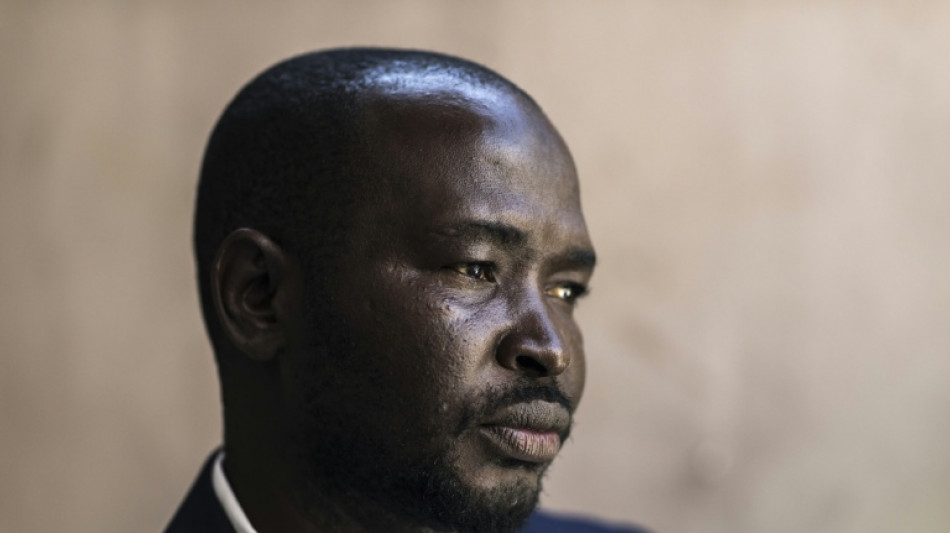
Disappearances multiply in strongman Doumbouya's Guinea / Photo: PATRICK MEINHARDT - AFP

More than a year after his abduction in Guinea by men in fatigues, Abdoul Sacko is still grappling with the physical and psychological scars of the torture he endured.
Now in exile, the activist is one of the rare critics of the country's authoritarian government to have been released after kidnapping.
Since General Mamady Doumbouya seized power in the west African nation in a 2021 coup, abductions of opposition figures and their families have become systemic, with enforced disappearances now on the rise.
"I was roughed up, slapped and had a gun pointed to my head," Sacko told AFP in a rare interview from Dakar, where he lives part-time.
After being kidnapped from his home in front of his family one night in February 2025, the activist said he was tortured in several locations in the capital Conakry, which he is not able to locate due to having been constantly hooded.
His captors subjected him to waterboarding while demanding whether he planned to stage a coup.
They also asked him why he liked "to criticise and talk about corruption so much", said Sacko, who is a representative with the Forum of Social Forces of Guinea citizen movement.
A few hours later they released him in the bush about 60 kilometres (40 miles) from Conakry, where he was found in a critical condition.
His release is a rare exception under Doumbouya's rule.
- 'Where are they?' -
"From 2023 until today, we have counted somewhere around 20 people who are victims of forced disappearances," said Alseny Farinta Camara of the civil society organisation Turn the Page.
The activist himself escaped an attempted kidnapping in August 2024.
Gendarmes came to his home while he was running errands. Warned by neighbours, he immediately fled abroad and never returned.
Now in Senegal, he continues to document human rights violations in Guinea.
"We are witnessing arbitrary arrests, torture, kidnappings and disappearances," he told AFP in an interview.
Guinea's authorities have always denied knowledge of the disappearances and the few investigations that have been announced have come to nought, much to the dismay of human rights groups.
A prime example is the disappearance of activists Oumar Sylla, better known as Fonike Mengue, and Mamadou Billo Bah, who have been missing since July 2024.
"Where are they? They are in the hands of the state. Are they alive? Only the state can answer that," Sacko said, exasperated.
Having seized power by force in 2021, Doumbouya helped legitimise his rule in the eyes of international partners by holding a presidential election in December, although with no significant opponent in the race.
Since his election, no country or international institution has come out against Guinea's human rights record.
Guinea has meanwhile rejoined the Economic Community of West African States (ECOWAS) as well as the African Union (AU), which had excluded it after the coup.
- 'Total silence' -
By participating in an AU summit in Addis Ababa in February the Guinean leader formalised his return to the international community's good graces.
"Mamady Doumbouya has joined the club of 'good' coup leaders who played by the rules, who organised elections and who are now legitimate heads of state in the eyes of the international community," said Franklin Nossiter, an analyst with the International Crisis Group (ICG) think tank.
Camara, from Turn the Page, added that countries that valued democracy were nonetheless "now more concerned with doing business with the military regime".
Normalisation of the regime has not stopped disappearances: last week, the 84-year-old mother and sister of an exiled opposition figure were abducted from their home, only to be returned Monday.
Family members of those critical of the regime are now targets for abduction since many opposition figures live in exile.
Late last year four relatives, including two children, of exiled singer Elie Kamano were kidnapped, as was journalist Mamoudou Babila Keita's father, who was in his 70s. None have been seen since.
Under the dictatorship of Sekou Toure from 1958 to 1984, tens of thousands of political and regular prisoners were reportedly tortured and killed in an infamous concentration camp, Camp Boiro.
But for Sacko, the phenomenon is now worse.
"Never in Guinea's history have we seen the situation where men disappear in the state's total silence, without the state taking responsibility."
(P.Werner--BBZ)