Berliner Boersenzeitung - Eurovision final: how it works

EUR -
AED 4.256956
AFN 73.025715
ALL 95.949476
AMD 436.297619
ANG 2.074964
AOA 1062.93451
ARS 1612.94327
AUD 1.652435
AWG 2.089356
AZN 1.967595
BAM 1.955789
BBD 2.330587
BDT 141.989225
BGN 1.981335
BHD 0.437098
BIF 3425.18131
BMD 1.159144
BND 1.479892
BOB 7.995956
BRL 6.158991
BSD 1.157194
BTN 108.18041
BWP 15.778914
BYN 3.510781
BYR 22719.216032
BZD 2.327287
CAD 1.590438
CDF 2637.051746
CHF 0.913915
CLF 0.027244
CLP 1075.743011
CNY 7.982325
CNH 8.005156
COP 4253.376791
CRC 540.497051
CUC 1.159144
CUP 30.717307
CVE 110.264398
CZK 24.533102
DJF 206.058876
DKK 7.485174
DOP 68.689625
DZD 153.294405
EGP 59.995673
ERN 17.387155
ETB 182.369105
FJD 2.566866
FKP 0.868886
GBP 0.868988
GEL 3.147122
GGP 0.868886
GHS 12.613931
GIP 0.868886
GMD 85.195634
GNF 10142.944655
GTQ 8.863952
GYD 242.098679
HKD 9.082181
HNL 30.628833
HRK 7.547526
HTG 151.809172
HUF 393.825438
IDR 19654.671984
ILS 3.603923
IMP 0.868886
INR 108.971735
IQD 1515.891728
IRR 1524998.397107
ISK 144.047075
JEP 0.868886
JMD 181.799008
JOD 0.821884
JPY 184.582318
KES 149.909182
KGS 101.364683
KHR 4623.974769
KMF 494.9542
KPW 1043.263627
KRW 1744.871088
KWD 0.355359
KYD 0.964295
KZT 556.326964
LAK 24848.864411
LBP 103633.234522
LKR 360.97803
LRD 211.758845
LSL 19.520593
LTL 3.42265
LVL 0.701154
LYD 7.40796
MAD 10.813041
MDL 20.15189
MGA 4824.973672
MKD 61.639664
MMK 2432.829233
MNT 4136.032637
MOP 9.340449
MRU 46.320747
MUR 53.912042
MVR 17.920267
MWK 2006.589051
MXN 20.785187
MYR 4.565818
MZN 74.068653
NAD 19.520593
NGN 1572.088888
NIO 42.579768
NOK 11.082828
NPR 173.089056
NZD 1.98507
OMR 0.445687
PAB 1.157194
PEN 4.000678
PGK 4.994973
PHP 69.722594
PKR 323.078037
PLN 4.286287
PYG 7557.95876
QAR 4.231477
RON 5.101971
RSD 117.449359
RUB 96.003076
RWF 1683.690813
SAR 4.352186
SBD 9.333031
SCR 15.877613
SDG 696.645486
SEK 10.817726
SGD 1.4866
SHP 0.869658
SLE 28.485998
SLL 24306.675843
SOS 661.296392
SRD 43.453394
STD 23991.933773
STN 24.499866
SVC 10.124945
SYP 128.330276
SZL 19.526893
THB 38.14515
TJS 11.114439
TMT 4.068594
TND 3.417581
TOP 2.790939
TRY 51.295008
TTD 7.850957
TWD 37.135139
TZS 3008.583584
UAH 50.692923
UGX 4373.976133
USD 1.159144
UYU 46.629746
UZS 14107.92302
VES 527.051768
VND 30499.388379
VUV 137.76417
WST 3.161925
XAF 655.953421
XAG 0.017051
XAU 0.000258
XCD 3.132643
XCG 2.085489
XDR 0.815796
XOF 655.953421
XPF 119.331742
YER 276.574852
ZAR 19.764849
ZMK 10433.68695
ZMW 22.593877
ZWL 373.24379
  • RBGPF

    -13.5000

    69

    -19.57%

  • BCC

    -1.5600

    68.3

    -2.28%

  • RELX

    -0.4600

    33.36

    -1.38%

  • RYCEF

    -1.2600

    15.34

    -8.21%

  • CMSD

    -0.2420

    22.658

    -1.07%

  • JRI

    -0.3900

    11.77

    -3.31%

  • BCE

    0.0600

    25.79

    +0.23%

  • NGG

    -3.5400

    81.99

    -4.32%

  • GSK

    -0.5300

    51.84

    -1.02%

  • RIO

    -2.5000

    83.15

    -3.01%

  • CMSC

    -0.2000

    22.65

    -0.88%

  • VOD

    -0.0900

    14.33

    -0.63%

  • BTI

    -1.3500

    57.37

    -2.35%

  • AZN

    -5.3300

    183.6

    -2.9%

  • BP

    -1.0800

    44.78

    -2.41%

Eurovision final: how it works
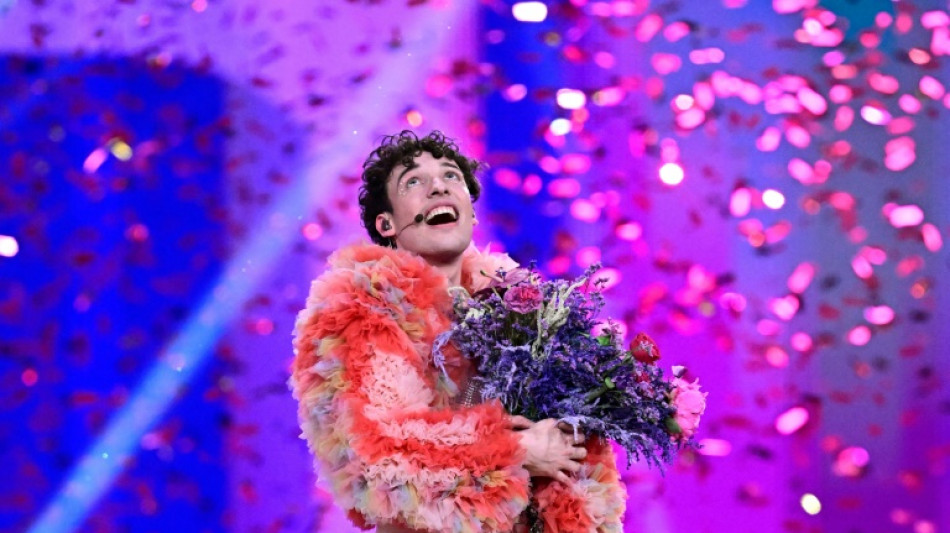
Eurovision final: how it works / Photo: Tobias SCHWARZ - AFP/File

Eurovision final: how it works

The Eurovision Song Contest evokes a world of intrigue with song rules, juries and votes that draw out the drama until a winner is crowned.

Text size:

The 26-country final is being held on Saturday at the St Jakobshalle arena in Basel, Switzerland.

Here is a look at how the competition is put together and how the voting system works:

- Hosts -

Winners get to host the following year's competition. Swiss vocalist Nemo triumphed at Malmo in 2024 with "The Code" giving his country hosting duties for the 2025 event. The singer will perform twice in this year's show in Basel.

- Who takes part? -

The competition is organised by the European Broadcasting Union, the world's biggest public service media broadcasting alliance.

Competing acts are selected by EBU member broadcasters representing their countries. This year, 37 countries entered.

The song and artist can be chosen through televised national selection shows, an internal process or a mixed method.

- The rules -

With 26 acts succeeding each other on stage in the final, songs must be under three minutes, and no more than six performers can be part of a country's show.

Lead vocals must be live, performed to a pre-recorded backing track.

Songs must be original, and since 1999 can be in any language. The lyrics and performances must avoid political, commercial or offensive content.

- The finalists -

Some 31 countries took part in the semi-finals on Tuesday and Thursday, with 20 acts progressing to the final after audience televotes.

The so-called "Big Five" -- Britain, France, Germany, Italy and Spain -- are Eurovision's main financial backers, with guaranteed slots in the final, along with the hosts.

- Voting system -

All 37 participating countries get to vote in the final.

Two sets of points, with equal weight, come from each country.

One set is given by a jury of five music industry professionals, who vote in advance after watching the second dress rehearsal.

The other set is given on the night by viewers voting via telephone, text message or the official app.

Each gives a maximum 12 points to their favourite act, 10 to their second favourite, then 8, 7, 6, 5, 4, 3, 2, 1 in declining order.

The rest of the world also has a viewer online vote, counting as an additional voting country.

Countries cannot vote for themselves.

- Winner -

Each country's jury votes are revealed in turn, with only the maximum 12-point recipient announced verbally.

Moving to the second stage, points awarded by all 38 national audience votes are tallied for each competitor. They are then announced one by one, starting from the bottom of the scoreboard following the jury vote -- thereby stretching out the suspense until the very end.

The winner receives a microphone-shaped trophy and gets to perform their song again.

(T.Burkhard--BBZ)