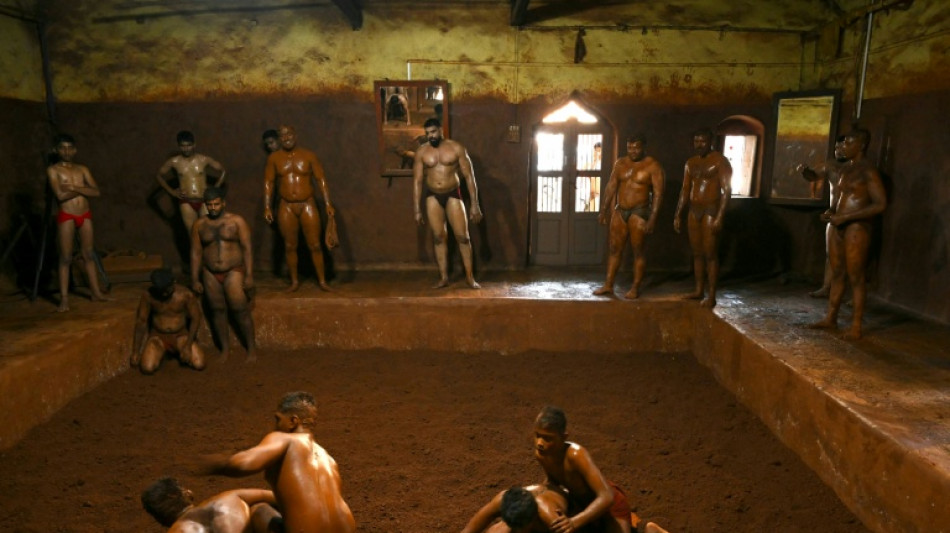
Rooted in the earth, India's traditional mud wrestling thrives / Photo: Indranil MUKHERJEE - AFP

Crowds cheer as muscular men in tight loincloths slap sacred scented soil on their bulging thighs and arms for a mud wrestling bout in India.
"When we fight, we sweat," said 33-year-old Mauli Jamdade, a wrestling star in Maharashtra state, rubbing red-brown earth onto his body for each clash.
"The mud gives us grip and helps us grapple better."
Unlike conventional wrestling matches played on mats with regulated draws, India's mud wrestling is more raw -- but has been the training ground for Olympic success.
This style of wrestling, known as "kushti" or "dangal", has millennia-old roots but emerged during the period of India's Mughal rulers in the 16th century, blending traditional hand-to-hand combat with Persian martial arts.
There are no blows or kicking, but plenty of throws to the ground, and it remains hugely popular.
It took Jamdade over 15 minutes to defeat his rival, starting with a slow circling dance then twisting, turning and locking arms, before he pinned him down.
The bout ends when one wrestler pins his opponent's back to the mud, irrespective of how long it takes.
- From mud into the Olympics -
Both men and women Indian wrestlers have won medals at the Olympics and Commonwealth Games in the more regulated form of the sport.
But it is the mud, not mat, version that is popular in swathes of rural areas -- with supporters saying it is not just a spectacle but a tradition that many want to uphold.
Bank cashier Anil Harale ended his wrestling career after injuring his leg, but after work still slips out of his office clothes for a dirty wrestle.
"I miss it," said the 46-year-old, who hopes his "unfulfilled dream" will be realised by his teenage son, an aspiring wrestler.
Wrestler KD Jadhav, who took bronze at the 1952 Olympics -- the first Indian to win an individual Olympic medal -- began his sporting career as a mud wrestler in Kolhapur, a city in Maharashtra.
"It is from mud that wrestlers reach the Olympics," said excited fan Sachin Mote, among hundreds cheering the wrestlers at a bout.
- Mud, milk, oil -
Kolhapur is a core base of the sport with its centuries-old residential gymnasiums known as talims.
Jamdadejoined the Gangavesh talim aged 14.
A picture of the Hindu monkey god Hanuman -- a deity worshipped by wrestlers for his strength and devotion -- gazes over waist-deep pits where the soil is dug.
The earth is mixed with turmeric, yoghurt and milk, as well as neem tree leaves and oil, before it is ploughed and smoothened across the ring.
For the wrestlers, the soil is sacred.
"It is everything," said Jamdade. "There is nothing without it."
More than a hundred wrestlers -- some as young as 10 -- train at the talim.
It is an austere life. The rigorous training includes waking up before dawn, running, hundreds of push-ups, rope climbing and grappling.
Tobacco and alcohol are strictly prohibited, phone usage is restricted and pre-marital relationships are considered a distraction.
- 'Never end' -
For Jamdade, the first year at the talim was all about gaining weight -- and that is an expensive affair.
"There are people who weigh 125-130 kilos (275-285 pounds)," he said.
"To fight with them, and match their strength, I need to be at least 120 kilos."
So when he is not in the ring or training, Jamdade focuses on eating.
That includes at least five kilos of goat meat each week, some 70 egg whites, 24 apples, leafy vegetables and dry fruits.
He washes that down with at least 21 litres of milk, 14 litres of sweet lemon juice and a protein shake made with almonds, cashews, honey, cardamom seeds, honey and milk.
His monthly food bill totals $350 but the prize money he has won helps his family, who are from a poor farming background.
Winnings range from a few hundred dollars to $1,700 -- more than the annual average income of an agricultural household in India.
While the popularity of more organised wrestling on mats has grown, Jamdade believes mud bouts have a safe future as a core part of village fairs.
"Fairs will always continue," he said. "Mud wrestling will never end."
(G.Gruner--BBZ)