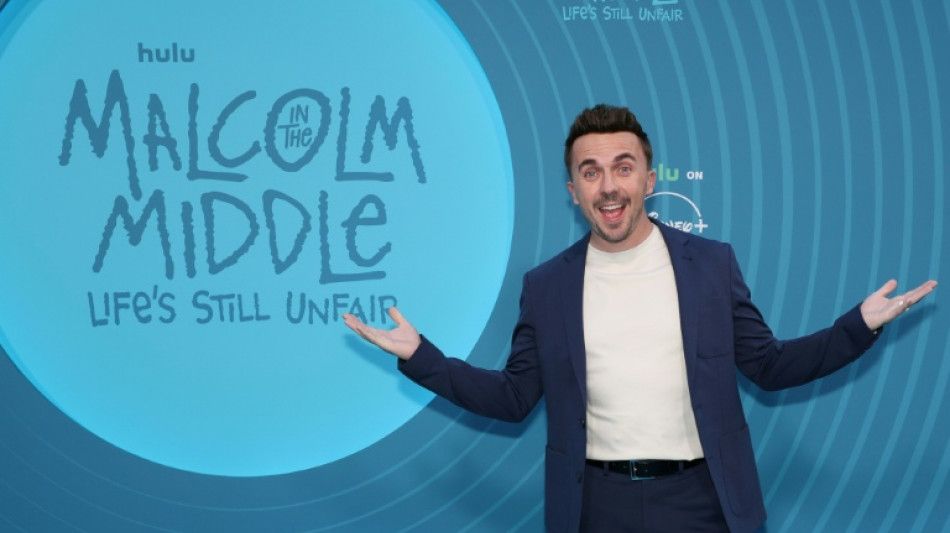
Wave of nostalgia as 2000s TV makes a comeback / Photo: ANGELA WEISS - AFP

In the early 2000s, television viewers first discovered "Malcolm in the Middle," the hilarious tale of a teenager trying to survive the antics of his dysfunctional family.
Twenty-five years later, the "Malcolm" gang is back on Disney+, with nearly all of the original cast including Emmy winner Bryan Cranston -- part of a wave of revivals tapping into a public craving for cozy nostalgia.
The strategy is also a moneymaker for networks and streaming services, as tried-and-true content comes with minimal financial risk -- and often huge fan interest.
From the Trojan War to Superman, "we've been continuing to take characters, universes, dramatic spaces, and repurpose them for a long, long time," says Robert Thompson, a professor of media and pop culture at Syracuse University.
But the trend has soared in the streaming era, because "going back to properties that are already established is one way of avoiding a lot of potential risks in that," Thompson told AFP.
"All of the millions of dollars that were spent marketing, promoting, establishing the brand of those things way back when they were on in the first place -- those bills have already been paid."
Beyond the rebooted "Malcolm in the Middle: Life's Still Unfair," medical sitcom "Scrubs" -- which originally ran from 2001 to 2010 -- returned to ABC and Hulu early this year, with most of the original cast including Zach Braff and Donald Faison.
In July, Amazon's Prime Video will debut "Elle," a prequel series focused on the high school years of Elle Woods, the pink-obsessed heroine played by Reese Witherspoon in the "Legally Blonde" films that debuted in 2001.
Not all of these projects come to fruition.
Hulu opted not to move forward with a much-anticipated reboot of "Buffy the Vampire Slayer" (1997-2003), despite having a filmed pilot ready to go.
But Fox is relaunching "Baywatch," the sun-kissed 1989-2001 series focused on California lifeguards that made Pamela Anderson a household name.
And some series that debuted in the 2000s, like "Grey's Anatomy," "NCIS" and "Law and Order: SVU," are still going strong -- with both new episodes airing on networks and older episodes figuring among the most streamed content each year.
- 'Comfort' -
So why are viewers, who are bombarded with content choices, going back to shows made a quarter-century ago?
For Sohni Kaur, who researched the subject while pursuing psychology and media studies at Scripps College, it comes down to good old nostalgia.
"I think this is a pretty common coping mechanism for a lot of people" to return to shows they enjoyed in their youth, Kaur said.
During the coronavirus pandemic, she rewatched all of the "Twilight" vampire romance films, which were released from 2008 to 2012, and Bollywood flicks from the 1990s.
"It does really provide a lot of comfort to me" to watch older films and TV shows, said the practicing psychologist.
"Looking back and revisiting something that we already know about kind of relieves that anxiety, or it kind of just distracts us from all of the current changes that are happening."
Some television series -- such as "Friends" (1994-2004) or "Gilmore Girls" (2000-2007) -- naturally generate more nostalgia because they feature families or close-knit friend groups, Kaur said.
But even the "Scream" horror movies, which debuted in 1996, are still going strong, with "Scream 7" taking in more than $200 million worldwide so far this year, according to Box Office Mojo.
For Thompson, "some of this nostalgic stuff goes on a cycle, usually somewhere around 20 years."
In that span, children and teens who loved the original series have become adults, and return to things that defined their younger years.
Now, those adults have purchasing power to buy tickets or subscribe to streaming platforms. And they can introduce their children to the content as well.
Kaur also says the phenomenon recalls a "moment right before it switched over into that really rapidly increasing technological growth."
"I think going back to that, again, feels safe," she said.
In the late 90s and the 2000s, television programs still generated pop culture watershed moments that everyone experienced at once.
Rebooting those series represents the "cultural centrality to television that was made before the turn of the century and even into the new century," Thompson said.
Another throwback is that streamers are increasingly rolling back the years to adopt the weekly airing of an episode at a time, in order to reinvent the era of appointment television.
HBO Max's medical drama "The Pitt," which stars Emmy winner Noah Wyle, is being released that way, and certainly recalls the heyday of the show that first made Wyle a star: NBC's "ER," which debuted in 1994 and helped George Clooney shoot to fame.
(T.Renner--BBZ)