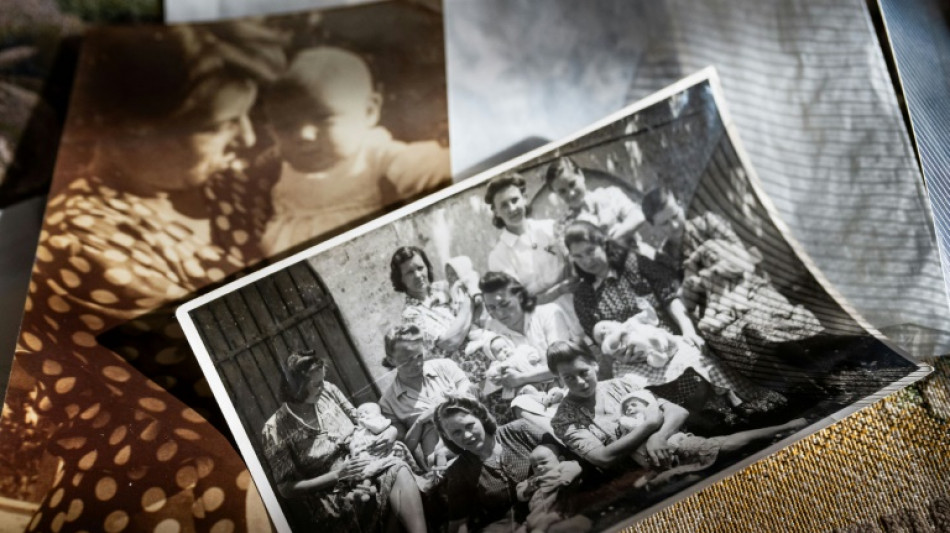
The miracle babies who survived Ravensbruck / Photo: MATEUSZ SLODKOWSKI - AFP/File

They were born in a hell on Earth and were never supposed to survive. But by some miracle a handful of babies born in Ravensbruck concentration camp in northern Germany made it out alive.
Guy Poirot -- who was born there on March 11, 1945 -- said they owe their lives to "the collective will of the women" who risked their lives to hide and feed them when they had almost nothing for themselves.
"We are the children of all those women," the 80-year-old French survivor told AFP.
German Ingelore Prochnow, who was born in Ravensbruck nearly a year before him, calls them "my camp mothers", who saved them from extermination and hunger in the second biggest Nazi camp after Auschwitz-Birkenau.
Until 1943, most newborns were smothered, drowned or burned and women up to eight months pregnant were mostly given lethal injections to abort their babies.
So women hid their bumps for fear of being sent to the "Revier", the camp infirmary notorious for medical experiments and for selections for execution.
Like the other 130,000 inmates of the Nazi's biggest camp for women and children, they worked 12 to 14 hours a day transporting bricks, pushing wagons, resewing uniforms or working in a Siemens factory.
"The guards beat and kicked me numerous times," wrote Polish prisoner Waleria Peitsch despite "my advanced state" after arriving on the biggest convoys carrying pregnant women after the Warsaw Uprising in August 1944.
Still, she survived the violence and the epidemics sweeping the camp to give birth to her son Mikolaj on March 25, 1945.
- 'Kinderzimmer' -
After a new medical officer arrived in the autumn of 1943 births were tolerated if they happened out of sight.
French resistance member Madeleine Aylmer-Roubenne brought her daughter Sylvie into the world on March 21, 1945, in "a sort of corridor, no water, no toilet nearby or electricity, just a candle on the floor."
Her German midwife, a common criminal, risked her life to get the forceps and chloroform from the infirmary which had a state-of-the-art birthing room with "all the obstetric instruments" you could imagine, Aylmer-Roubenne wrote in her memoirs of the camp.
The same solidarity saw women stealing food and rags for new mothers so they could make nappies and medical gloves to make teats for bottles.
"The women washed the babies with the lukewarm drink they got in the morning, warmed them and protected them from the guards," said Prochnow.
"Alone my mother could never have kept me alive."
The newborns were gathered together in the "Kinderzimmer" or children's room from September 1944 where their life expectancy was no more than three months, wrote Marie-Jose Chombart de Lauwe, a medical student and French resistance fighter who tried to keep them alive.
Rats bit at their fingers at night. Almost all were taken by hunger, dysentery, typhus and the terrible cold, with temperatures dropping to minus 15 degrees Centigrade (five degrees Fahrenheit).
With the mothers being worked to exhaustion, most had no milk. There was little milk powder to put into the two bottles that were shared by between 20 and 40 babies.
"Mummy had no milk," French survivor Jean-Claude Passerat-Palmbach recalled. "So a Romanian Roma woman and a Russian, who had lost their babies, breastfed me."
Born in November 1944, he only survived because of the generosity of the other prisoners in the farm where his mother was sent afterwards.
- Babies like 'little old people' -
The babies looked like "little old people", Chombart de Lauwe said, with wrinkled skin, bloated tummies and triangular faces. They suffered from abscesses and green diarrhoea.
The situation got even worse in 1945. Around 6,000 prisoners were gassed and thousands of women and children sent to other camps as the Russians advanced. In total, between 20,000 and 30,000 people perished in Ravensbruck.
Sylvie Aylmer and her camp "brother" Guy Poirot were saved by being hidden under the skirts of some of the 7,500 prisoners evacuated by the Swedish Red Cross between April 23 and 25 after SS chief Heinrich Himmler agreed to free them in the hope of saving his own skin.
Ingelore Prochnow and her mother, however, were forced into a "death march" of 60 kilometres towards the Malchow sub-camp when advancing Soviet troops liberated them.
The babies that survived Ravensbruck were for the most part born just before its liberation by the Red Army during the night of April 29 to 30.
The Nazis burned their records, but a register kept by a Czech escapee noted 522 births in the camp between September 1944 and April 1945. Only 30 of those names were not marked as dead. Some were transferred to Bergen-Belsen where "only a few newborns survived", according to Valentine Devulder, who is writing a thesis on pregnant women in the camps.
- Transgenerational trauma -
Growing up, many of the little survivors like Sylvie Aylmer were not told they had been born in a concentration camp. For her, Ravensbruck had been "a French village".
"I discovered when I was 13 when my sister and I went to an exhibition on Ravensbruck and the former prisoners who were there took us in their arms. It was a shock," she remembered. She has still never gone back. That place "gives me the creeps", she said.
Her father, who was also a resistance member, died in the camps.
The Pole Mikolaj Sklodowski, now a priest, says Mass there and often takes young people on visits. "Talking about the suffering in the concentration camps is a duty to those who remain there forever," he said.
The camps have marked all of them in one way or another.
Guy Poirot, who talks about his experiences to young people "so this will not happen again", said he is still "very marked psychologically" by what happened. The former civil servant, who has a son, said his "health has been fragile" all his life.
Sylvie Aylmer suffered from anorexia when she was small and spent several years in therapy. "Things were not easy with my mother. When she saw me, she saw the camp," she said.
Ingelore Prochnow was abandoned by her mother in a refugee camp when she was three having survived the camps. She only learned about her past when she was 42.
She said she is "resilient and rarely sick" but her youngest daughter was anorexic. "She weighed only 30 kilos (66 pounds, four stones and 10 pounds) when she died. She looked like a concentration camp prisoner and felt she was carrying my weight on her shoulders," said the mother of two.
"She died in 2019 aged 50. The final diagnosis was that she was suffering from 'transgenerational trauma'."
(K.Lüdke--BBZ)