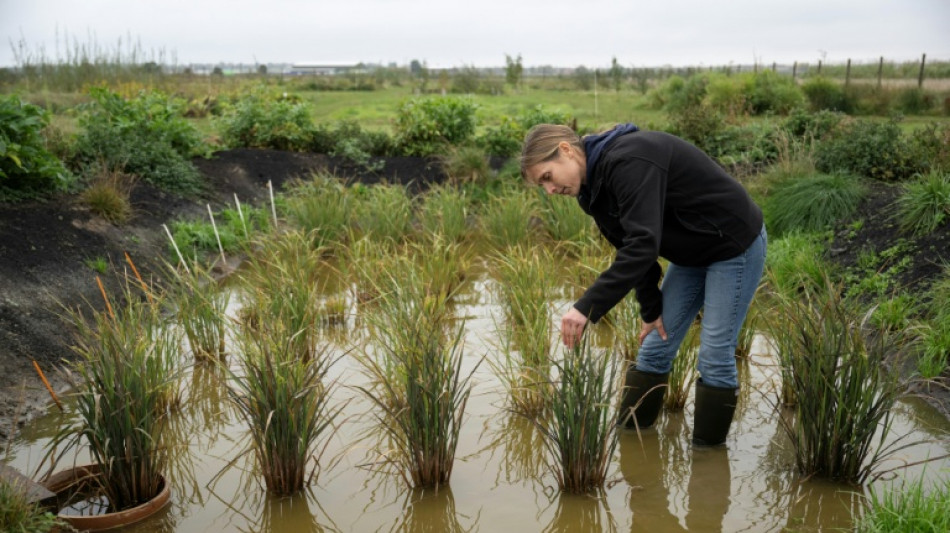
Growing rice in the UK 'not so crazy' as climate warms / Photo: Oli SCARFF - AFP

Wearing large rubber boots, Nadine Mitschunas joyfully handled mature rice plants peeking through the water of her small plot growing in the fertile soil of eastern England.
Growing rice "has not been done before in the UK", said Mitschunas, a field ecologist at the UK Centre for Ecology & Hydrology (UKCEH).
But as temperatures warm due to climate change, "it's not such a crazy idea because it seems to work", she added.
As rice grows in eastern England, lemons groves and chickpeas are also cropping up in the south.
A warmer climate and changing rainfall patterns have made planning ahead essential, and British researchers are embarking on a journey of agricultural transformation.
Mitschunas is leading research with a project that tests new crops in the flat Fens of Cambridgeshire by rewetting peatlands.
Its rich soil has facilitated high production levels, and the region now cultivates one third of England's vegetables and 20 percent of its potatoes and beetroots.
But soil drainage gradually impoverishes the land, posing a threat to local farmers and releasing the CO2 captured by the peatland which are important carbon sinks.
- Farming for the future -
Craig and Sarah-Jane Taylor, the landowners participating in the UKCEH scheme, are conscious of the issue.
"We recognise that our soils are depleting and that we need to change to secure the future," said Sarah-Jane Taylor, underlining the question of "water availability... and that's only going to get worse".
The United Kingdom, like the rest of the world, is affected by climate change. It now has to contend with more frequent extreme weather, rising temperatures, and drier soil in some areas.
A recent UKCEH study suggested that the growth of popular crops such as wheat and strawberries would become much more difficult over the coming decades if the climate warms by 2C. If temperatures rise by 4C, onion and oat crops would be hit.
On the other hand, crops such as sunflower, durum wheat, soybean, chickpeas, lemon and okra could become more viable, particularly in southwestern England or near the Scottish coast.
China and India are the world's leading producers of rice.
And in the Fens, Mitschunas has tested nine rice varieties regularly grown in the United States, the Philippines, Macedonia and Japan -- four of them show promise, particularly one that originates from Colombia.
Once the grains germinated in a laboratory, the seedlings were planted in water in June, and harvesting began in early October.
"I am not eating my own rice yet," the ecologist joked. But such a scenario could become a reality within 10 years.
"The suitable climate for rice is moving more northwards" in Europe, she said, pointing to successful initiatives in the Netherlands and Germany.
Mitschunas is also testing everything from lettuce and celery to pumpkins and strawberries -- and even aromatic plants.
Along with crop experimentation, her project aims to regenerate peatlands and improve the country's CO2-capturing capacities.
- No time to waste -
She is not the only British researcher testing new crops.
At the University of Southampton in southern England, professor of biological sciences Mark Chapman is leading a study on different crops, including chickpea cultivation.
"If we wait until 20 or 30 years, and then realise that we can't grow wheat... like we always have done, we've then got (a) problem," he said.
He emphasised the need to "smooth the transition" by prioritising which future crops to grow and ensuring consumers are ready to change their habits.
"I think we're at that point where we just need to try more things," he said. "We need to get farmers involved, who are actually going to plant the crops."
The pioneers in the Fens, Sarah-Jane and Craig Taylor, have noted other farmers' growing interest in the project following their initial surprise.
"Once upon a time potatoes and sugar beet weren't grown here and now they're one of the main crops in the area," said Sarah-Jane Taylor.
"So why couldn't rice potentially be an option here? And why shouldn't we look at it?"
(K.Müller--BBZ)