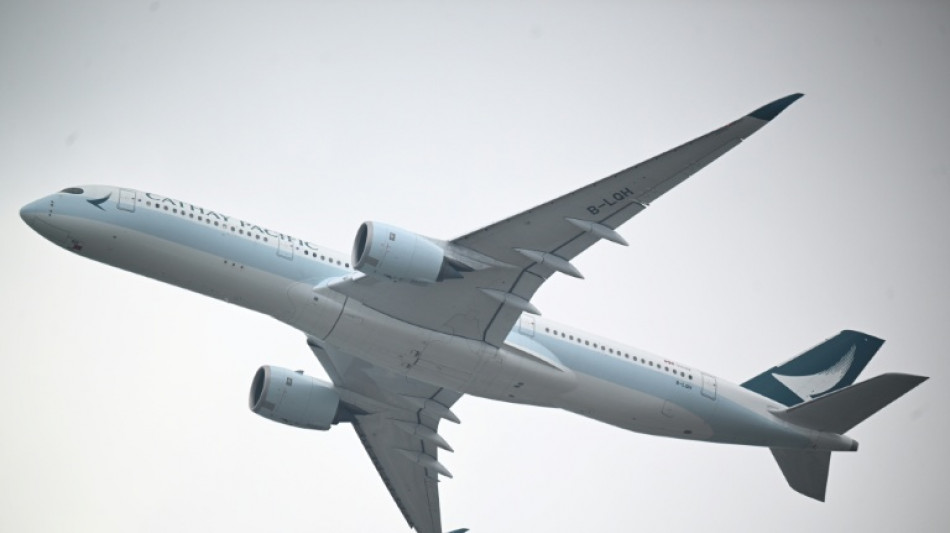
Airlines in Asia hike fares as Mideast war raises fuel costs / Photo: Peter PARKS - AFP

Airlines in the Asia-Pacific region, including Qantas, Air India and Cathay Pacific, have hiked fares -- or will soon -- to factor in surging jet fuel prices spurred by war in the Mideast.
The average world price of aviation fuel reached $173.91 a barrel on Monday, according to the benchmark Platts index, nearly double the levels of January and well above crude oil.
This is explained by refining costs, but also by the fact that kerosene is a lower priority than petrol or diesel, according to the International Air Transport Association (IATA).
War in the Mideast has choked trade in the Strait of Hormuz, which normally carries nearly 20 percent of global oil production.
The impact is particularly acute for Asia, as more than 80 percent of the oil and gas moving through the strait is destined for its markets, according to the US Energy Information Administration.
"Since early March 2026, aviation turbine fuel (ATF), which accounts for nearly 40 percent of an airline's operating costs, has seen significant price escalation due to supply interruptions," Air India said Tuesday, announcing surcharge rises.
Air India said pressure is amplified further by "the high Excise Duty and VAT on ATF in major metro cities such as Delhi and Mumbai, magnifying the impact and placing substantial strain on airline operating economics."
The price increases will be rolled out in three phases, with Air India adding $4.30 to the cost of domestic flights from Thursday, and an additional $20 on flights to Southeast Asia.
As of March 18, the surcharge for Europe will increase by 25 percent to $125, and 33 percent to $200 for North America.
But Air India didn't offer details on the third phase of its price increases.
Hong Kong aviation giant Cathay Pacific on Wednesday announced its own surcharges, as fuel prices doubled in March from the average of the previous two months.
- 'Unsustainable' -
Founder of India's low-cost carrier SpiceJet Ajay Singh called on Delhi to look for ways to reduce taxes on jet fuel, warning in an interview with Bloomberg that even $90 a barrel of oil was "totally unsustainable".
Singh did not rule out the possibility of grounding part of his fleet if oil prices continue to soar.
Australian airline Qantas said in a statement that it is also increasing fares which "will vary from route to route" after jet fuel costs rose up to 150 per cent over the past fortnight.
"Despite the hedging measures, this situation leads to higher costs for the entire group," it said.
Dean Long from the Australian Travel Industry Association told ABC News that the carrier's international airfares would rise by about five per cent across the board, but the war's full impact would not be felt for another three to six months.
Thai Airways finance director Rut Rugsumruad told investors in a video conference that the airline can increase fares "by 10–15 percent due to uncertainty in fuel prices, and it still has room to raise fuel surcharges further if oil prices continue to climb".
But for the moment a Thai Airways spokesperson told AFP that "prices remain fixed for now, though they are subject to change based on supply and demand".
In Europe, Scandinavian airline SAS became one of the first to announce a "temporary" price increase since the start of the Middle East war.
Others, such as Air France-KLM and Lufthansa, are relatively protected by their "hedging" strategy, which involves the purchase of fuel at a fixed price several months in advance.
burs-jug/ane/jm
(L.Kaufmann--BBZ)