Teen Gun Violence Survivor Spends Three Years in St. Louis Hospital

Jaloni, a survivor of gun violence in St. Louis, spent more than 475 days across three years living in SSM Health Cardinal Glennon Children’s Hospital. With no safe place to go and family unable to provide care, the teen turned his hospital room into a home, illustrating the growing national issue of children remaining in hospitals beyond medical necessity.
Jaloni spent more than 475 days over three years living on the third floor of SSM Health Cardinal Glennon Children’s Hospital in St. Louis, transforming a medical facility into his primary residence because he had nowhere else safe to go.
The young man, now 18, first entered the hospital in June 2023 with fresh gunshot wounds piercing his right arm and chest. What began as an emergency stay for physical trauma evolved into a prolonged social stay, a phenomenon where children remain hospitalized beyond their medical needs due to a lack of appropriate discharge options. His experience highlights a systemic crisis affecting thousands of children nationwide, particularly those in the foster care system or with complex physical and mental health requirements.
Jaloni’s journey began in room 3005, a space that initially felt sterile and unfamiliar. He had no personal items, no posters on the walls, and no snacks on his shelf. The pain from his injuries was severe, leaving him barely able to move during his first night. However, the strong pain medication he received induced a dreamlike state where he felt as though he were soaring.
In reality, Jaloni was trapped between two worlds. Outside the hospital, he had been a fearless teenager involved in risky behavior and street life. Inside, he was a patient dependent on his grandmother for reassurance that life would improve once he was released. His grandmother, who had been his legal guardian since childhood, could not make that promise.
Medical records confirm Jaloni stayed at the hospital for over 475 days during this period. While some of this time was medically necessary to treat bullet wounds and a spinal cord injury, significant portions were driven by social factors. His mother, Quette, and his grandmother struggled to manage his care after he was discharged to a rehabilitation facility and then home. Both women faced immense physical limitations; his grandmother is a double amputee who uses a wheelchair, and his mother worked as a paid caregiver for another family.
Caring for Jaloni required turning him every four hours to prevent bedsores, changing bandages, cooking, and cleaning. His mother stated she repeatedly told hospital officials that the burden was too great. "I just couldn’t take care of him anymore," Quette said. "It was something that I was not ready for." She reported begging for assistance that never arrived.
Jaloni’s condition deteriorated in November, leading to a 911 call when he developed what appeared to be an infection and bedsores. He was readmitted to Cardinal Glennon less than five months after his initial discharge. Hospital officials reportedly told the family, "Well, y’all almost killed him," accusing them of neglect.
Because Jaloni’s family lived in Illinois, just across the river from St. Louis, he became a ward of the state of Illinois. This legal status prevented him from returning to his mother and grandmother. Social workers considered placing him in a home in Chicago, 300 miles away. Jaloni refused, stating he wanted to go home, not to another distant location. He remained in the hospital while adults determined his placement.
This second stay lasted 250 days. During this time, Jaloni realized that finding housing for a teenager in a wheelchair was exceptionally difficult. Potential homes needed ramps, elevators, space for medical equipment, and caregivers capable of handling his needs. These barriers are common for youth aging out of foster care with disabilities.
Jaloni’s situation is part of a broader national trend. In the fiscal year ending in June 2025, the Illinois Department of Children and Family Services reported 304 young people staying in psychiatric hospitals beyond medical necessity. Additionally, 312 youths spent more than 24 hours in emergency departments awaiting safe placement. In Missouri, data obtained through public records requests showed that 648 youths in state custody were boarded in hospitals during the fiscal year ending in June.
State records indicate that Missouri has spent more than $64.7 million over the past five years boarding children in state custody in hospitals because they had nowhere else to go. However, Dave Dillon, a spokesperson for the Missouri Hospital Association, noted that these figures likely represent a substantial undercount. Many hospitals lack the staff resources to log and request reimbursement for housing children, leaving costs uncompensated.
SSM Health spokesperson Liz Sharpe-Taylor stated in an email that the health system is committed to serving those in need. When patients remain hospitalized due to an absence of discharge options, hospitals often bear a burden of extensive uncompensated costs. The hospital system declined to comment on the specific details of Jaloni’s stay.
During his extended stays, Jaloni’s environment shifted from a clinical space to a personalized living area. His grandmother visited frequently in the early days, teaching him to cook fried tilapia with spaghetti and keeping his secrets. She provided a safe space for him to land during his initial recovery.
In 2024, while Jaloni was hospitalized, his grandmother died. Her passing left him uncertain about his future until his aunt, Deborah, agreed to become his foster parent. Deborah, whom Jaloni calls "Tete," had cared for him during his first year of life. This time, however, the challenge was different. Jaloni was no longer a newborn; he required a wheelchair-accessible apartment with a ramp and a specialized hospital bed.
Deborah moved into a first-floor, one-bedroom apartment to accommodate Jaloni’s needs. She rearranged her life to prepare for his arrival, but Jaloni remained hospitalized until the home was ready. During this waiting period, he continued to live on the third floor of Cardinal Glennon.
Jaloni described the experience of being stuck in the hospital for a year as potentially the worst of his life. He expressed anger at the duration of his stay. However, as time passed, his perspective changed. He explored the hospital, playing video games like Fortnite at the nurses' station and eating in the cafeteria. He learned about the hospital morgue in the basement, where he was told a 13-year-old girl had recently died. That girl had made him a bracelet before her death.
A network of hospital staff, including nurses, a custodian, and a cook, looked out for Jaloni. A teacher from Cardinal Glennon visited five days a week to help with his online high school classes. Jaloni also provided emotional support to the staff, listening to their stories about relationships and dating. "It’s like I’m a therapist, for real," he said.
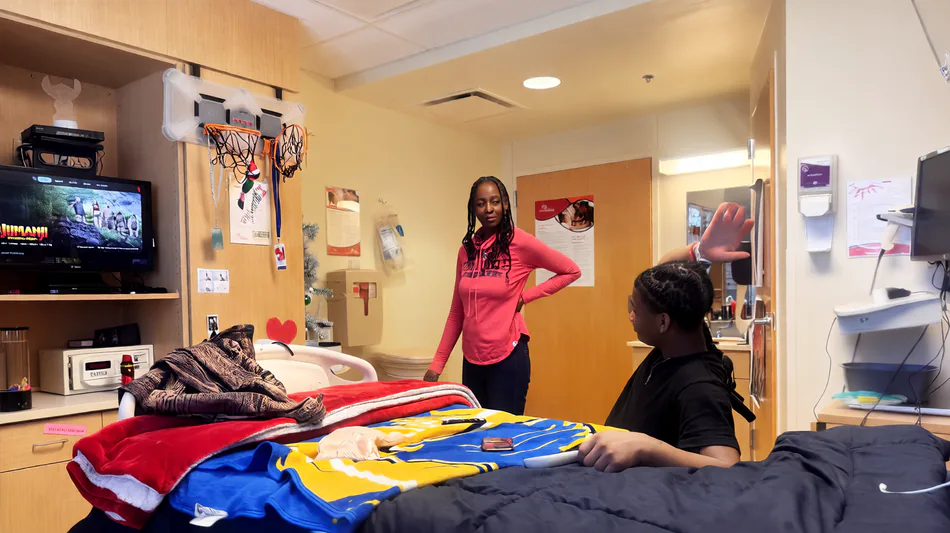
To allow for deep cleaning and prevent cabin fever, the hospital moved Jaloni into a new room every 30 days. He slept in almost every room on the third floor. Staff once asked if he wanted to avoid room 3005, fearing it would trigger trauma from his initial shooting. Jaloni disagreed, smiling as he noted how much he had accomplished since that day.
His room became a sanctuary filled with personal items. He displayed photographs of his brother, who had died after being shot, on his bathroom door. The sink held grooming supplies including castor oil, Shea Moisture mud mask, Old Spice deodorant, and Dior cologne. He kept stuffed animals, including a dog named Bruno and another named Snoop. A fish tank with glowing plastic neon fish sat in his room, which he called his "kingdom."
In March, large black letters spelling "J-A-L-O-N-I" were mounted outside his door, above a "STOP" sign instructing visitors to knock. The space resembled a college dorm more than a hospital room.
Jaloni’s diet expanded beyond standard hospital food after he spoke with a cook about the quality of meals. He began ordering special items like lemon pepper wings with cheese fries, Philly cheesesteaks with crushed Doritos, and meat lover’s pizza with a tortilla-shell crust. A hospital worker gifted him an air fryer to keep his food crispy. His aunt also brought in favorite meals from nearby restaurants.
Despite these comforts, Jaloni’s world remained narrow. He observed events on the floor and heard gunshots from outside, including the shooting of a 15-year-old boy at a nearby gas station who was later treated on his floor. "We hear people shooting all around here," Jaloni said. Yet, he felt safer inside the hospital than in his community.
Jaloni was discharged in May after his aunt found a larger, two-bedroom apartment with a homemade wheelchair ramp. He needed time to adjust to what he calls "the real world." His aunt gave him the larger bedroom to ensure space for his bed and mobility. He keeps prescription medications on a shelf under his television and uses an air fryer to cook while his aunt is at work.
While his peers prepared for their senior year of high school, Jaloni focused on turning 18. He celebrated his birthday in August at the St. Louis Aquarium, a stark contrast to the plastic fish tank in his hospital room. His aunt quietly celebrated small milestones, such as the first time Jaloni took out the trash.
Jaloni continues to struggle with anxiety around crowds and fear of violence. To stay safe, he often stays inside, goes out at night, and wears a black hoodie to make himself invisible. His aunt is trying to cut back on smoking but finds it difficult due to the stress of caregiving and work.
Deborah supports Jaloni’s dreams of earning his GED, learning a trade, and becoming a business owner. "She’s doing her best to help Jaloni fly," he said. "This time, she wants him to soar toward his dreams." For now, Jaloni’s primary goal is simple: to stay out of the hospital and stay alive.
Jaloni asked KFF Health News to use only his first name to protect his family’s safety. The project was supported by a grant from the Association of Health Care Journalists, with funding from The Joyce Foundation.
(G.Gruner--BBZ)