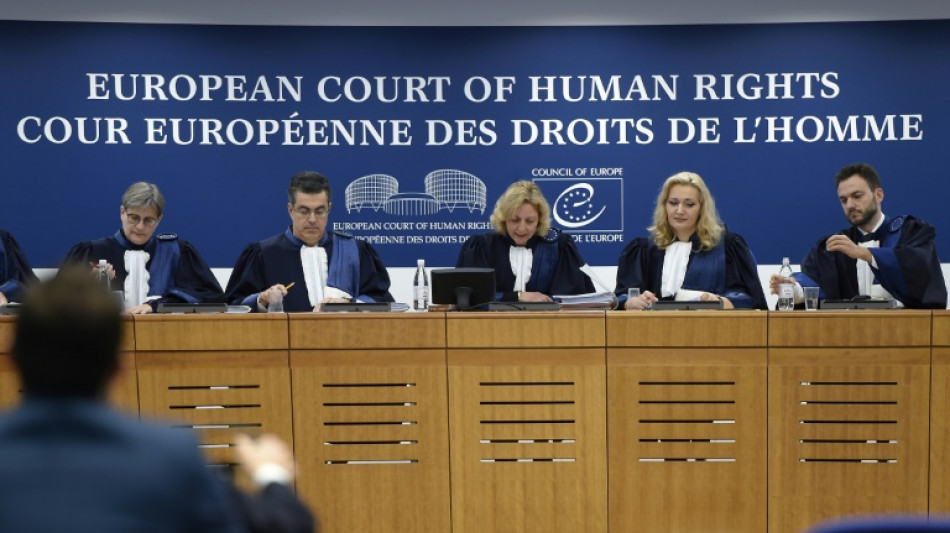
Courtrooms: a growing arena in the climate fight / Photo: FREDERICK FLORIN - AFP

The battle against climate change is increasingly being fought in the courtroom, as national governments, specific laws and individual companies are targeted for their roles in the crisis.
The cases have sometimes resulted in successfully influencing policy -- an outcome hoped for by the six Portuguese youths who have lodged a case against 32 countries at the European Court of Human Rights (ECHR), accusing the governments of moving too slowly.
Here is some key background and analyst commentary on climate lawsuits around the world:
- An explosion of lawsuits -
The number of court cases linked to climate change doubled between 2017 and 2022, according to the UN Environment Programme and Columbia University's Sabin Center for Climate Change Law.
There were more than 2,500 cases lodged worldwide as of mid-September, a Sabin Center tracker showed, with more than 1,600 in the United States.
Of the cases worldwide, 135 were brought in developing countries, including Small Island Developing States -- far-flung nations whose land is some of the most at-risk from climate change.
"Why is climate litigation still growing? Because the climate crisis is increasing in its intensity, its immediacy," Michael Burger, executive director of the Sabin Center, told AFP.
"And because government and corporate action is inadequate to meet the moment."
The number of cases being filed appears to have slowed over the past year, though it's still too early to tell for sure, according to the latest report from the Grantham Research Institute on Climate Change in London.
- Effectiveness -
Climate change litigation has affected the "outcome and ambition of climate governance," experts from the UN's Intergovernmental Panel on Climate Change (IPCC) wrote in a report last year, adding that successful cases also serve as a form of external pressure on governments.
Urgenda, an environmental organization in the Netherlands, notched a notable win at the Dutch Supreme Court in 2019, with justices ordering the government to reduce its greenhouse gas emissions by 25 percent by the end of the following year.
Government policies "that are explicitly linked to the case" were subsequently introduced, said Catherine Higham, a Grantham Research Institute policy fellow.
- Litigation 'cuts both ways' -
But a number of high-profile cases have been unsuccessful, and those seeking a greener future aren't the only ones filing lawsuits: high-emitting companies are starting to file suit against climate-friendly laws they don't like.
"Litigation cuts both ways," says Higham.
"Those that benefit from the status quo will do what they can to preserve their benefits, and that will include going to court," added Burger.
Additionally, activists can find themselves in the crosshairs of suits linked to disruptive protests, though "judges have generally taken the climate crisis" as well as the role of civil disobedience "into consideration in sentencing," according to a report from the UN Environment Programme.
- Companies targeted -
In addition to governments, companies themselves can also be the target of lawsuits, with litigants pressing for both compensation and a change in corporate behavior.
In another historic Dutch decision, Shell was ordered in 2021 to reduce its CO2 emissions by 45 percent by 2023 -- a decision the oil major is appealing.
A new strategy employed by climate change activists is to target "greenwashing," accusing companies or organizations of deceptive practices concealing their true environmental footprint.
FIFA is among those that have been accused of the practice.
- Stronger data -
Scientists are increasingly able to establish the links between climate change and individual extreme weather events, as well as the role of specific high-emitting industries, from oil extraction to mining to cement production, in climate change -- data that is often used in lawsuits.
A county in the northwestern US state of Oregon filed suit in June against multiple international oil majors, seeking $51 billion in damages after a deadly "heat dome" blanketed the northwest of the country in 2021.
- Human rights -
Human rights also take center stage in some cases, often concerning people's rights to health and well-being or to a clean environment.
These sorts of arguments are often made in cases before international tribunals, like the ECHR.
- Non-binding, but influential -
Even when decisions are non-binding, they can influence government attitudes and policies worldwide.
Activists are currently awaiting advisory opinions from the International Court of Justice and the International Tribunal for the Law of the Sea on the obligations of individual states in climate matters.
"Although such opinions are non-binding, they have great potential to shape the future development of climate change law," according to the Grantham Research Institute.
(A.Lehmann--BBZ)