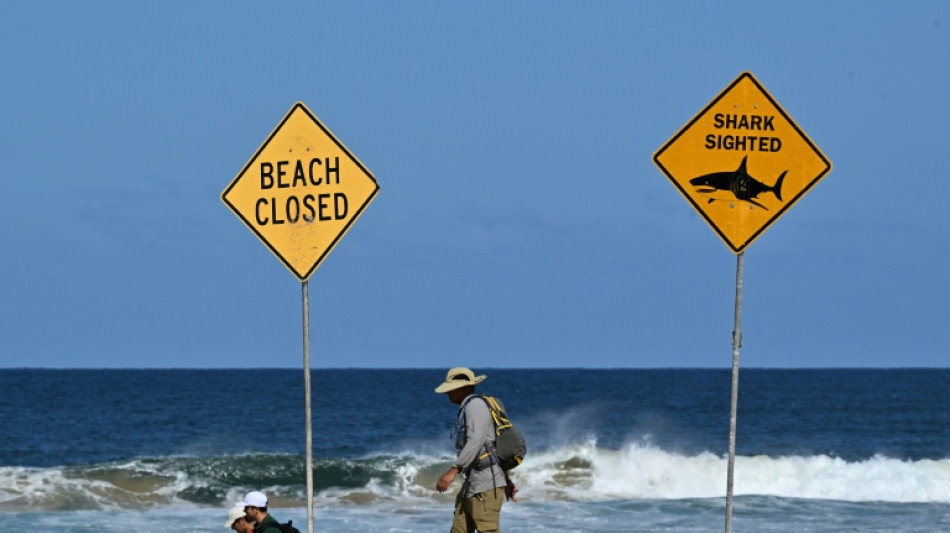
Racing towards great white sharks in Australia / Photo: Saeed KHAN - AFP

Sensible people might prefer to flee at torpedo speed from a great white shark, but there's one job in Australia that pays you to race towards the predators.
And when you reach the big fish, you have to fix a tracker to its dorsal fin while bobbing in a boat on the ocean swell.
The job is key to a sophisticated protection network that lets swimmers, surfers and fishers check for the aquatic hunters in real time when they venture into the water.
Every day, workers lay 305 satellite-linked buoys at popular spots in waters up to 15 meters (50 feet) deep along the coastline of New South Wales as part of the state-run programme.
The so-called smart drumlines have baited hooks and when a shark takes a bite it is caught, sending a signal to the tagging team.
Then comes the hard part.
But it's not the wild "rodeo" people might think, said Paul Butcher, principal research scientist for the state government shark tagging and tracking programme for the past 10 years.
"The sharks are really benign. The process has little impact on those sharks," he told AFP.
A boat races to the buoy within 16 minutes of the alert.
If the fish is one of three potentially dangerous species -- a great white, bull shark or tiger shark -- team members get to work.
They wrap two ropes around the animal: one near its tail and another in front of the pectoral fin to support its body.
- Trance-like state -
Once the carnivore has been pulled close to the side of the boat, it is rolled to one side carefully while ensuring seawater is passing through its gills.
The position places the shark naturally into a trance-like state that minimises the risk of harm to the team and the animal.
Workers measure the shark's length, collect tissue samples, and fit an acoustic tag to its dorsal fin.
Finally, the animal is released at least one kilometre (half a mile) offshore, vanishing into the blue with a flick of its tail.
The whole process takes about 15 minutes.
"You get some animals that have their own personalities," Butcher said.
"Great whites, when we catch them, they're easy to work on next to the boat. Tiger sharks, not so much. And bull sharks are really benign as well."
In the past 10 years, the state's programme -- managed by the Department of Primary Industries -- has tagged 1,547 white sharks, 756 tiger sharks and 240 bull sharks.
Tagged sharks are detected when they swim past one of 37 listening stations dotted along the coastline.
That sets off an alarm on the SharkSmart app, giving beachgoers an instant notification on their mobiles and smart watches.
The technology forms part of a multi-layered approach that authorities have adopted, alongside spotter drones and old-fashioned nets.
- Fatal attacks on the rise -
More than 1,280 shark incidents have been recorded around Australia since 1791 -- about 260 of them fatal -- according to a national database.
Though still relatively rare, fatal attacks are on the rise with 57 reported deaths in the 25 years to 2025, compared to 27 in the previous quarter-century.
In November, a three-metre (10-foot) bull shark fatally bit one woman and injured her boyfriend off a remote beach north of Sydney.
The Swiss tourists were reportedly filming a pod of dolphins.
Despite overfishing depleting some shark species, scientists say the rise in fatalities may be linked to the growing numbers of people taking to the water.
Rising ocean temperatures also appear to be swaying sharks' migratory patterns.
Researchers say shark lives, too, need protecting.
Globally, about 37 percent of oceanic shark and ray species are now listed as either endangered or critically endangered by the International Union for Conservation of Nature, a database for threatened species.
(Y.Yildiz--BBZ)