Taiwan Farmer Revives Ancient Climate-Resilient Millet to Preserve Indigenous Heritage

In the mountainous region of Taitung county, southeastern Taiwan, Indigenous farmer Banu Ismahasan is working to restore oil millet, an ancient grain that largely vanished from local fields over six decades ago. Once cultivated by the Bunun community as a reliable backup crop during harvest failures, the drought-resistant plant is being reintroduced to preserve both agricultural heritage and genetic diversity for a changing climate.
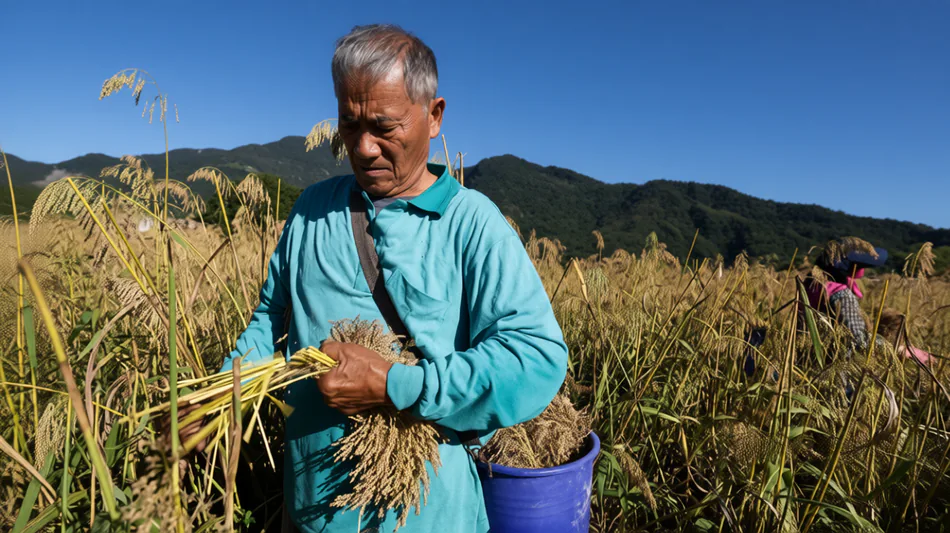
Banu Ismahasan walks through a golden field of tall stalks in southeastern Taiwan, harvesting by hand the grain heads of an ancient crop resistant to extreme weather. Once grown by Indigenous farmers in Taiwan as a safeguard against staple crop failure, oil millet largely disappeared from fields more than 60 years ago as rice became more widely available.
Over the past decade, Ismahasan and his elderly parents have worked to revive the nearly forgotten crop in the Bunun community in Buklavu, a village surrounded by lush green mountains in Taitung county.
“We just hope to bring back many traditional Bunun crops and grow them on this land again,” Ismahasan, 48, told AFP in his oil millet field under a clear blue sky.
Oil millet, known as “dill” in the Bunun language, is endemic to Taiwan and can be found growing wild in the mountains. Ismahasan first read about the plant online and then embarked on his own research, combing through historical documents and speaking to tribal elders, including a woman who recalled last eating it half a century ago.
He discovered that Bunun farmers used to grow oil millet alongside their staple crop foxtail millet as a “back-up” when harvests failed or disasters hit. After years of growing oil millet himself, Ismahasan came to understand why his ancestors relied on the crop.
A single oil millet seed can grow 15 to 20 panicles, or branching seed clusters, and the stems regenerate on their own, while foxtail millet typically grows one panicle per seed and must be sown again after being cut. It has also proven hardier than foxtail millet when extreme weather or disease outbreaks have ravaged his 2.2-hectare (5.4-acre) farm.
During a drought several years ago that lasted more than 200 days, the oil millet “stayed bright green” while other crops withered, Ismahasan said. Typhoons, floods and even a rust disease outbreak have not affected it either.
Hsing Yue-ie, a retired professor from Taiwan’s Academia Sinica and an expert in plant genetics, first heard of oil millet 15 years ago at an international forum. Unbeknownst to Hsing, specimens of Taiwan oil millet collected in the 1890s were sitting in Britain’s Royal Botanic Gardens, Kew.
Hsing led a research team to find oil millet in the mountains of southeastern Taiwan and began studying the little-known cereal. She found that the seed’s protective wax coating enabled it to grow without irrigation, fertilisers or pesticides, even on poor-quality land.
Rich in oil, protein and minerals, it can be used for human and animal consumption, as well as for fuel. “It’s naturally very efficient at using sunlight and water,” said Hsing. “As for soil conditions, even in mountainous areas where the ground is full of large rocks, it can still grow very well.”
Ismahasan started his crop with one panicle of oil millet. The family now harvests oil millet twice a year on a section of their property where they grow other traditional Bunun cereal crops.
Tiny and tasteless, oil millet can be used in porridge, steamed buns, bread and even popcorn. But the family has struggled to convince other farmers to grow it because it is not yet commercially viable.
Oil millet is not only labour intensive but also significantly more expensive for consumers than rice, by far Taiwan’s most popular staple. While the current market for oil millet is limited, Taiwan’s National Crop Germplasm Center sees value in preserving its seeds for the future, when climate change might force more farmers to consider growing the crop.
Oil millet seeds are “very precious” because of their genetic diversity and ability to adapt to the environment, Lin Yen-yu, an assistant researcher at the centre, told AFP. Seeds are kept in aluminium foil packets and stored at -18C under low-moisture conditions where they can last for decades, Lin said.
“In the future, when cultivation methods or climate change undergo certain shifts, their value may start to be recognised and discovered,” he said.
Ismahasan said his priority for now was to get more people in his community growing and eating oil millet, bringing “it back into our everyday lives, just as it was for our elders”.
“If we don’t even eat it ourselves anymore, how can we expect to turn it into a viable business?” he said.
(A.Berg--BBZ)