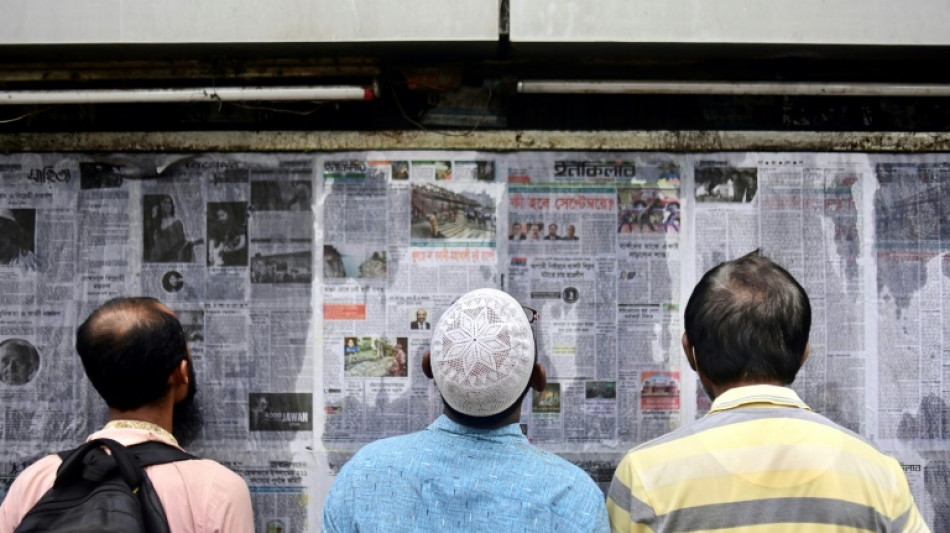
Fake experts drive disinformation before Bangladesh polls / Photo: Munir UZ ZAMAN - AFP

Hundreds of articles praising Bangladeshi government policies apparently by independent experts have appeared in national and international media but the authors have questionable credentials, fake photos, and may not even exist, an AFP investigation has found.
Commentators say it is evidence of a sustained campaign of disinformation by unknown actors ahead of elections due by the end of January but appears to be intended to benefit the government of Prime Minister Sheikh Hasina.
Such articles have been published by Chinese state news agency Xinhua, leading media across Asia, and quoted by the South Asia Brief of the Washington-based Foreign Policy magazine.
Rights groups and foreign powers, including the United States, have long raised concerns over efforts by Hasina's government to silence criticism and stamp out political dissent.
AFP found that names forming a network of so-called experts are producing regular op-ed pieces, some posing as academics from leading global universities, some using stolen headshot photos, and others making up quotes from real analysts.
"It's a coordinated influence operation," said A Al Mamun, a journalism professor at Bangladesh's University of Rajshahi. "These articles primarily promote narratives that are favourable to the current Bangladesh government."
A surge of articles appeared online around September 2022, when Bangladesh's foreign ministry issued a call for "good columnists" to counter negative "propaganda".
AFP sent multiple requests for comment to top officials at Bangladesh's foreign ministry and information ministry but received no reply.
Foreign Minister A.K. Abdul Momen told AFP he did "not have enough time" to comment.
- No records -
AFP analysed more than 700 articles published in at least 60 domestic and international news sites with bylines attributed to 35 names, all of which appeared for the first time online last year.
The articles overwhelmingly endorse narratives pushed by Dhaka, with some posted on Bangladesh government websites.
Many are staunchly pro-Beijing and fiercely critical of Washington -- which has issued Dhaka stiff warnings of the need for free and fair elections.
While it was not possible to prove if the 35 names investigated by AFP are real, no online presence apart from their articles could be found, none has a visible social media profile, and none has published research papers in academic journals.
At least 17 of the 35 claimed links to major Western and Asian universities but AFP's digital verification reporters found no records for them.
Eight major universities confirmed that they had never heard of nine of the writers purportedly working for them, including the University of Delaware in the United States, Canada's University of Toronto, Switzerland's University of Lucerne, and the National University of Singapore.
"We checked our school records and do not find his name on our rolls," India's Jawaharlal Nehru University said about one purported writer claiming ties.
Headshot photographs of eight of the reported columnists belong to other people, including a popular fashion influencer on Indian social media.
AFP also found examples where the same article was published using different names in English and in Bengali.
Among the names is Doreen Chowdhury, a seemingly industrious columnist who has written at least 60 articles praising Dhaka's government, supporting growing ties with China, and warning that gun violence in the United States is a "threat to human rights".
Chowdhury's photograph is taken from an Indian actor, while the University of Groningen in the Netherlands -- where Chowdhury is reportedly a doctoral researcher in politics -- said it has no record of her.
AFP received a response from the email address listed beneath the articles that said Chowdhury was an "alias to avoid security concerns", but the email's author declined to provide a real identity or explain the use of a false photograph.
- 'Entirely fabricated' -
Fumiko Yamada, who has had articles published in outlets including the Bangkok Post and a blog by the London School of Economics, is portrayed as a specialist in Bangladesh Studies at Australia's University of Melbourne.
However, AFP found that there are no records of her there and that "Bangladesh Studies" is not a specific research study area.
Articles attributed to Yamada range from praising Hasina's "vital counsel" to blasting Washington's "double standards towards the democracy and human rights of others by incessantly interfering in their internal affairs".
Other articles include fake quotes from real experts.
Gerard McCarthy, a professor at the International Institute of Social Studies in the Netherlands, said "entirely fabricated" quotes attributed to him were used in an article condemning "Western duplicity" towards Myanmar, written under the byline Prithwi Raj Chaturvedi.
Newspaper editors said they printed articles in good faith, after reading their academic background and seeing them published elsewhere.
"We trusted the credentials," said Mubin S Khan, feature editor of Dhaka's Business Standard.
Bangladesh's Daily New Age editor Nurul Kabir said he had been sent a slew of op-ed pitches in early 2023, "mostly on topics like Bangladesh's relations with India, China and USA".
He later stopped publishing them, fearing they were "mercenary writers" being pushed by "vested" interests, but was shocked to learn they appeared to be fictitious.
"I should have been a little more conscious in this age of disinformation and propaganda about checking the identities of the writers," he said.
(T.Burkhard--BBZ)