Biden embraces allies as Xi comes to San Francisco / Photo: Loren Elliott - AFP

President Joe Biden, eager to showcase US leadership in the face of Beijing and Moscow, this week leads another major summit, but this time the guests will include not only allies but Chinese President Xi Jinping.
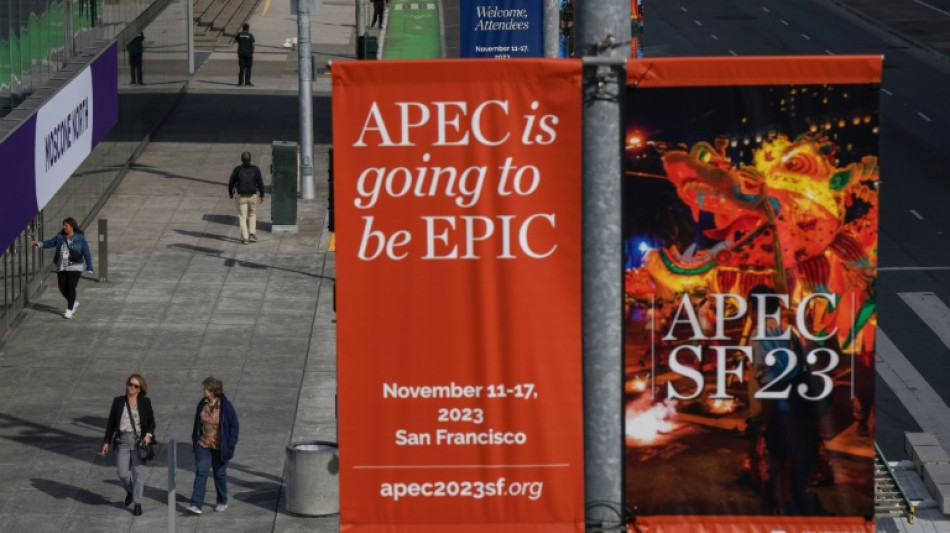
Biden will welcome to San Francisco the 20 other members of the Asia-Pacific Economic Cooperation (APEC) forum, conceived three decades ago in an era when US policymakers were convinced that robust trade would bring the Pacific Rim together.
That sanguine vision is over, with the Biden administration at APEC pushing only a limited economic pact and in recent months ramping up sanctions against China, seen as the main challenger to US global primacy.
But both the United States and China have voiced hope for greater stability and -- with a visit to Washington politically unfeasible, and US elections one year away -- APEC marks a unique chance for Xi to see Biden on US soil.
The Biden-Xi meeting on Wednesday -- their first since a year ago at a G20 summit in Bali -- is expected to take up a broad gamut of disagreements including Taiwan, whose elections in two months could trigger fresh tensions with Beijing, which claims the self-ruling democracy and has not ruled out seizing it by force.
One US official voiced hope Xi and Biden would "open up new lines of communication," amid US desire to restore contact between the two militaries, seen as especially vital to managing a Taiwan crisis.
For other leaders in San Francisco, APEC risks "feeling like a sideshow" to Biden and Xi, but they are also likely relieved by the meeting, said Jude Blanchette, a China specialist at the Center for Strategic and International Studies.
"Even countries in the region who are extraordinarily worried about China's increasing aggression still have deep economic inter-linkages with China and at the margin would vastly prefer a stable US-China relationship to an unstable one," he said.
- Allies gather again -
In contrast to its diplomacy aimed at avoiding conflict with China, the United States has shunned Russia -- an APEC member -- over its invasion of Ukraine.
Russian President Vladimir Putin, facing an arrest warrant from the International Criminal Court, was never expected to go to San Francisco and the United States made clear he was unwelcome.
Moscow will instead be represented by Deputy Prime Minister Alexei Overchuk, still the highest-level Russian visitor to the United States since the war.
Biden, drawing an implicit contrast to his predecessor and rival Donald Trump, has focused on highlighting alliances, including through new formats such as a three-way military pact with Australia and Britain.
Despite China's presence, the United States will still work with allies in APEC on "pushing back against any sort of efforts to undermine international rules and norms," Matt Murray, the senior US official for APEC, told AFP.
He said the organization was well-placed as the venue for the Biden-Xi summit as APEC is non-binding, allowing countries with disagreements to talk.
US allies attending APEC will include Australian Prime Minister Anthony Albanese -- who over the past month has visited both Washington and Beijing -- as well as Japanese Prime Minister Fumio Kishida and South Korean President Yoon Suk Yeol.
Ahead of flying to San Francisco Biden will offer a White House welcome to outgoing Indonesian President Joko Widodo, as the United States seeks to compete with China for the archipelago's vast nickel reserves vital for electric cars.
- Momentum on trade deal -
San Francisco was selected for it historic ties to Asia and its central role in global technology but APEC is unlikely to offer a respite from the issue that has dominated Biden's attention for a month -- the Israel-Hamas war.
APEC members include not only Indonesia, the world's largest Muslim-majority country, but neighboring Malaysia, where Prime Minister Anwar Ibrahim has faced calls from opposition to boycott the summit over US support of Israel.
APEC -- which speaks of member "economies" instead of "countries" -- unusually includes both China and Taiwan.
Taiwan is represented not by a politician but a businessperson -- Morris Chang, a historic figure in Taiwan's semiconductor industry.
Free-trade deals have fallen out of favor in Washington, with Trump pulling out of the nascent Trans-Pacific Partnership pitched to Asian allies by his predecessor Barack Obama.
Biden has instead coined the Indo-Pacific Economic Framework for Prosperity (IPEF), which does not offer market access but seeks to ease the way for business across 14 countries that include Japan, India, Australia, South Korea and much of Southeast Asia -- but not China.
Negotiations have already concluded on one of three parts of IPEF -- supply chains -- and APEC may see conclusions on the two others, trade and clean energy, said Wendy Cutler, a former US trade negotiator now vice president of the Asia Society Policy Institute.
(S.G.Stein--BBZ)