Radical Numerics develops offline AI tool to detect engineered pathogens

Frontier AI labs have warned that their technology could help develop dangerous bioweapons.
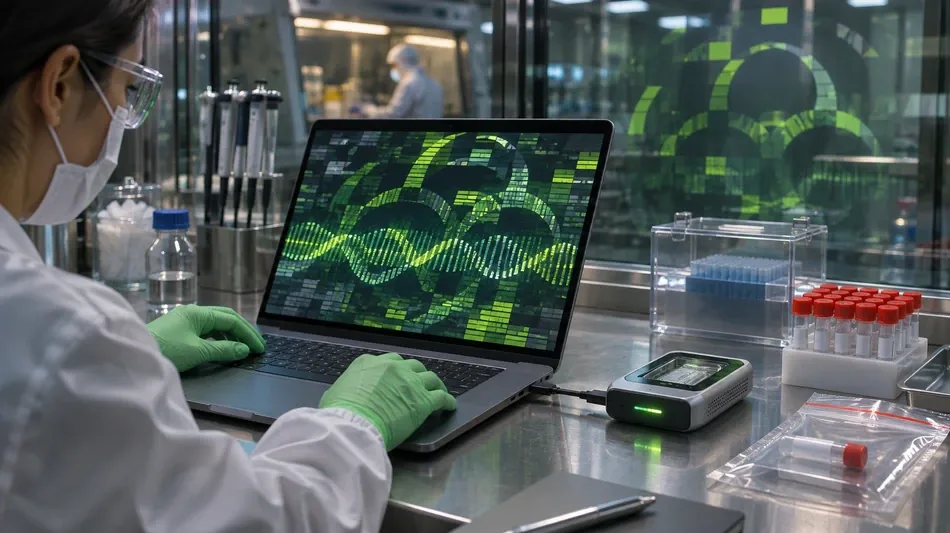
Frontier AI labs have warned that their technology could help develop dangerous bioweapons. Now, a startup says it has developed a defense. On Wednesday, Radical Numerics said that it has developed a new edge model called Omnii Defense that is designed to flag natural and AI-engineered pathogens using a laptop and a USB gene sequencer. It can also run without an internet connection, allowing researchers in the field with spotty connections to use it. Though many scientists say AI-made bioweapons are a low-likelihood threat, Radical Numerics hopes its technology will help researchers and public health officials identify emerging biological threats.
Eric Nguyen, cofounder and CEO of Radical Numerics, says he sees a coming arms race in biodefense similar to what’s playing out in cybersecurity, where threat actors and security defenders are leveraging AI in an attempt to gain an edge. "We felt that the biosecurity space was far behind on the defense side," he says.
Nguyen and his cofounders were part of the research team behind Evo and Evo-2, open-source DNA foundation models they worked on during their doctoral research at Stanford University. They founded Radical Numerics in 2025. The San Francisco–based company recently made waves after rolling out Omnii, a new genome language model built on different types of biological information beyond DNA, including RNA, proteins, and epigenetic signals. In October, Radical said that it used Omnii to create custom bacteriophages, viruses that infect and kill specific bacteria, targeting a drug-resistant strain of E. coli. Its cocktail was used to treat a sick patient, with special permission from the Food and Drug Administration.
Another AI biotech startup, Tabula Bioscience, was also involved in that research, but Radical didn’t disclose the partnership in its announcement last month. The omission led Harvard geneticist George Church, who was an adviser to both companies, to resign from his role at Radical last week. Omnii Defense, the company’s latest tool, makes multiple predictions about a sequence, including the odds of it being pathogenic or AI-generated and what taxonomic group it most closely resembles. The model assigns a genome a "threat score" between zero and one that combines the likelihood of unnaturalness with functional predictions. The higher the score, the higher the threat.
Earlier biodefense tools, such as the federally funded Finding Engineering-Linked Indicators, or Felix, can compare genetic sequences of interest against libraries of known organisms, essentially searching for cataloged matches. That can be helpful in a scenario where a bad actor has made a few tweaks to an existing pathogen. But they aren’t designed to make predictions in the way that Omnii is. The benefit of AI models is that they can learn patterns in sequences associated with biological function instead of relying on exact sequence matches. That could allow them to recognize similarities between sequences even when their genetic spelling has changed. Christine Parthemore, Radical Numerics’ head of biodefense, says Omnii is a "step change."
In one experiment, the company removed Bundibugyo virus—which is now driving an Ebola outbreak in East Africa—from the training data, first at the species level and then its whole genus. "It was as if Omnii was operating in 1976," Parthemore says, referring to the year Ebola was discovered. With just the species removed, the model still detected that 33 percent of the Bundibugyo sequences pushed to it were something pathogenic. Even with the whole genus removed, it flagged 22 percent of the viral sequences. Non-AI tools gave essentially no indication of potential risk, she says. "We absolutely need to be vigilant about what AI is enabling, and if we can use technology to compete with it and hopefully get ahead of any kind of nefarious actors, that seems sensible," says Bronwyn MacInnis, director of pathogen surveillance in the Infectious Disease and Microbiome program at the Broad Institute of MIT and Harvard.
However, MacInnis cautions that detecting a signal is still a big leap from determining whether a pathogen has real consequence or whether a threat was engineered. Access to Omnii Defense is now limited to vetted external testers. Radical Numerics says it is working with national laboratories, government agencies, and other independent evaluators to assess the model’s performance.
(K.Müller--BBZ)