
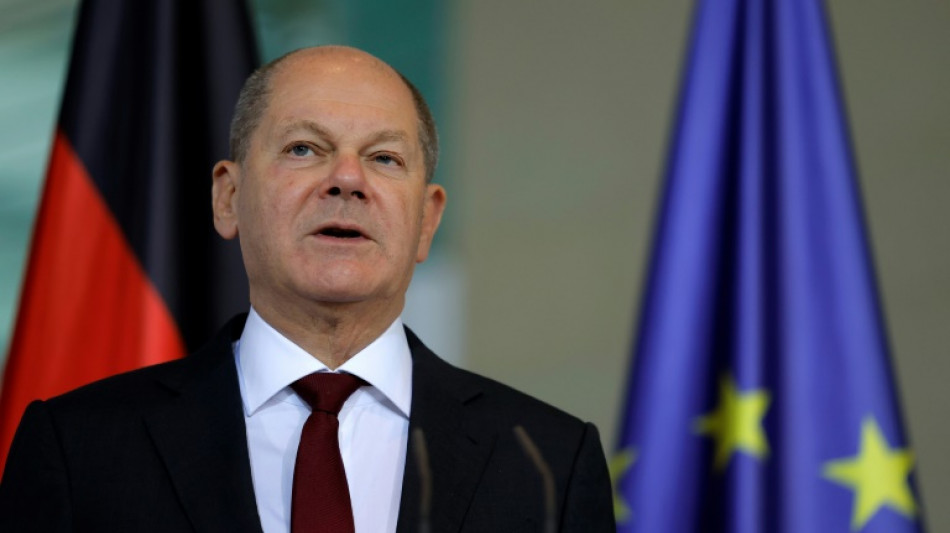
German govt spending plans at risk as court rules / Photo: Odd ANDERSEN - AFP/File

Germany's top court will decide Wednesday whether the government broke debt rules enshrined in the constitution, potentially throwing its spending plans into disarray and further fuelling tensions in the ruling coalition.
The Federal Constitutional Court is examining accusations from the main opposition CDU party that Chancellor Olaf Scholz's ruling coalition has acted in contravention of the "debt brake".
This key commitment to balanced budgets caps Germany's new borrowing to 0.35 percent of gross domestic product.
The brake was suspended from 2020-2022 to deal with shocks from the coronavirus pandemic and energy crisis, as is permitted during emergencies, but came back into force this year.
The court case centres on a change to accounting rules for funds outside the main budget that was implemented last year by the centre-left-led coalition, giving it more room for deficit spending outside times of crisis.
In particular, it is examining a decision to transfer 60 billion euros ($64 billion) of loan authorisations that had been part of pandemic support programmes to a fund aimed mainly at fighting climate change.
Critics argue this amounted to "budgetary acrobatics" that violated the debt brake, and the centre-right CDU lodged a legal complaint at the top court.
Ahead of the ruling, Berenberg Bank economist Salomon Fiedler said the government's spending plans may be "at risk".
"We see a significant probability that the court will find against the government," he wrote in an analyst note.
If it takes a "strict" interpretation, the government may have to slash deficit spending plans by 40 billion euros for 2024, equivalent to one percent of GDP, he said.
A decision against the government could also further strain ties within Scholz's three-party coalition, particularly with the pro-market FDP, who pushed to ensure the debt brake was reinstated and are seeking to rein in spending.
- Debt debate -
The climate fund, now worth 212 billion euros, is aimed in large part at speeding up Germany's shift to an emissions-free economy, with measures such as helping cover the cost of replacing gas boilers with more climate-friendly heat pumps.
As it is not officially part of the budget, the coalition has argued the fund is not relevant in calculating whether the debt brake is being respected.
But law professor Hanno Kube, who advised the plaintiffs, told AFP that "the purpose of the fund is not an emergency situation... but a long-term challenge, the fight against climate change".
In hearings at the court in the southwestern city of Karlsruhe in June, the government argued the climate fund also addressed long-running consequences of the pandemic.
But Kube dismissed this, saying the green transition was not "at all linked to overcoming the economic crisis linked to the coronavirus".
Berenberg's Fiedler argued a court ruling against the government could have implications for other "off-budget funds".
But he also said that, even if the court rules against the government, adjustments to the budget may not be as high as feared, and it may give the government time to bring the deficit down.
The court's ruling, which comes after nearly five months of deliberations, will likely further fuel ongoing debates around whether the debt brake needs to be relaxed.
While the FDP has pushed for it to be kept in place, Economy Minister Robert Habeck of the Green party called last month for the rules to be redesigned for times of crisis.
A strict spending limit had been designed in an era of benign "globalisation, friendly coexistence and cheap Russian gas", which had now come to an end, Habeck said.
(Y.Yildiz--BBZ)



