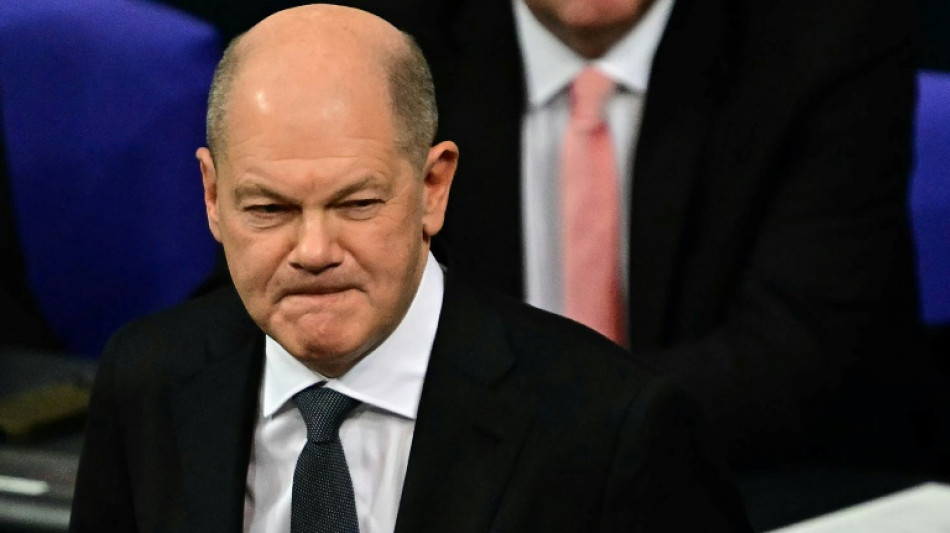
Under-fire Scholz to trigger German elections with confidence vote / Photo: Tobias SCHWARZ - AFP

Germany's embattled centre-left Chancellor Olaf Scholz traded angry blows with his top rival ahead of a parliament vote Monday that was expected to trigger the process towards February 23 elections.
Scholz, 66, whose three-party coalition collapsed last month, has called a confidence vote which he is expected to lose, clearing the way for the dissolution of the Bundestag and a return to the ballot box.
Friedrich Merz, 69, the top candidate of the conservative CDU-CSU opposition alliance of ex-chancellor Angela Merkel, is well ahead in opinion polls to became the next leader of Europe's top economy.
In parliament, Scholz outlined plans for massive spending on security, business and social welfare, but Merz demanded to know why he had not taken those steps in the past, asking: "Were you on another planet?"
Scholz argued that his government had made great progress over the past three years, including boosting spending on the German armed forces, which he said previous CDU-led governments had left "in a deplorable state".
"It is high time to invest powerfully and decisively in Germany," Scholz said, warning about Russia's war in Ukraine that "a highly armed nuclear power is waging war in Europe just two hours' flight from here".
But Merz fired back at Scholz that he had left the country in "one of the biggest economic crises of the postwar era".
"You had your chance, but you did not use it ... You, Mr. Scholz, do not deserve confidence", charged Merz.
If Scholz loses the vote, President Frank-Walter Steinmeier can then move to dissolve the legislature and formally declare the agreed February 23 election date.
- Minority government -
The political contest comes at a time when Germany is struggling to revive its stuttering export-led industrial sector amid high energy prices and tough competition from China.
Berlin also faces major geopolitical challenges as it confronts Russia over the Ukraine war and as Donald Trump's looming return to the White House heightens uncertainty over NATO and trade ties.
Merz, a former corporate lawyer, long rained withering fire on the motley alliance of the chancellor's Social Democrats (SPD), the left-leaning Greens and the liberal Free Democrats (FDP).
Coalition bickering over fiscal and economic woes came to a head when Scholz fired his rebellious FDP finance minister Christian Lindner on November 6, the very day Trump was re-elected.
The departure of Lindner's FDP left Scholz at the helm of a minority government with the Greens.
Unable to pass major bills or a new state budget without opposition support, the government is now limping along, with all sides in election mode.
- 'Plagued by doubt' -
German politics in the post-war era was long staid, stable and dominated by the two big-tent parties, the CDU-CSU and the SPD, with the small FDP often playing kingmaker.
The Greens emerged in the 1980s, but the political landscape has been further fragmented over the past decade by the rise of the far-right Alternative for Germany (AfD), a shock for a country whose dark World War II history had long made far-right parties taboo.
The AfD grew from a eurosceptic fringe party into a major political force when it protested against Merkel's open-door policy to migrants, and now has around 18 percent voter support.
While other parties have committed to a "firewall" of non-cooperation with the AfD, some have borrowed from its anti-immigration and anti-Islam rhetoric.
After the fall of Syrian president Bashar al-Assad, some CDU lawmakers were quick to demand that the around one million Syrian refugees in Germany return to their home country.
The election is all the more heated as it comes at a time "the German model is in crisis," said Berlin-based political scientist Claire Demesmay, of Sciences Po Paris.
Germany's prosperity "was built on cheap energy imported from Russia, on a security policy outsourced to the USA, and on exports and subcontracting to China", she told AFP.
Demesmay said the country was now in a sweeping process of reorientation which is "feeding fears within society that are reflected on the political level".
"We can see a political discourse that is more tense than a few years ago. We have a Germany plagued by doubt."
(A.Berg--BBZ)