Berliner Boersenzeitung - South Korea births rose last year on surge in marriage

EUR -
AED 4.073781
AFN 72.102275
ALL 90.815588
AMD 405.295141
ANG 1.985347
AOA 1018.305674
ARS 1714.145039
AUD 1.619697
AWG 1.996678
AZN 1.888603
BAM 1.956162
BBD 2.259818
BDT 139.885901
BGN 1.938808
BHD 0.423273
BIF 3356.42148
BMD 1.109265
BND 1.434366
BOB 13.307124
BRL 6.168516
BSD 1.121993
BTN 105.444524
BWP 15.392642
BYN 3.359422
BYR 21741.601709
BZD 2.256518
CAD 1.580493
CDF 2567.948903
CHF 0.924473
CLF 0.027737
CLP 1091.639343
CNY 7.399188
CNH 7.402938
COP 3658.024487
CRC 507.487105
CUC 1.109265
CUP 26.927986
CVE 110.29089
CZK 24.385869
DJF 199.796995
DKK 7.4758
DOP 68.05168
DZD 151.761054
EGP 59.400834
ERN 16.638981
ETB 182.613944
FJD 2.513149
FKP 0.83271
GBP 0.835637
GEL 2.883876
GGP 0.83271
GHS 13.138433
GIP 0.83271
GMD 82.085701
GNF 9939.885288
GTQ 8.574013
GYD 235.115192
HKD 8.701977
HNL 30.159176
HRK 7.508629
HTG 147.067894
HUF 364.925579
IDR 20176.761018
ILS 3.521751
IMP 0.83271
INR 103.973719
IQD 1701.006968
IRR 2114343.034607
ISK 136.60605
JEP 0.83271
JMD 178.070564
JOD 0.786493
JPY 177.336055
KES 145.790624
KGS 97.004811
KHR 4575.8679
KMF 490.295319
KPW 998.338811
KRW 1482.821284
KWD 0.345404
KYD 0.934973
KZT 500.922752
LAK 25254.676195
LBP 100474.103941
LKR 372.879043
LRD 190.735317
LSL 18.394106
LTL 3.275373
LVL 0.670983
LYD 7.192332
MAD 10.945269
MDL 20.161733
MGA 5076.87139
MKD 61.553635
MMK 2329.175069
MNT 3997.186781
MOP 9.066069
MRU 45.260769
MUR 52.323403
MVR 17.081233
MWK 1945.53393
MXN 20.64576
MYR 4.517593
MZN 70.884571
NAD 18.394106
NGN 1493.038231
NIO 41.287645
NOK 10.594369
NPR 168.708957
NZD 1.993378
OMR 0.42652
PAB 1.122063
PEN 3.823808
PGK 5.038865
PHP 70.303034
PKR 308.064276
PLN 4.414482
PYG 6926.282481
QAR 4.09016
RON 5.346881
RSD 117.595453
RUB 92.152202
RWF 1659.984918
SAR 4.169854
SBD 8.974786
SCR 15.519656
SDG 667.222025
SEK 11.070325
SGD 1.42524
SHP 0.831191
SLE 25.398021
SLL 23260.745543
SOS 641.210057
SRD 41.759385
STD 22959.554043
STN 24.504206
SVC 9.817818
SYP 14422.668294
SZL 18.399158
THB 37.469322
TJS 10.311667
TMT 3.882429
TND 3.344085
TOP 2.670845
TRY 55.720289
TTD 7.609409
TWD 36.479193
TZS 2952.181217
UAH 51.030959
UGX 4578.074675
USD 1.109265
UYU 45.400658
UZS 13435.487736
VES 998.882953
VND 28457.649032
VUV 132.909061
WST 3.091588
XAF 655.957
XAG 0.021344
XAU 0.000277949726
XCD 2.997845
XCG 2.022184
XDR 0.784308
XOF 655.957
XPF 119.331742
YER 262.334988
ZAR 18.409202
ZMK 9984.718908
ZMW 22.860233
ZWL 357.183004
SSP 6373.170625
MXV 2.319752
  • CMSD

    -0.1200

    19.81

    -0.61%

  • JRI

    0.0000

    10.77

    0%

  • BCC

    -1.8200

    74.15

    -2.45%

  • CMSC

    -0.2228

    19.53

    -1.14%

  • BCE

    0.2000

    20.34

    +0.98%

  • RIO

    0.0100

    94.17

    +0.01%

  • AZN

    -2.7400

    161.47

    -1.7%

  • GSK

    -1.1800

    48.17

    -2.45%

  • RBGPF

    0.0000

    65

    0%

  • NGG

    0.8800

    75.82

    +1.16%

  • RYCEF

    -0.7300

    19.08

    -3.83%

  • BTI

    -0.4500

    54.4

    -0.83%

  • BP

    0.4700

    43.99

    +1.07%

  • RELX

    -0.0600

    33.18

    -0.18%

  • VOD

    -0.1800

    16.15

    -1.11%

South Korea births rose last year on surge in marriage
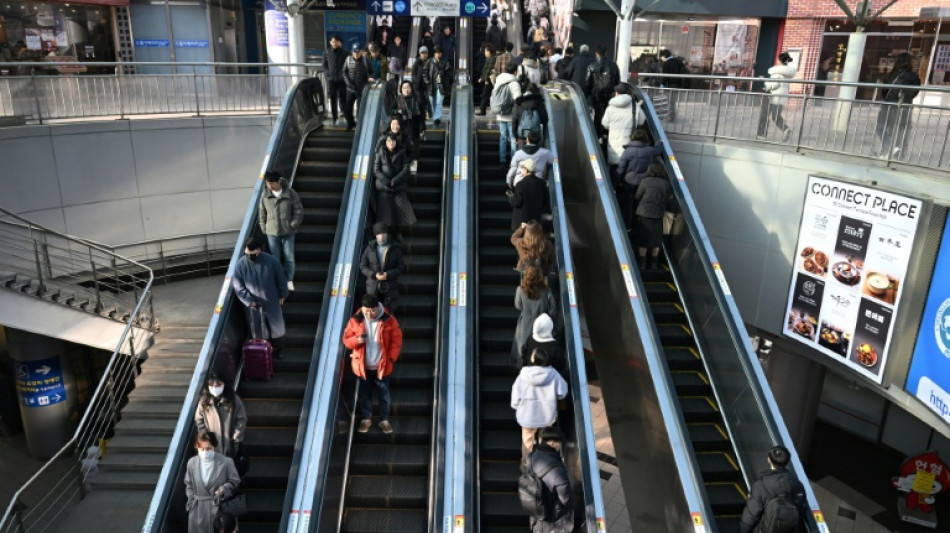
South Korea births rose last year on surge in marriage / Photo: Jung Yeon-je - AFP

South Korea births rose last year on surge in marriage

The number of births in South Korea rose last year for the first time in more than a decade on the back of a rise in marriages, officials said on Wednesday, bucking a trend for a country battling a demographic crisis.

Text size:

South Korea has one of the world's longest life expectancies and lowest birth rates -- a combination that presents a looming demographic challenge.

Seoul has poured billions of dollars into efforts to encourage women to have more children and maintain population stability.

The crude birth rate -- the number of babies born per 1,000 people -- was 4.7, interrupting a continuous downward trend since 2014, according to preliminary data from Statistics Korea.

And the fertility rate, or the average number of babies a woman is expected to have in her lifetime, was 0.75, "up 0.03 from 0.72 in 2023", it said.

"The number of births in 2024 was 238,300, an increase of 8,300 (3.6 percent) from the previous year," the report added.

Park Hyun-jeong, an official from Statistics Korea, attributed the rise to an increase in marriages as well as shifting demographics.

"The population has seen a significant increase in the number of people in their early 30s," she told a press conference.

"This has had a major impact," Park explained.

"Additionally, many marriages that were delayed due to Covid-19 have now taken place, and this upward trend continues."

Park said the number of marriages last year had been the most since 1996 -- "the highest on record".

The average maternal age at childbirth in 2024 was 33.7 years, Seoul said, one of the highest in the world.

But the fertility rate remains far below the 2.1 children needed to maintain South Korea's population of 51 million.

At current rates, the population will nearly halve to 26.8 million by 2100, according to the Institute for Health Metrics and Evaluation at the University of Washington in Seattle.

- Continued decline -

Experts say there are multiple reasons for the low birth rate, from high child-rearing costs and property prices to a notoriously competitive society that makes well-paid jobs difficult to secure.

The double burden for working mothers of managing the brunt of household chores and childcare while also maintaining their careers is another key factor, they say.

The South Korean government offers cash subsidies, babysitting services and support for infertility treatment.

But the number of births has until now continued to decline.

Neighbouring Japan is grappling with the same issue -- it has the world's second-oldest population after Monaco and the country's relatively strict immigration rules mean it faces growing labour shortages.

(P.Werner--BBZ)



