Berliner Boersenzeitung - Ethiopia inaugurates Africa's biggest dam

EUR -
AED 4.315061
AFN 77.724052
ALL 96.430624
AMD 448.409899
ANG 2.103659
AOA 1077.442142
ARS 1689.86317
AUD 1.771311
AWG 2.117872
AZN 2.000409
BAM 1.955407
BBD 2.365825
BDT 143.551156
BGN 1.955723
BHD 0.442954
BIF 3469.888012
BMD 1.174964
BND 1.514389
BOB 8.146363
BRL 6.363838
BSD 1.174664
BTN 106.549193
BWP 15.513883
BYN 3.43521
BYR 23029.292606
BZD 2.362425
CAD 1.618037
CDF 2643.668428
CHF 0.935862
CLF 0.027385
CLP 1074.304613
CNY 8.280264
CNH 8.270365
COP 4486.012203
CRC 587.581934
CUC 1.174964
CUP 31.136544
CVE 110.242848
CZK 24.334798
DJF 209.177969
DKK 7.469862
DOP 74.615007
DZD 152.355249
EGP 55.786091
ERN 17.624459
ETB 182.824164
FJD 2.707411
FKP 0.878162
GBP 0.87939
GEL 3.166584
GGP 0.878162
GHS 13.508286
GIP 0.878162
GMD 86.356626
GNF 10214.903998
GTQ 8.998192
GYD 245.75062
HKD 9.139045
HNL 30.940783
HRK 7.533746
HTG 153.908419
HUF 384.767195
IDR 19613.555028
ILS 3.788072
IMP 0.878162
INR 107.0163
IQD 1538.79735
IRR 49477.729809
ISK 148.209797
JEP 0.878162
JMD 187.72228
JOD 0.83304
JPY 181.945504
KES 151.570389
KGS 102.7508
KHR 4700.035597
KMF 493.48453
KPW 1057.467812
KRW 1734.02351
KWD 0.360476
KYD 0.978907
KZT 605.860839
LAK 25453.88542
LBP 105208.716305
LKR 363.207019
LRD 207.354807
LSL 19.70844
LTL 3.469363
LVL 0.710724
LYD 6.367721
MAD 10.782034
MDL 19.828016
MGA 5235.947914
MKD 61.529756
MMK 2467.149311
MNT 4167.41132
MOP 9.416348
MRU 46.726611
MUR 53.953914
MVR 18.090249
MWK 2036.890717
MXN 21.142242
MYR 4.799753
MZN 75.091164
NAD 19.708524
NGN 1706.364458
NIO 43.231129
NOK 11.939308
NPR 170.456749
NZD 2.033351
OMR 0.451772
PAB 1.174664
PEN 3.955622
PGK 4.991976
PHP 69.151912
PKR 329.196053
PLN 4.220693
PYG 7889.414739
QAR 4.28114
RON 5.092412
RSD 117.375408
RUB 93.410413
RWF 1710.256349
SAR 4.408683
SBD 9.587758
SCR 16.622882
SDG 706.738724
SEK 10.924779
SGD 1.517208
SHP 0.881527
SLE 28.257383
SLL 24638.409984
SOS 670.16534
SRD 45.365159
STD 24319.380662
STN 24.494974
SVC 10.277979
SYP 12993.304299
SZL 19.712039
THB 37.042495
TJS 10.802308
TMT 4.112374
TND 3.43531
TOP 2.829032
TRY 50.181881
TTD 7.972398
TWD 36.98804
TZS 2919.78564
UAH 49.650723
UGX 4184.159255
USD 1.174964
UYU 46.036627
UZS 14211.204945
VES 314.232054
VND 30939.73712
VUV 142.713252
WST 3.265592
XAF 655.825222
XAG 0.018677
XAU 0.000274
XCD 3.175399
XCG 2.116984
XDR 0.815636
XOF 655.825222
XPF 119.331742
YER 280.170076
ZAR 19.761072
ZMK 10576.086666
ZMW 27.22253
ZWL 378.337899
  • RIO

    0.1600

    75.82

    +0.21%

  • BTI

    0.6400

    57.74

    +1.11%

  • SCS

    0.0200

    16.14

    +0.12%

  • CMSC

    0.0000

    23.3

    0%

  • NGG

    1.1000

    76.03

    +1.45%

  • BCE

    0.2161

    23.61

    +0.92%

  • BP

    -0.0100

    35.25

    -0.03%

  • RYCEF

    0.3100

    14.95

    +2.07%

  • CMSD

    0.1150

    23.365

    +0.49%

  • JRI

    -0.0065

    13.56

    -0.05%

  • BCC

    -1.1800

    75.33

    -1.57%

  • VOD

    0.1100

    12.7

    +0.87%

  • RBGPF

    0.4300

    81.6

    +0.53%

  • GSK

    0.4300

    49.24

    +0.87%

  • RELX

    0.7000

    41.08

    +1.7%

  • AZN

    1.7300

    91.56

    +1.89%

Ethiopia inaugurates Africa's biggest dam
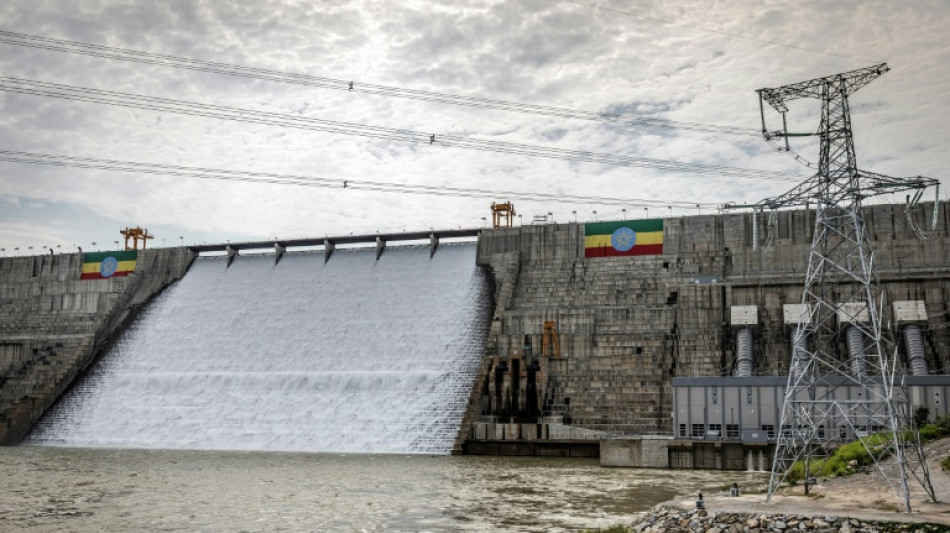
Ethiopia inaugurates Africa's biggest dam / Photo: Luis TATO - AFP

Ethiopia inaugurates Africa's biggest dam

Ethiopia was set to inaugurate Africa's largest hydroelectric project on Tuesday that has promised to revolutionise the country's energy sector but sparked diplomatic rows with downstream neighbour Egypt.

Text size:

For Ethiopia, the Grand Renaissance Dam (GERD) is a national project of historic scale and a rare unifying symbol in a country torn apart by ongoing internal conflicts.

Towering 145 metres (476 feet) high and stretching nearly two kilometres (1.2 miles) across the Blue Nile near the Sudanese border, the $4-billion megastructure is designed to hold 74 billion cubic metres of water and generate 5,000 megawatts of electricity -- more than double Ethiopia's current capacity.

That makes it the largest dam by power capacity in Africa, though still outside the top 10 globally.

Images on state media showed Prime Minister Abiy Ahmed touring the site early Tuesday with Kenyan President William Ruto, Somalia's President Hassan Sheikh Mohamud and African Union chief Mahmoud Ali Youssouf.

The festivities began the night before with a dazzling display of lanterns, lasers and drones writing slogans like "geopolitical rise" and "a leap into the future", watched by Abiy who has made the project a cornerstone of his rule.

Some 45 percent of Ethiopia's 130 million people lack electricity, according to World Bank data, and frequent blackouts in Addis Ababa force businesses and households to rely on generators.

Analysts argue the GERD, under construction since 2011, could transform Ethiopia's economy, boosting industrial production, enabling a shift towards electric vehicles and supplying power-hungry neighbours through regional interconnectors that stretch as far as Tanzania.

But neighbouring Egypt, dependent on the Nile for 97 percent of its water, sees a looming disaster.

With a population of 110 million and little rainfall, Egypt's reliance on the river is absolute.

President Abdel Fattah al-Sisi has repeatedly called the dam an "existential threat" and vowed Egypt would take all measures under international law to defend its water security.

"Whoever thinks Egypt will turn a blind eye to its water rights is mistaken," he told reporters last month.

The standoff has sharpened regional rivalries. Egypt has strengthened ties with Eritrea and Somalia -- both of which have tense relations with Ethiopia -- and coordinates closely with Sudan, which also worries about reduced flows.

Attempts at mediation by the United States, World Bank, Russia, the UAE and the African Union have all faltered over the past decade.

"For the Egyptian leadership, GERD is not just about water, it is about national security. A major drop in water supply threatens Egypt's internal stability. The stakes are economic, political and deeply social," said Mohamed Mohey el-Deen, formerly part of Egypt's team assessing GERD's impact.

The tensions have not been all bad for Ethiopia's government.

"Ethiopia is located in a rough neighbourhood and with growing domestic political fragility, the government seeks to use the dam and confrontation with neighbours as a unifying strategy," said Alex Vines, of the European Council on Foreign Relations.

(K.Lüdke--BBZ)