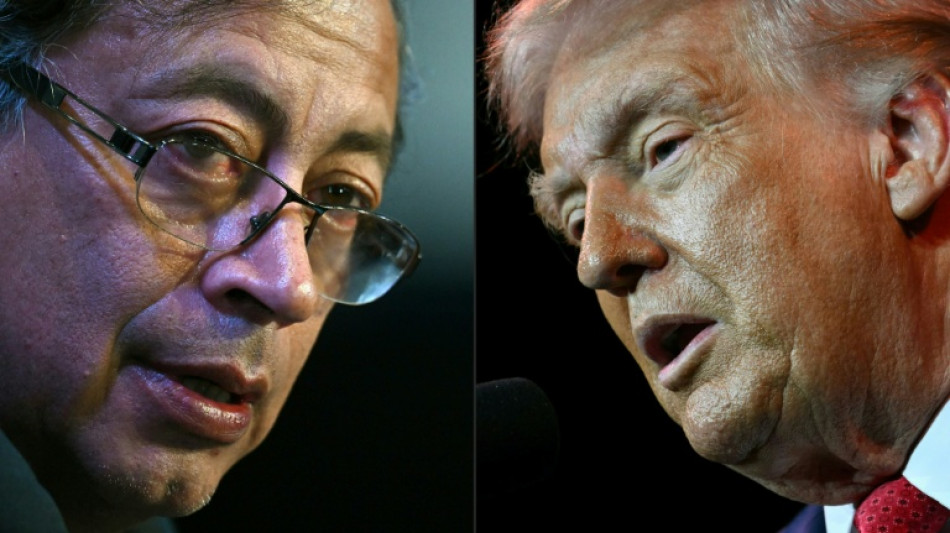
Online foes Trump, Petro set for White House face-to-face / Photo: Luis ROBAYO, Mandel NGAN - AFP/File

Colombia abruptly agreed to accept US deportation flights on Friday, an olive branch days before the countries' dueling presidents meet face-to-face for the first time, at the White House.
One is an alleged "racist" and "authoritarian," the other a "low rated" "drug leader" who should "watch his ass."
After months of trading insults from their very active social media accounts, presidents Donald Trump and Gustavo Petro will hold an unlikely summit in Washington on Tuesday.
Trump and Petro come from opposite ends of the political spectrum, and have sparred over everything from Israeli operations in Gaza to jailed migrants to Venezuela.
Petro will have a US visa ban suspended for the visit -- which comes after months of US sanctions, funding cuts and threats to bomb targets in Colombia.
That the meeting is happening is a sign of improved relations, but in Bogota there is deep nervousness about what might happen.
The Colombian leader is an ardent leftist, an ex-guerrilla and prone to long monologues laden with references to history and mythology.
Trump rarely likes to share the spotlight and has admitted to having a short attention span.
Diplomats joke darkly about Petro being "Zelenskyed" -- receiving an Oval Office dressing down like the Ukrainian president.
"Both Trump and Petro are volatile," said Felipe Botero, a political expert at the University of the Andes. "The meeting could easily go off the rails."
- 'It will work out' -
The meeting is likely to focus on drugs: Colombia is the world's biggest producer of cocaine, and the United States by far its largest consumer.
For decades, Colombia has been Washington's closest partner in Latin America, with billions of dollars flowing to Bogota to boost the country's military and intelligence services in the drug fight.
But under Petro, coca production and cocaine exports have surged.
Critics blame the end of eradication programs and his policy of negotiating with an alphabet soup of drug-running guerrillas, cartels and paramilitaries who still control swaths of the country.
A January 7 phone call appears to have been a turning point between the two leaders.
"I appreciated his call and tone," Trump said after the call. "I am sure it will work out very well for Colombia and the USA."
Petro leaves office later this year, but for Colombia, the stakes are huge: hundreds of millions of dollars a year in military and other aid and the country's most important trading relationship.
Ahead of the meeting, Petro took steps to please Washington, announcing the resumption of migrant deportation flights to Colombia, the original trigger of the Petro–Trump conflict.
There will be 20 flights, averaging "one a week," according to Colombian Foreign Minister Rosa Villavicencio.
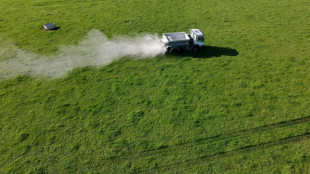
Colombia will also restart glyphosate fumigation to destroy coca crops, a practice halted since 2015 and strongly opposed by Petro as a senator.
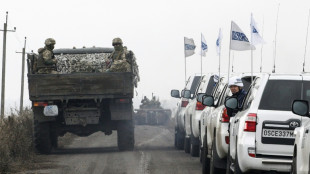
The government says Petro also agreed with Trump to act jointly against the ELN -- Colombia's largest guerrilla group -- near the Venezuela border, after failed peace talks.
The visit comes before Colombia's May elections, where left-wing candidate Ivan Cepeda leads polls to succeed Petro. Cepeda recently accused the United States of trying to "influence" the election.
(T.Burkhard--BBZ)