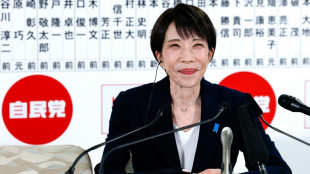
Takaichi on course for landslide win in Japan election / Photo: Kazuhiro NOGI - AFP

Japanese Prime Minister Sanae Takaichi was on course for a thumping victory in snap elections on Sunday, a result that could however rile China and worry financial markets.
Capitalising on her honeymoon start as Japan's first woman premier, Takaichi's ruling bloc looked to have secured a two-thirds majority in the lower house, according to media estimates.
If confirmed, it would be the best result for the Liberal Democratic Party (LDP) since elections in 2017 under Takaichi's mentor, assassinated former prime minister Shinzo Abe.
The LDP alone was seen winning about 300 of the 465 seats up for grabs, up from 198, and regaining a majority -- and potentially a super-majority on its own without its junior partner, the Japan Innovation Party (JIP).
"We received (voter) backing for Prime Minister Sanae Takaichi's responsible, proactive fiscal policies and a strengthening of national defence capabilities," LDP secretary general Shunichi Suzuki told media.
The new Centrist Reform Alliance of the main opposition Constitutional Democratic Party (CDP) and the LDP's previous partner Komeito looked to have lost more than two-thirds of its 167 seats.
The anti-immigration Sanseito party was projected to have increased its seats from two to between five and 14, broadcaster NHK said.
- A hit with voters -
Takaichi has injected new life into the LDP, which has governed Japan almost non-stop for decades but which has shed support in recent elections because of unhappiness about rising prices and corruption.
A heavy metal drummer in her youth and an admirer of Britain's "Iron Lady" Margaret Thatcher, Takaichi was on the ultra-conservative fringe of the LDP when she became party chief and prime minister in October.
She has defied pessimists to be a hit with voters, especially young ones, with fans lapping up everything from her handbag to her jamming to a K-pop song with South Korea's president.
She also pulled out all the stops to welcome US President Donald Trump shortly after she took office.
Two days before the polls, Trump endorsed Takaichi as a "strong, powerful, and wise Leader, and one that truly loves her Country".
But she will have to deliver on the economy and inflation, which contributed to the demise of her two predecessors, Fumio Kishida and Shigeru Ishiba.
"With prices rising like this, what matters most to me is what policies they'll adopt to deal with inflation," Chika Sakamoto, 50, told AFP at a voting station in a snowy Tokyo on Sunday.
"Prices for just about everything are really going up, but incomes aren't rising much, so our disposable income is shrinking," she said.
- Pandas and public debt -
However, Takaichi has not had everything her own way, particularly with regard to worries about her stewardship of the public finances of Asia's number-two economy.
She followed up a $135 billion stimulus package aimed at easing the pain of inflation -- a big cause of voter discontent -- with a campaign promise to suspend a consumption tax on food.
Japan's debt is more than twice the size of the entire economy, and in recent weeks yields on long-dated bonds have hit record highs, causing jitters worldwide.
"Various parties are proposing policies like abolishing the consumption tax. While that might be fine for now, I'm very worried about whether such measures are truly responsible for the generations that come after us," voter Taku Sakamoto, 49, told AFP.
"We have consistently stressed the importance of responsible and proactive fiscal policy," Takaichi insisted late Sunday.
Her election triumph may also cause consternation in Beijing.
Barely two weeks in office, Takaichi -- seen before assuming the premiership as a China hawk -- suggested that Japan could intervene militarily if Beijing sought to take self-ruled Taiwan by force.
China, which regards the democratic island as part of its territory and has not ruled out force to annex it, was furious with her unscripted remarks.
It summoned Tokyo's ambassador, warned its citizens against visiting Japan and conducted joint air drills with Russia. Japan's last two pandas were even returned to China last month.
Margarita Estevez-Abe, associate professor of political science at Syracuse University, said the China episode raised Takaichi's popularity even more.
"Now she doesn't have to worry about any elections until 2028, when the next upper house elections will take place," Estevez-Abe told AFP before the polls.
"So the best scenario for Japan is that Takaichi kind of takes a deep breath and focuses on amending the relationship with China."
(Y.Berger--BBZ)