'Strangled': Pakistan faces economic imperative in Iran war peace push / Photo: Aamir QURESHI - AFP/File

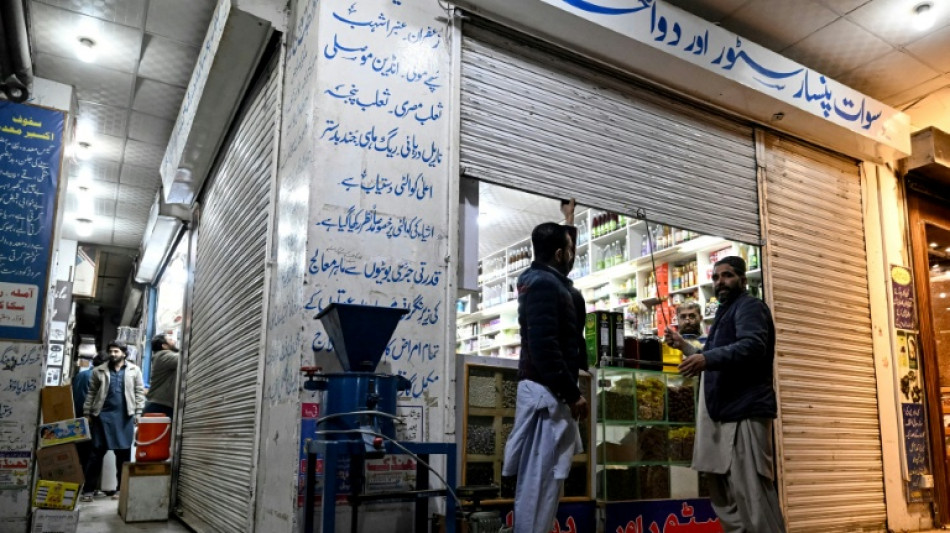
Sheikh Nadeem sat on a plastic chair outside his bedding store in the Pakistani capital Islamabad, scrolling through his phone as he waited for customers he knew were not coming.
Between rising fuel costs and rolling blackouts due to the US-Israel war on Iran, and government restrictions on opening hours aimed at saving electricity, he said the effect on business owners has been "devastating".
"We can't cover our expenses, and neither do we have the income to be able to pay our workers' salaries," the 40-year-old told AFP this week.
Pakistan has been enjoying the diplomatic spotlight as it mediates between the United States and Iran, burnishing its credentials as a regional power -- but it has a pressing economic imperative to resolve the crisis, too.
Ravaged by decades of external shocks and mismanagement, Pakistan's economy is heavily dependent on oil and natural gas imports from the Gulf, and a sustained supply and price shock could push the country's nascent macroeconomic recovery back over the edge.
Some say the process has already begun. Petrol prices are up by more than 14 percent at the pump, and last week authorities ordered widespread rolling blackouts to save precious natural gas.
"When petrol goes up, everything becomes more expensive," said Waqar Saleem, a day labourer at an Islamabad shoe store. "Flour, sugar, everything. When we go to get vegetables they tell us that freight transportation is closed."
For economic analyst Khurram Husain, the blackouts are the main problem, with knock-on effects for both industries and households.
"This is the real crisis," he said.
The shock is hitting just as the country was cautiously emerging from the depths of one of its cyclical economic upheavals.
- 'Where is the growth?' -
Consumer inflation hit 7.3 percent in March, according to official data, but Pakistanis have been reeling from years of double-digit pandemic-era price increases, which hit a peak of 38 percent in May 2023.
Unemployment was at 7.1 percent last year, as per government data, but around 29 percent of the country's more than 250 million people remain in poverty -- up from 23 percent in 2018-19.
While policymakers have touted a recovery from the brink of sovereign default three years ago, people say macroeconomic stability has not translated to better opportunities.
"They say that our country is going towards prosperity, but we do not see it," said Saleem, the shoe-store worker.
The real conundrum for Pakistan's economy has always been finding drivers for GDP growth, and that challenge remains. The International Monetary Fund (IMF) this month lowered its 2026 growth forecast to 3.6 percent -- down 0.8 percentage points due to the Middle East war.
The country remains heavily indebted, and is currently locked into a $7 billion IMF programme.
"This regime has been on for about three years and beyond stabilisation they have nothing to show for it," said a Pakistani economic official, speaking on condition of anonymity.
"Three years down the line, everybody is asking: where is the growth going to come from?"
The textile sector -- one of the country's largest exporters -- will be first in line to feel the pain from a prolonged energy shock, the official added.
Medium-scale factories and small-scale businesses such as Nadeem's bedding store will likely be the next in line.
"For the last year I have been paying out of my own pocket, how much longer can I go on like this?" he asked.
- 'Hand to mouth' -
The war has posed serious challenges for Pakistani households, too.
The country is shielded from the fertiliser shortages caused by the closure of the Strait of Hormuz because it produces most of its own supply.
That sector, however, is dependent on imported natural gas. The government has not yet cut supplies, but as imports grow more expensive, there will be a knock-on effect on food prices.
"Food security is a big problem because when there isn't gas then there won't be fertiliser," said the economic official.
Husain was more optimistic about fertiliser prices being managed, but said food prices would likely increase due to higher transportation costs.
Battered by years of economic uncertainty, Muhammad Ahsan said the current crisis has put him at his wits' end.
"If this goes on for another two or four months then our entire business will be finished," he said, sitting at the counter of his small jewellery kiosk.
"We are hand-to-mouth people. We earn in a day so that we can spend it (the same day)."
He was glad to hear Pakistan is taking the lead on mediating an end to the war, but wanted more from policymakers on the home economic front.
"Fine, you are taking the country forward on the diplomatic front, no doubt," he said.
"But the people are being strangled. They are dying."
(Y.Yildiz--BBZ)