What's behind the Pakistani strikes on Afghanistan? / Photo: STR - AFP

Airstrikes that hit Afghanistan's border area and the key city of Kandahar are a clear warning from Pakistan to the country's supreme leader, analysts told AFP.
With vital security issues still unresolved between the neighbouring countries, renewed violence raises the spectre of a return to full-scale war seen earlier this year.
The latest strikes followed militant attacks in Pakistan and hit 10 targets, Islamabad said Thursday, while the Afghan government reported four civilians killed.
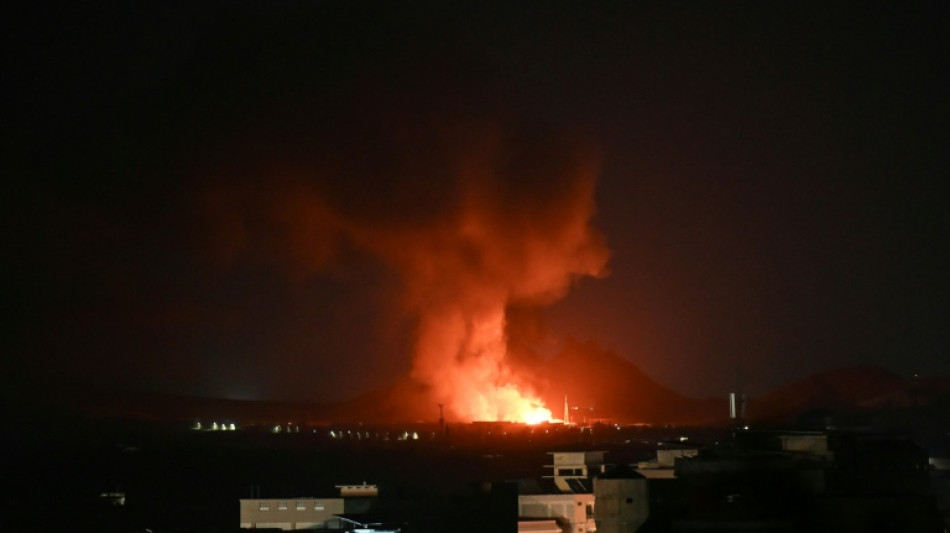
In Kandahar, home to the Taliban government's supreme leader, Hibatullah Akhundzada, a fireball lit up the night sky.
Antonio Giustozzi, a senior research fellow at the UK-based RUSI think tank, said "the Pakistanis are signalling their willingness to escalate".
"The Taliban are not very worried about these strikes along the border," he told AFP.
"This strike on Kandahar is another way of reminding the Taliban that they can come after you," added Giustozzi, in reference to the Afghan leadership.
Although there has been a series of recent strikes near the frontier, this is the first confirmed Pakistani bombardment of Kandahar since March.
It follows a militant attack on a police headquarters in northern Pakistan last week that killed at least 31 people, as well as Islamabad reporting drones launched across the border.
Pakistan said the latest strikes were limited to "identified military objectives" linked to attempted attacks.
For Giustozzi, "the Pakistani military has to show to the Pakistani public that they are responding", regardless of the value of such operations.
Farzana Shaikh, an associate fellow at the Chatham House think tank, said Islamabad clearly feels that Afghanistan is not doing enough to tackle militant groups such as the Pakistani Taliban (TTP) that frequently commit attacks.
However, she said, "the issue is actually far more complex than simply this trading of accusations".
The Afghan government is concerned that if it curbs the Pakistani Taliban, "many of these TTP fighters would gravitate towards (the) Islamic State" group, Shaikh said.
The group's regional branch, IS-K, had carried out multiple deadly attacks in Afghanistan since the Taliban authorities returned to power in 2021.
The Afghan government denies Pakistan's accusation that it shelters groups such as the TTP.
But with Islamabad confronting a rise in militant violence, Shaikh said the Kandahar strike "probably sends out a very powerful message that Pakistan will respond not only forcefully, but also target the top leadership".
- Bring Afghanistan 'to heel' -
Georges Lefeuvre, a research associate at the French Institute for International and Strategic Affairs (IRIS), suggested Pakistan's operation was calculated as part of the "tit for tat" between the two countries.
"There does not seem to have been, on Pakistan's part, any intention to cause mass casualties," he said.
"This is not an escalation of the conflict; it is the continuation of a conflict that is not finding any resolution," encompassing both militancy and long-festering frontier disputes, Lefeuvre said.
There has been a considerable diplomatic effort to resolve the conflict this year, with China hosting talks and countries including Qatar, Saudi Arabia and Turkey also engaging.
But global interest has been focused since February on the United States' war against Iran, in which Pakistan has sought to act as a peacemaker.
Giustozzi said multiple countries have been putting pressure on the Afghan government, which has been making an effort to "restrain" the TTP.
Mediating countries "are trying to at least resolve these issues so that Pakistan can pay greater attention to the developments in the Gulf and the Middle East", he said.
Shaikh, meanwhile, suggested that with the world distracted by the Iran war, Pakistan may think it should "seize the opportunity while it can to bring the government in Kabul to heel".
"Pakistan has made a big play of its commitment to diplomacy and dialogue, but seems quite incapable of reaching out to those Talibs to bring about any shift in the current deadly situation," she said.
burs-iw-rsc/ksb
(T.Renner--BBZ)