Berliner Boersenzeitung - Runaway black hole creating trail of new stars: scientists

EUR -
AED 4.364958
AFN 78.444506
ALL 96.70307
AMD 449.057774
ANG 2.127603
AOA 1089.902292
ARS 1708.847087
AUD 1.717983
AWG 2.139394
AZN 2.01877
BAM 1.956923
BBD 2.389221
BDT 145.153323
BGN 1.996019
BHD 0.448092
BIF 3495.859672
BMD 1.188552
BND 1.505413
BOB 8.214716
BRL 6.276621
BSD 1.186251
BTN 107.803883
BWP 15.612502
BYN 3.382613
BYR 23295.624435
BZD 2.385819
CAD 1.630723
CDF 2620.75823
CHF 0.922789
CLF 0.02603
CLP 1027.800964
CNY 8.265609
CNH 8.266621
COP 4385.460727
CRC 587.017211
CUC 1.188552
CUP 31.496635
CVE 110.328332
CZK 24.237073
DJF 211.246819
DKK 7.468429
DOP 74.280139
DZD 153.471835
EGP 55.935871
ERN 17.828284
ETB 184.403724
FJD 2.627289
FKP 0.872372
GBP 0.868154
GEL 3.19738
GGP 0.872372
GHS 12.936426
GIP 0.872372
GMD 87.388748
GNF 10390.614856
GTQ 9.104226
GYD 248.19247
HKD 9.26839
HNL 31.461097
HRK 7.527697
HTG 155.462701
HUF 381.591842
IDR 19975.997953
ILS 3.704022
IMP 0.872372
INR 109.027267
IQD 1557.00347
IRR 50067.764438
ISK 145.419082
JEP 0.872372
JMD 186.730905
JOD 0.842704
JPY 183.390644
KES 153.025863
KGS 103.938991
KHR 4789.8653
KMF 496.159455
KPW 1069.717862
KRW 1720.370131
KWD 0.364362
KYD 0.988567
KZT 596.062159
LAK 25592.475576
LBP 106264.579767
LKR 367.277739
LRD 219.465981
LSL 19.046608
LTL 3.509486
LVL 0.718943
LYD 7.491143
MAD 10.848507
MDL 20.012319
MGA 5354.428161
MKD 61.665398
MMK 2495.882361
MNT 4238.458474
MOP 9.527669
MRU 47.40474
MUR 54.102781
MVR 18.374713
MWK 2059.760902
MXN 20.601766
MYR 4.709641
MZN 75.770314
NAD 19.04657
NGN 1678.235871
NIO 43.61925
NOK 11.612471
NPR 172.480204
NZD 1.991194
OMR 0.456997
PAB 1.186281
PEN 3.983433
PGK 5.147782
PHP 70.242841
PKR 332.179897
PLN 4.206595
PYG 7972.408726
QAR 4.327935
RON 5.096396
RSD 117.419444
RUB 90.957782
RWF 1726.966444
SAR 4.457015
SBD 9.604652
SCR 17.94765
SDG 714.916838
SEK 10.617106
SGD 1.508612
SHP 0.891722
SLE 28.988778
SLL 24923.345894
SOS 676.765709
SRD 45.3135
STD 24600.632251
STN 24.543604
SVC 10.379958
SYP 13144.882814
SZL 19.040224
THB 37.066156
TJS 11.074143
TMT 4.171818
TND 3.399557
TOP 2.861748
TRY 51.574017
TTD 8.061628
TWD 37.410157
TZS 3013.543344
UAH 51.143167
UGX 4205.414042
USD 1.188552
UYU 44.515741
UZS 14399.310448
VES 425.753257
VND 31077.076128
VUV 142.3479
WST 3.275161
XAF 656.317181
XAG 0.010834
XAU 0.000235
XCD 3.212122
XCG 2.137927
XDR 0.816245
XOF 656.67149
XPF 119.331742
YER 281.448332
ZAR 19.012896
ZMK 10698.406719
ZMW 23.161808
ZWL 382.713345
  • SCS

    0.0200

    16.14

    +0.12%

  • CMSD

    0.0300

    24.16

    +0.12%

  • RBGPF

    -0.8300

    82.4

    -1.01%

  • NGG

    1.0800

    82.58

    +1.31%

  • RYCEF

    0.0000

    17.12

    0%

  • CMSC

    0.0300

    23.78

    +0.13%

  • RIO

    0.0400

    90.47

    +0.04%

  • GSK

    1.1700

    50.32

    +2.33%

  • BTI

    -0.1700

    58.99

    -0.29%

  • BCE

    -0.0500

    25.15

    -0.2%

  • VOD

    0.0600

    14.23

    +0.42%

  • BCC

    -0.9300

    83.4

    -1.12%

  • RELX

    -0.3900

    39.51

    -0.99%

  • JRI

    0.0500

    13.73

    +0.36%

  • AZN

    1.2800

    94.23

    +1.36%

  • BP

    0.2300

    36.76

    +0.63%

Runaway black hole creating trail of new stars: scientists
Runaway black hole creating trail of new stars: scientists / Photo: Handout - NASA/ESA/AFP

Runaway black hole creating trail of new stars: scientists

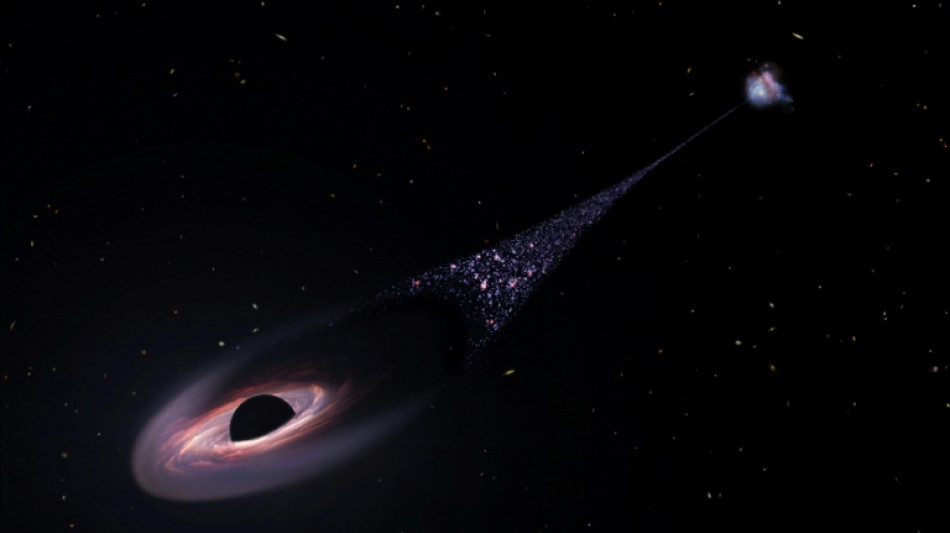
A huge black hole is tearing through space, leaving behind a 200,000-light-year-long trail of newborn stars, space scientists say.

Text size:

The supermassive monster -- likely born of a bizarre game of intergalactic billiards -- is rampaging through the blackness and plowing into gas clouds in its path.

The incredible forces at play mean this gas is being forged into a contrail of new stars, which have been captured on camera by NASA's powerful Hubble Space Telescope.

"We think we're seeing a wake behind the black hole where the gas cools and is able to form stars," said Pieter van Dokkum of Yale University.

"What we're seeing is the aftermath. Like the wake behind a ship, we're seeing the wake behind the black hole."

Researchers believe gas is probably being blasted and warmed by the motion of the black hole.

"Gas in front of it gets shocked because of this supersonic, very high-velocity impact of the black hole moving through the gas," said van Dokkum.

The black hole weighs about the same as 20 million of our Suns.

Scientists believe it began its rampage after being ejected from a celestial menage-a-trois.

The working theory is that two galaxies probably merged about 50 million years earlier, bringing together two supermassive black holes, which whirled around each other harmoniously.

But a third galaxy butted in with its own black hole, creating an unstable and chaotic scene that eventually saw one of them ejected at high speed -- fast enough to travel between the Earth and the Moon in just 14 minutes.

Stargazers say there is no cause for earthly concern because this is all very far away.

It's also a long time ago -- back when the universe was half of its current age. We are seeing it now because of the time it has taken for light to arrive here.

The runaway black hole, which has never been seen before, was discovered by accident, says van Dokkum.

"I was just scanning through the Hubble image and then I noticed that we have a little streak.

"It didn't look like anything we've seen before," he said, adding the star trail is "quite astonishing, very, very bright and very unusual."

While this is the first tearaway black hole ever spotted, it might not be the only one, says NASA.

Their Nancy Grace Roman Space Telescope, which is expected to launch some time this decade, should give astronomers a much wider view of the universe -- and could lead to the discovery of more of these star-forming runaways.

(L.Kaufmann--BBZ)