Berliner Boersenzeitung - NASA lab hopes to find life's building blocks in asteroid sample

EUR -
AED 4.275122
AFN 76.951508
ALL 96.407134
AMD 444.158219
ANG 2.083785
AOA 1067.470349
ARS 1669.879159
AUD 1.756945
AWG 2.098273
AZN 1.982723
BAM 1.954314
BBD 2.344718
BDT 142.311827
BGN 1.956539
BHD 0.438825
BIF 3451.527319
BMD 1.16409
BND 1.509659
BOB 8.072898
BRL 6.324382
BSD 1.164115
BTN 104.788799
BWP 15.487294
BYN 3.366755
BYR 22816.167101
BZD 2.34133
CAD 1.61215
CDF 2598.24936
CHF 0.939117
CLF 0.027394
CLP 1074.676357
CNY 8.232097
CNH 8.229826
COP 4473.144483
CRC 568.467899
CUC 1.16409
CUP 30.848389
CVE 110.763347
CZK 24.281
DJF 206.882482
DKK 7.468768
DOP 74.793271
DZD 151.372477
EGP 55.255519
ERN 17.461352
ETB 180.96902
FJD 2.644574
FKP 0.873102
GBP 0.873493
GEL 3.137243
GGP 0.873102
GHS 13.34018
GIP 0.873102
GMD 85.560233
GNF 10114.201488
GTQ 8.917222
GYD 243.555916
HKD 9.057145
HNL 30.660694
HRK 7.53518
HTG 152.42414
HUF 384.552518
IDR 19432.448033
ILS 3.753202
IMP 0.873102
INR 104.919737
IQD 1525.040794
IRR 49037.297726
ISK 148.956952
JEP 0.873102
JMD 186.628141
JOD 0.825353
JPY 181.402491
KES 150.458805
KGS 101.799956
KHR 4663.34582
KMF 491.246319
KPW 1047.68099
KRW 1710.374588
KWD 0.35748
KYD 0.970167
KZT 594.867832
LAK 25246.917892
LBP 104249.206439
LKR 359.226946
LRD 205.474698
LSL 19.767474
LTL 3.437256
LVL 0.704147
LYD 6.326191
MAD 10.754126
MDL 19.738082
MGA 5191.076484
MKD 61.65593
MMK 2444.623116
MNT 4130.162301
MOP 9.329409
MRU 46.425711
MUR 53.687521
MVR 17.930364
MWK 2018.674247
MXN 21.260823
MYR 4.789653
MZN 74.397151
NAD 19.767474
NGN 1689.235207
NIO 42.837439
NOK 11.785435
NPR 167.662278
NZD 2.015686
OMR 0.447595
PAB 1.16412
PEN 3.915824
PGK 4.940245
PHP 68.817513
PKR 329.015111
PLN 4.236968
PYG 8005.914588
QAR 4.243275
RON 5.090684
RSD 117.406669
RUB 89.112309
RWF 1693.812509
SAR 4.36897
SBD 9.581151
SCR 15.605213
SDG 700.206137
SEK 10.938137
SGD 1.510522
SHP 0.873369
SLE 27.609677
SLL 24410.386406
SOS 664.098062
SRD 45.002513
STD 24094.315986
STN 24.481391
SVC 10.186257
SYP 12871.148147
SZL 19.761979
THB 37.145973
TJS 10.680981
TMT 4.085956
TND 3.419501
TOP 2.80285
TRY 49.505728
TTD 7.887039
TWD 36.296671
TZS 2852.020713
UAH 49.077196
UGX 4118.869188
USD 1.16409
UYU 45.475433
UZS 13958.390025
VES 299.876844
VND 30685.41657
VUV 141.83633
WST 3.246193
XAF 655.461589
XAG 0.02003
XAU 0.000278
XCD 3.146012
XCG 2.098105
XDR 0.815047
XOF 655.458776
XPF 119.331742
YER 277.693509
ZAR 19.829345
ZMK 10478.205074
ZMW 26.920653
ZWL 374.836556
  • RBGPF

    0.8500

    79.2

    +1.07%

  • BCC

    -1.2400

    71.81

    -1.73%

  • GSK

    0.0600

    48.47

    +0.12%

  • SCS

    -0.0200

    16.12

    -0.12%

  • CMSD

    -0.0800

    23.17

    -0.35%

  • RIO

    -0.0400

    73.02

    -0.05%

  • NGG

    -0.0800

    75.33

    -0.11%

  • CMSC

    -0.2100

    23.22

    -0.9%

  • RELX

    -0.8400

    39.48

    -2.13%

  • AZN

    1.1000

    91.28

    +1.21%

  • BTI

    0.4000

    57.41

    +0.7%

  • JRI

    -0.0700

    13.72

    -0.51%

  • VOD

    0.0300

    12.5

    +0.24%

  • RYCEF

    0.3100

    14.8

    +2.09%

  • BCE

    -0.2100

    23.34

    -0.9%

  • BP

    -0.0500

    35.78

    -0.14%

NASA lab hopes to find life's building blocks in asteroid sample
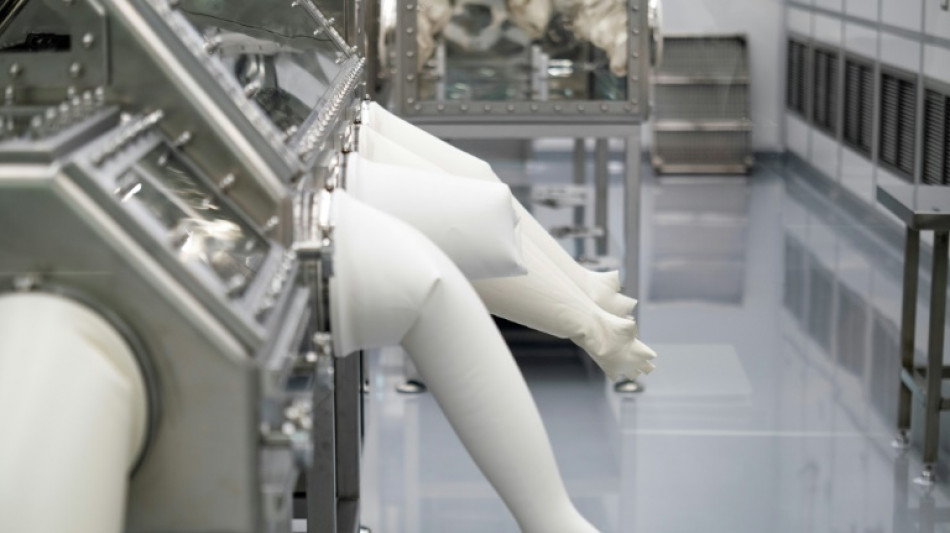
NASA lab hopes to find life's building blocks in asteroid sample / Photo: Mark Felix - AFP

NASA lab hopes to find life's building blocks in asteroid sample

Eager scientists and a gleaming lab awaits.

Text size:

A sample from the asteroid Bennu, which could be key to understanding the formation of the solar system and our own planet, is set to be analyzed at NASA's Johnson Space Center in Houston after it reaches Earth in late September.

The precious cargo is currently aboard OSIRIS-REx, a US space probe launched in 2016 to Bennu, which orbits the Sun at an average distance of about 105 million miles (168 million kilometers).

Long white sleeves hang from the huge metal and glass box in which the sample will be handled.

Scientists will separate pieces of the rock and dust for study now, while carefully storing away the rest for future generations equipped with better technology -- a practice first started during the Apollo missions to the Moon.

"We don't expect there to be anything living but (rather) the building blocks of life," Nicole Lunning, lead OSIRIS-Rex sample curator, told AFP.

"That's really what motivated going to this type of asteroid, to understand what the precursors were that may have fostered life in our solar system and on Earth."

Once the return vessel arrives at the Texas "cleanroom," Lunning's job will be to carefully disassemble it and separate the contents, all while keeping the material pure and uncontaminated.

- Origins of life -

The spacecraft is scheduled to land in the Utah desert on September 24, carrying an estimated 8.8 ounces, or 250 grams of material -- just over a cupful.

Obtaining it involved a high-risk operation in October 2020: the probe came into contact with the asteroid for a few seconds, and a blast of compressed nitrogen was emitted to raise the dust sample which was then captured.

The whole mission was imperiled when NASA realized a few days later that the valve of the collection compartment was failing to close, letting fragments escape into space.

But the precious cargo was finally secured after being transferred to a capsule fixed in the spacecraft's center.

The first samples brought to Earth by asteroids were carried out by Japanese probes in 2010 and 2020, with the latter found to contain uracil, one of the building blocks of RNA.

The finding lent weight to a longstanding theory that life on Earth may have been seeded from outer space when asteroids crashed into our planet carrying fundamental elements.

Cosmochemist Eve Berger can't wait to get to work on the Bennu material.

"These samples haven't hit the Earth. They haven't been exposed to our atmosphere. They haven't been exposed to really anything except harsh space for billions of years," she said.

Ultimately they "will help us to determine whether what we really think is true, is true," said Berger.

Not only might the Bennu sample add to our knowledge of the ingredients that brought life to our world, but "if we can figure out what happened here on the Earth, that helps us to extrapolate to other bodies where we might look or how we might interpret what we're seeing," she added.

Could Bennu bring back something that's never been seen before? "You never know," said Berger.

"Bennu is a trickster, so we'll know more in a few months when the sample comes back -- that would be exciting!"

(F.Schuster--BBZ)