Dazzling auroras fade from skies as sunspot turns away / Photo: Geoff Robins - AFP

The spectacular auroras that danced across the sky in many parts of the world over the weekend are fading, scientists said Monday, as the massive sunspot that caused them turns its ferocious gaze away from Earth.
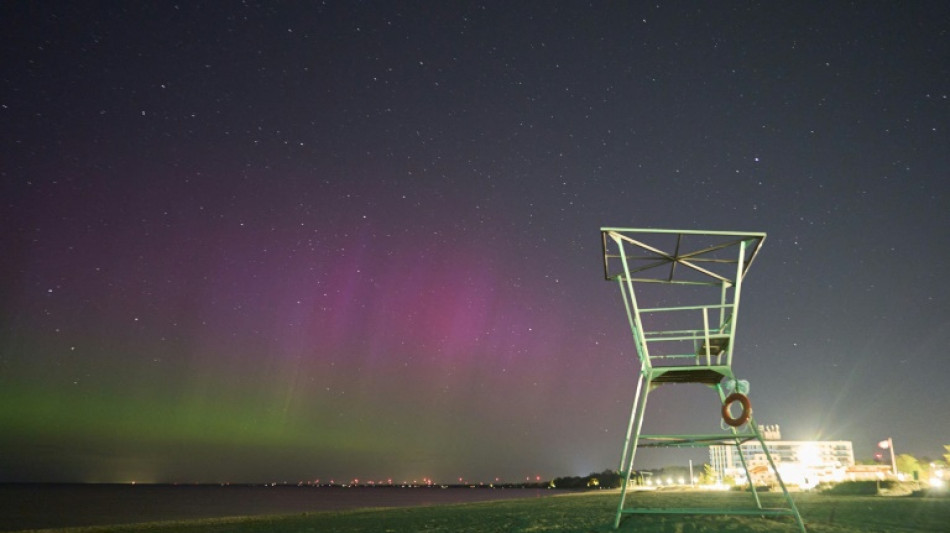
Since Friday, the most powerful solar storm to strike our planet in more than two decades has lit up night skies with dazzling auroras in the United States, Tasmania, the Bahamas and other places far from the extreme latitudes where they are normally seen.
But Eric Lagadec, an astrophysicist at France's Observatoire de la Cote d'Azur, told AFP that the "most spectacular" period of this rare event has come to an end.
The first of several coronal mass ejections (CMEs) -- expulsions of plasma and magnetic fields from the Sun -- came just after 1600 GMT Friday, according to the US-based National Oceanic and Atmospheric Administration (NOAA).
The event was later upgraded to an "extreme" geomagnetic storm -- the first since the "Halloween Storms" of October 2003 that caused blackouts in Sweden and damaged power infrastructure in South Africa.
Excitement over the phenomenon -- and otherworldly photos of pink, green and purple night skies -- broke out across the world, from Austria to Australia's island state of Tasmania.
The storm had been forecast to intensify again until 0600 GMT Monday, the NOAA said, adding that auroras could be viewable as far south as New York.
But thousands of people who came out on Sunday night in the hope of seeing the aurora borealis over the Joshua Tree National Park in California instead saw the Milky Way. AFP pictures showed stars shining clearly in the night sky.
- 'Monster sunspot' -
Lagadec said that while there were further solar outbursts on Sunday, it is unlikely that more auroras will be visible to the naked eye in lower latitudes such as in France.
"Only the most experienced photographers will be able to capture them" in such areas, said Lagadec, who was moved by witnessing an aurora during the event's peak on Friday night.
The solar storm emanated from a massive sunspot cluster that is 17 times wider than our planet.
The storm has not ended, and auroras are expected to continue in the far northern or southern regions where they are normally visible.
But "the source of the storm is a sunspot that is now on the edge of the Sun, (so) we do not expect the next coronal mass ejections to head in Earth's direction," Lagadec said.
Scientists had already warned that the intensity of anything seen on Sunday night would unlikely reach the level of Friday's show.
"This is likely the last of the Earth-directed CMEs from this particular monster sunspot," Mathew Owens, a professor of space physics at the UK's University of Reading, told AFP.
When charged particles from solar winds are captured by Earth's magnetic field, they accelerate towards the planet's magnetic poles, which is why auroras are normally seen there.
But during periods of heightened solar activity, the effects extend farther toward the equator.
- Satellites weathered storm -
Unlike during 2003's solar storms, no major disruptions to power or communications networks appear to have been reported this time around.
Elon Musk's satellite internet operator Starlink said on X that its thousands of satellites in low Earth orbit had "weathered the geomagnetic storm and remain healthy".
Unlike solar flares, which travel at the speed of light and reach Earth in around eight minutes, CMEs travel at a more sedate pace, with officials putting the current average at 800 kilometers (500 miles) per second.
People with eclipse glasses can still look for the sunspot cluster during the day.
Fluctuating magnetic fields associated with geomagnetic storms induce currents in long wires, including power lines, which can lead to blackouts. Long pipelines can also become electrified.
Spacecraft are at risk from high doses of radiation, although the atmosphere prevents this from reaching Earth.
Even pigeons and other species that have internal biological compasses can be affected.
(A.Berg--BBZ)