Berliner Boersenzeitung - Webb telescope finds most distant galaxy ever observed, again

EUR -
AED 4.393318
AFN 77.747328
ALL 97.061495
AMD 452.609388
ANG 2.141116
AOA 1096.82506
ARS 1723.902185
AUD 1.716885
AWG 2.154477
AZN 2.015163
BAM 1.96411
BBD 2.406
BDT 145.978881
BGN 2.008696
BHD 0.450889
BIF 3552.419669
BMD 1.196101
BND 1.512952
BOB 8.254824
BRL 6.269397
BSD 1.194564
BTN 109.571071
BWP 15.722657
BYN 3.403917
BYR 23443.577612
BZD 2.402586
CAD 1.62943
CDF 2637.402216
CHF 0.917045
CLF 0.026139
CLP 1032.007751
CNY 8.318104
CNH 8.30887
COP 4410.885206
CRC 593.516226
CUC 1.196101
CUP 31.696674
CVE 110.734461
CZK 24.26207
DJF 212.72831
DKK 7.467731
DOP 75.158637
DZD 154.280296
EGP 56.23687
ERN 17.941513
ETB 185.732536
FJD 2.636984
FKP 0.873322
GBP 0.867795
GEL 3.217131
GGP 0.873322
GHS 13.079396
GIP 0.873322
GMD 87.314699
GNF 10465.882724
GTQ 9.165859
GYD 249.925386
HKD 9.33
HNL 31.525654
HRK 7.546322
HTG 156.664182
HUF 379.471408
IDR 19978.473309
ILS 3.715777
IMP 0.873322
INR 109.514819
IQD 1564.934578
IRR 50385.750541
ISK 145.194819
JEP 0.873322
JMD 187.684122
JOD 0.848074
JPY 183.005807
KES 154.105723
KGS 104.597859
KHR 4803.444638
KMF 499.367593
KPW 1076.514027
KRW 1719.161836
KWD 0.366364
KYD 0.995512
KZT 601.828953
LAK 25739.801713
LBP 106974.384583
LKR 369.898192
LRD 220.992283
LSL 19.156012
LTL 3.531775
LVL 0.723509
LYD 7.539934
MAD 10.848593
MDL 20.141221
MGA 5362.735446
MKD 61.747587
MMK 2511.870941
MNT 4264.260501
MOP 9.598995
MRU 47.724328
MUR 54.446697
MVR 18.491482
MWK 2071.429923
MXN 20.658917
MYR 4.727584
MZN 76.251258
NAD 19.155932
NGN 1684.182416
NIO 43.956354
NOK 11.532817
NPR 175.314249
NZD 1.990868
OMR 0.459896
PAB 1.194544
PEN 4.003975
PGK 5.110688
PHP 70.520926
PKR 334.458746
PLN 4.198733
PYG 8006.945639
QAR 4.342775
RON 5.098738
RSD 117.40807
RUB 91.360275
RWF 1742.874387
SAR 4.485741
SBD 9.665653
SCR 16.205658
SDG 719.44787
SEK 10.556374
SGD 1.510957
SHP 0.897385
SLE 29.172603
SLL 25081.636916
SOS 681.48919
SRD 45.807084
STD 24756.873682
STN 24.604311
SVC 10.452269
SYP 13228.36747
SZL 19.150188
THB 37.179008
TJS 11.157462
TMT 4.198314
TND 3.444603
TOP 2.879924
TRY 51.916496
TTD 8.12344
TWD 37.558821
TZS 3055.10961
UAH 51.278611
UGX 4265.081918
USD 1.196101
UYU 44.759384
UZS 14453.275008
VES 428.457265
VND 31258.900883
VUV 143.229868
WST 3.26451
XAF 658.760848
XAG 0.011231
XAU 0.000236
XCD 3.232523
XCG 2.152927
XDR 0.821429
XOF 658.749786
XPF 119.331742
YER 283.240356
ZAR 19.119469
ZMK 10766.344184
ZMW 23.586503
ZWL 385.144001
  • SCS

    0.0200

    16.14

    +0.12%

  • BCC

    -1.4450

    81.955

    -1.76%

  • CMSC

    -0.0064

    23.7732

    -0.03%

  • BP

    0.4700

    37.23

    +1.26%

  • NGG

    1.6200

    84.2

    +1.92%

  • AZN

    1.6400

    95.87

    +1.71%

  • RIO

    2.2850

    92.755

    +2.46%

  • BCE

    0.3690

    25.519

    +1.45%

  • BTI

    0.8150

    59.805

    +1.36%

  • JRI

    -0.0120

    13.718

    -0.09%

  • RYCEF

    0.1500

    17.15

    +0.87%

  • RBGPF

    -0.8300

    82.4

    -1.01%

  • GSK

    0.7600

    51.08

    +1.49%

  • RELX

    -1.5000

    38.01

    -3.95%

  • VOD

    0.2350

    14.465

    +1.62%

  • CMSD

    -0.0450

    24.115

    -0.19%

Webb telescope finds most distant galaxy ever observed, again
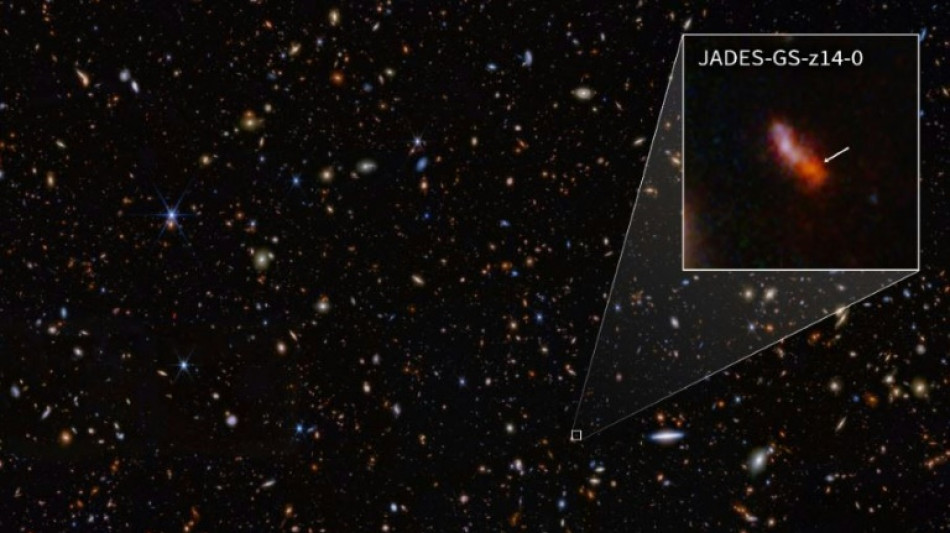
Webb telescope finds most distant galaxy ever observed, again / Photo: HANDOUT - ESA, NASA, CSA, STScI/AFP

Webb telescope finds most distant galaxy ever observed, again

The James Webb Space Telescope has discovered what appears to be a new record-holder for the most distant known galaxy, a remarkably bright star system that existed just 290 million years after the Big Bang, NASA said Thursday.

Text size:

Since coming online in 2022, the Webb telescope has ushered in a new era of scientific breakthroughs, peering farther than ever before into the universe's distant reaches -- which also means it is looking back in time.

And the latest finding has "profound implications" for our understanding of the so-called Cosmic Dawn, researchers said.

An international team of astronomers first spotted the galaxy called JADES-GS-z14-0 in early 2023, but they needed further observations to be sure it really was a record-breaker rather than a "confounding oddball," they said in a joint statement.

"The source was surprisingly bright, which we wouldn't expect for such a distant galaxy, and it was very close to another galaxy such that the two appeared to be part of one larger object," said Stefano Carniani from Scuola Normale Superiore in Italy and Kevin Hainline from the University of Arizona.

By the time light from the most distant galaxies reaches Earth, it has been stretched by the expansion of the universe and shifted to the infrared region of the light spectrum, which Webb is equipped to detect with unprecedented clarity.

The team carried out two confirmatory observations in October and then January -- first with Webb's primary imager called NIRCam, and second with its NIRSpec that analyzes the light from an object to determine its physical properties -- to be more certain of their hypothesis.

Not only does the new finding comfortably beat the previous record for oldest known galaxy -- which was held by JADES-GS-z13-0 that was present 320 million years after the Big Bang -- it also raises intriguing new questions for astronomy.

- Upends predictions -

"The most important aspect of JADES-GS-z14-0 was that at this distance, we know that this galaxy must be intrinsically very luminous," said Carniani and Hainline.

From the images, the galaxy was determined to be 1,600 light years across, suggesting that the light is coming from mostly young stars and not from emission near a growing supermassive black hole.

"This starlight implies that the galaxy is several hundreds of millions of times the mass of the Sun!" said the researchers. "This raises the question: How can nature make such a bright, massive, and large galaxy in less than 300 million years?"

Further analysis of the light emissions indicates the presence of oxygen, another surprising finding that points to "multiple generations of very massive stars had already lived their lives before we observed the galaxy."

Taken together, the observations of JADES-GS-z14-0 upend astronomical predictions of what the earliest galaxies may have looked like following the Big Bang 13.8 billion years ago.

Given the relatively small portion of the night sky they looked at, it's highly likely more luminous galaxies at possibly even earlier times will be found in the coming years, said the researchers, who will now look to publish their findings in a peer-reviewed journal.

(A.Berg--BBZ)