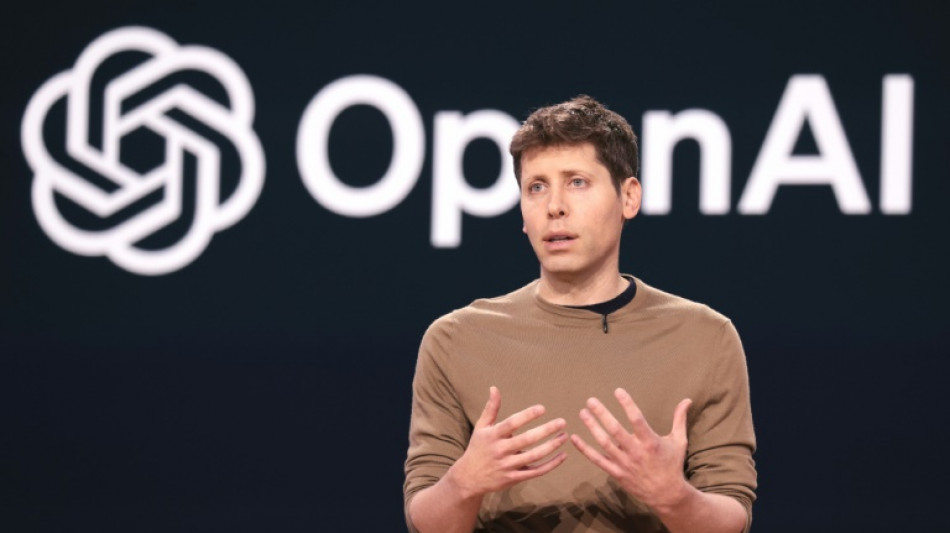
Is AI's meteoric rise beginning to slow? / Photo: Jason Redmond - AFP/File

A quietly growing belief in Silicon Valley could have immense implications: the breakthroughs from large AI models -– the ones expected to bring human-level artificial intelligence in the near future –- may be slowing down.
Since the frenzied launch of ChatGPT two years ago, AI believers have maintained that improvements in generative AI would accelerate exponentially as tech giants kept adding fuel to the fire in the form of data for training and computing muscle.
The reasoning was that delivering on the technology's promise was simply a matter of resources –- pour in enough computing power and data, and artificial general intelligence (AGI) would emerge, capable of matching or exceeding human-level performance.
Progress was advancing at such a rapid pace that leading industry figures, including Elon Musk, called for a moratorium on AI research.
Yet the major tech companies, including Musk's own, pressed forward, spending tens of billions of dollars to avoid falling behind.
OpenAI, ChatGPT's Microsoft-backed creator, recently raised $6.6 billion to fund further advances.
xAI, Musk's AI company, is in the process of raising $6 billion, according to CNBC, to buy 100,000 Nvidia chips, the cutting-edge electronic components that power the big models.
However, there appears to be problems on the road to AGI.
Industry insiders are beginning to acknowledge that large language models (LLMs) aren't scaling endlessly higher at breakneck speed when pumped with more power and data.
Despite the massive investments, performance improvements are showing signs of plateauing.
"Sky-high valuations of companies like OpenAI and Microsoft are largely based on the notion that LLMs will, with continued scaling, become artificial general intelligence," said AI expert and frequent critic Gary Marcus. "As I have always warned, that's just a fantasy."
- 'No wall' -
One fundamental challenge is the finite amount of language-based data available for AI training.
According to Scott Stevenson, CEO of AI legal tasks firm Spellbook, who works with OpenAI and other providers, relying on language data alone for scaling is destined to hit a wall.
"Some of the labs out there were way too focused on just feeding in more language, thinking it's just going to keep getting smarter," Stevenson explained.
Sasha Luccioni, researcher and AI lead at startup Hugging Face, argues a stall in progress was predictable given companies' focus on size rather than purpose in model development.
"The pursuit of AGI has always been unrealistic, and the 'bigger is better' approach to AI was bound to hit a limit eventually -- and I think this is what we're seeing here," she told AFP.
The AI industry contests these interpretations, maintaining that progress toward human-level AI is unpredictable.
"There is no wall," OpenAI CEO Sam Altman posted Thursday on X, without elaboration.
Anthropic's CEO Dario Amodei, whose company develops the Claude chatbot in partnership with Amazon, remains bullish: "If you just eyeball the rate at which these capabilities are increasing, it does make you think that we'll get there by 2026 or 2027."
- Time to think -
Nevertheless, OpenAI has delayed the release of the awaited successor to GPT-4, the model that powers ChatGPT, because its increase in capability is below expectations, according to sources quoted by The Information.
Now, the company is focusing on using its existing capabilities more efficiently.
This shift in strategy is reflected in their recent o1 model, designed to provide more accurate answers through improved reasoning rather than increased training data.
Stevenson said an OpenAI shift to teaching its model to "spend more time thinking rather than responding" has led to "radical improvements".
He likened the AI advent to the discovery of fire. Rather than tossing on more fuel in the form of data and computer power, it is time to harness the breakthrough for specific tasks.
Stanford University professor Walter De Brouwer likens advanced LLMs to students transitioning from high school to university: "The AI baby was a chatbot which did a lot of improv'" and was prone to mistakes, he noted.
"The homo sapiens approach of thinking before leaping is coming," he added.
(L.Kaufmann--BBZ)